Forgotten Trial Of A Uni Confederate in Cons-The Civil War Treason
l of Benjamin Gwinn HarBy Joshua E. Kastenberg s, bibliography, index, 2016, McFarland & Compa
e of the things that mak Civil War so fascinating tless number of small st involving people, place ts that had no major imp he outcome of the war, b fascinating in their own subject of this book bel hat category.
Preserving the military history of the Western Hemisphere since 1949. Membership includes a scholarly quarterly magazine with an annual twelve-
rovide our readers with timely an sman The Story Of An
ic Congressman representing Maryland’s Fifth Congressional District from 1863 until 1867. Like most people in his district he supported slavery and was an outspoken critic of the Lincoln administration, voting consistent ly against appropriations to figh the war. He opposed the 13th Amendment abolishing slavery. Harris was arguably the most unpopular man in Congress, which censured him in 1864 for praying for a Southern victory on the floor of the U.S. House of Representatives. Not surprisingly, eve members of his own party and prominent Maryland politicians distanced themselves from him. In May 1865 Harris was tried in a military court for aiding an abetting paroled Confederate soldiers. His guilt was not in question; Harris had given money to some soldiers. However, Harris, who represented himself, challenged the constitutionality of the proceedings since Federal and state courts were still open in Maryland. He was convicted and sentenced to three years in prison at the Old Capitol Prison and banned for life from serving in public office, though the latter had no basis in law. He only served about two weeks of his sentence before it was remitted by President Andrew Johnson, acting upon a request from Montgomery Blair, who ironically had been Lincoln’s Postmaster General. A year later, Harris’ conviction was nullified by the U.S. Supreme Court ruling in a separate, but related case, Ex Parte Milligan, which validated Harris’ argument that the military had no judicial authority when civilian courts are operating. When coming across an interesting story like this, a wr has to decide if there is enough material for a book or just an article. In the case of Harris, i appears that a long article would have sufficed. Unfortunately,
the author, a military judge with twenty years of experience in
the Air Force’s Judge Advocate General’s Corps, decided to make a book about it, and in “padding” the story to book-length form, author Kastenberg buries Harris’ story. The first problem is in the pr ace when the author flat-out says that his book is “not a laudatory biography.” While there is little doubt that most readers would agree with this assessment, it should be left up to the reader t decide how good or bad the subject of the biography is without being told up-front. Another problem is that despit being a “biography,” it reads more like a textbook on Civil War-era civilian and military law This reviewer has read close to a thousand Civil War-related books in his life, and this was the fir time he ever encountered a book in which he felt he needed a law degree to understand it. Harris i all but forgotten at times. In fa it is not until page 84 that the book takes on any semblance of a biography. Furthermore, for all the talk about the part of Maryland which Harris lived in and represented, there are no maps showing his district. Nor are there any photos or illustrations depicting an of the figures or sites mentioned in the book, except for a postwar photo of the Congressman on the front cover. What should have been a very interesting tale is a hard-to-rea bloated mess. Those interested in 19th century law or Maryland during the Civil War may want to check out this book, but it is doubtful that casual readers will find it enjoyable.
Tom Elmore, of Columbia SC, is finishing a study of Pope Pius IX and the American Civil War. He is also doing some preliminary research into 18th and 19th century Celtic South Carolinians.
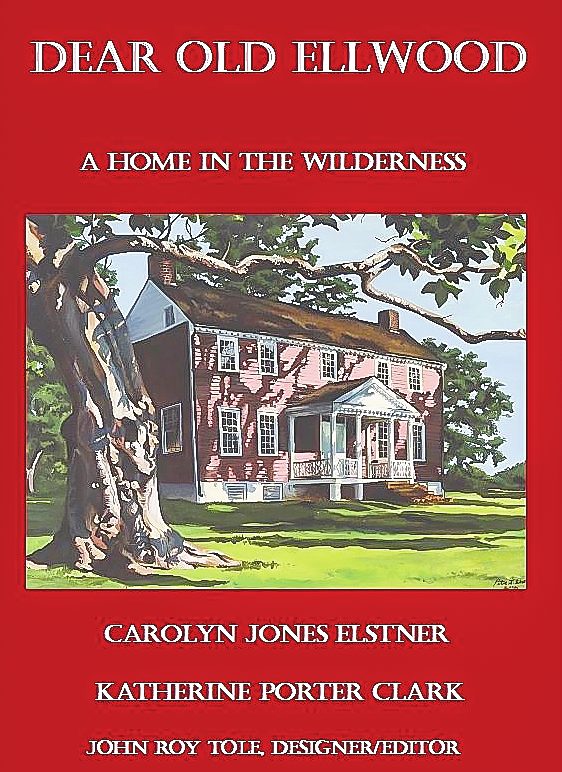
Historic Virginia Homestead Dear Old Ellwood: A Home in the Wilderness by Carolyn Jones Elstner and Katherine Porter Clark. Maps, photos, notes, index, 370 pps., 2016, Rappah-
West of Fredericksburg, Virgi ia, a long gravel driveway snake away from the bustling Constitution Highway. At the end, overlooking the valley of Wilderness Run, stands a silent witness to events of the American Civil War In their new study, Carolyn Jone Elstner and Katherine Porter Clark detail the history of and families who resided at Ellwood. Elstner and Clark are the ide candidates to take on this project. Mrs. Clark is the great-gre great granddaughter of Ellwood’s patriarch, William Jones. Her great-great grandfather was born at the house in 1858. Her co-author, Mrs. Elstner, is the great niece of Hugh Willis, who purchased Ellwood in 1907. Mrs. Elstner’s father, Gordon Jones, wa the last owner of Ellwood. Resting in the middle of the dense, secondary growth forest known as the Wilderness, the house was completed by 1790. Its more famous visitors during the Revolutionary War and Early National Periods included the Mar-
quis de Lafayette, James Madison and James Monroe. Ellwood so-
and became part of every battlefield tramper’s bucket list duri the Chancellorsville Campaign.
fire on the night of May 2, 1863 Lt. Gen. Thomas J. “Stonewall”
Jackson was taken to a nearby hospital where his left arm was
amputated. His chaplain, Beverly Tucker Lacy, whose brother J. Horace owned Ellwood, removed the limb and interred it in the family burying ground near the house. The marker for Jackson’s arm remains the only one in the small cemetery. War returned to Ellwood the following spring. During the battle of the Wilderness, Maj. Gen. Governeur K. Warren, head of the V Corps of the Army of the Potomac, used the house as his personal headquarters. Today, Ellwood is part of the Fredericks burg and Spotsylvania National Military Park. Since Gordon Jones donated the house and surrounding property to the National Park Service in 1977, the house has been restored to its wartime appearance with exhibits on the first floor. It is staffed season with the help of volunteers from the Friends of the Wilderness. As authors, Elstner and Clark make a great team. Until publication of this volume there has not been a major study of Ellwood’s history, and here they have woven together an engaging narrative. Their style of writing makes for an enjoyable, fun and fast-paced read. John Roy Tole, President of the Rappahannock Historical Society, also contributed greatly t the work through its design and editing. Maps, along with period and modern pictures and photographs are used throughout the text. Peter Elstner, Carolyn’s so supplements the book with his wonderful and life-like sketches at the beginning of each chapter. Throughout the book, the authors provide inserts on individuals and subjects pertinent to the fam ilies who owned the property and the surrounding region. Readers will find that the book crosses the spectrum of colonial, militar and social history. Of particular interest are several appendices, which include information on other owner properties, family trees, a timeline of major events related to Ellwood, slavery at
Ellwood, soldier burials and the acquisition of Ellwood by the National Park Service. It is highly
the Emerging Civil War blog and resides in Fredericksburg, Va.
Failure to Pursue: How the Escape of Defeated Forces Prolonged the Civil War. By David Frey. Notes, bibliography, index 402 pages, 2016, McFarland,
In this survey of published literature, David Frey states th he will investigate and test his “underlying thesis … that our Civil War … was decided in large part after battles when one side could have pursued, but didn’t pursue, a fleeing enemy to rende that enemy hors de combat.” Frey discusses battles in the Eastern and Western Theaters, and describes issues concerning pursuit of the defeated foe. He adds “Dénouements and Precursors,” or epilogues about the main participants. Beginning with the West, Frey summarizes and postulates about each battle. These include Shiloh, Iuka, Corinth, Chattanooga, Atlanta and Nashville. Turning to the East, he examines works published about First Bull Run, the Shenandoah Valley, Seven Days Battles, Second Bull Run, Chantilly, Antietam, Gettysburg and the Overland Campaign. More space is allocated to th battle segments than to the purs phase, the study’s primary focus The epilogues, while non-essential, add interesting sidelights Frey raises three questions: (1) “What took so long for the North to prevail?” (2) “Could us of effective, successful pursuit have enabled one side to more quickly vanquish the other, thus mitigating the immediate and long-term suffering as well as other societal losses?” and (3) “What factors prevented more successful pursuits leading to decisive victories?” His conclusions are based on the writings of authors “upon whose shoulders I humbly stand.”
Regarding the length of time it took to prosecute the war, Frey states in some cases there was a lack of commitment on the part of commanders, either because of their cautious natures or because they did not agree with the national objectives of their leader In addition, he believes advances in armament technology, as well as strategic mistakes prolonged the war. He cites cases where prominent generals such as Confederate Thomas J. “Stonewall” Jackson and James Longstreet failed to pursue the enemy successfully following battlefield victories. The author does not directly address the question of whether pursuits could have ended the war sooner. He cites the undersized nature of the Southern armies on the one hand, and the heavy losses on the Northern side even in victory that mitigated th possibility of successful pursuit Frey attributes the lack of successful pursuits to four facto including exhaustion of armies after battles, attitudes/capabili of commanders, lack of qualified subordinate commanders, and ineffective use of cavalry. He closes by speculating that the North could have ended the war sooner if they “had launched earlier pursuits….” Failure to Pursue raises inter esting questions about the nature of pursuits of the enemy once victory on the battlefield was achieved. Preferably more space would have been allocated to analysis of the factors and limit tions of such pursuits, rather th of the battles themselves. The book includes notes, bibli ography and index, but no maps which would have enhanced the battle discussions. The general reader will find this book useful as an overview about battles in the Eastern and Western Theater, and pursuit of the defeated foe. It will be less tractive to a more advanced Civil War audience because of the emphasis on secondary rather than primary sources.
Thomas J. Ryan is the author of the multiple award-winning Spies, Scouts, and Secrets in the Gettysburg Campaign (Savas Beatie, 2015). He is currently researching a new book with co-author Richard R. Schaus about George G. Meade’s postGettysburg pursuit of Lee’s Army of Northern Virginia, due out in 2018.
Colored Travelers: Mobility and the Fight for Citizenship
before the Civil War. By Elizabeth Stordeur Pryor. Photos, notes, index, bibliography, 218 pp., 2016, University of North Carolina Press, uncpress.unc. edu, 34.95.
American historiography had been the purview of white, male Anglo-Saxon, Protestants until the “revolution” of the 1970’s. until then, New Englanders Jare Sparks, Charles Francis Adams, Henry Brooks Adams, Francis Parkman, George Bancroft and John Gorham Palfrey shaped the narrative of the American Revolution and Federal Period as one of liberty and freedom— but as we now know, it was only for the privileged few, white, male land owners. In the 1970s, the “progressive” revolution in American history produced a new cohort of historians who began to look seriously at raci ethnic, gender, social, cultura and economic issues that had been largely ignored by earlier historians. An early work, si superseded, Stanley Elkins’ Slavery: A Problem in American Institutional and Intellectual (1960), was groundbreaking. Elkins’ view on American slaver compared it to Nazi concentrati camps, an argument soon fiercel rejected by both the Jewish and African American communities. Today, a whole host of new books has begun to look anew at race and slavery and its met astatic effect on the American body politic from the very beginning. Bind us Apart: How Enlightened Americans Invented Racial Segregation by Nicholas Guyatt (2016) needs little exposition. Wendy Warren’s New England Bound (2016) is a sharp rebuke to the 19th century historians as she chronicles slavery in colonial New England. In The Common Cause: Creating
Race and Nation in the American Revolution (also 2016), Robert
Parkinson lays out the case of American revolutionaries’ use of race as a tactic to unite patriot against Britain. Ibraim Kendi, in Stamped from the Beginning: The Definitive History of Racist Idea in America (2016), examines the intellectual and social history o racist ideas. Allan Taylor’s work Slavery and War in Virginia,
rely heavily on the narrative of aggression against the oppressed and the dispossessed—native Americans and slaves. Steven Hahn’s A Nation Without Borders (2016) asserts that America’s first imperialist impulse (in the 1830’s) was originally fueled by slavery. Pryor’s book fits within this category of “American Racial History Reassessed.” It is a slim volume, only 218 pages and five chapters, but filled with new assertions, assumptions and revelations. Perhaps her most disturbing chapter is the first, entitle “Nigger and Home: An Etymology,” where she explains the metamorphosis of the “n-word.” Pryor never uses the euphemistic “n-word,” but the real word, unapologetically, without quotes or italicization. She argues that the word went from “descriptor to epithet” as “black activists designated it a verbal symbol of U.S. racial repression, even as African American laborers continued to use it.” The key phrase here is “U.S. When black travelers were able to travel to Europe, the term became less important. The activists, ac cording to Pryor, elevated the word to an epithet in the 1830’s, using it reluctantly and only as reproach to their homeland. The evidence of discrimination on transatlantic travel is grim. Activist Charles Remond spent two weeks on an eastbound (to England) steamer on deck, not below where he could shelter from the weather’s extremes, but alone under a tent, and segregated from other passengers. For the return trip back to America, manned by progressive British sailors, Remond was allowed a berth below deck among the white voyagers. In 1838, transatlantic traveler David Ruggles was not allowed below deck on the steamer Rhode Island, but forced to spend 14 hours per day on the exposed deck. Pryor’s narrative exposes the hypocrisy of the state of Massachusetts. In the mid-19th century it was the home of abolitionists and the 54th Massachusetts Volunteer Infantry. Yet it was also
where slave trading began as early as 1624 and, as Pryor point out, it was rail workers in New England, specifically Massachusetts, who established the Jim Crow car. After all, black men were a threat to white women (as the argument went). At the same time, the separate but “equal” ca was not only for blacks but poor whites. By introducing the “poor white” evidence, Pryor weakens her racial argument, as she seems to be admitting that at least som economic discrimination was at play. Still, the notion that Amer ican-born blacks were treated as foreigners allowed activists to push for recognition of citizenship through unfettered access to travel. Free blacks roaming the land were unacceptable to white popular thought. When is a book about the American Civil War not an American Civil War book? The answer is probably when it is a history Outer Mongolia. Elizabeth Pryor’s Colored Travelers proves once again that there is absolute ly no break in American history from before America’s founding to the present day when it comes to Civil War and Civil Rights. The common threads are what some historians have called America’s original sin—slavery and racism. Pryor takes up the in tellectual argument that access t travel was a condition of citizen ship for any freed slave. A large question remains: How many of the four million slaves eventually liberated by the war were able to travel freely? Pryor concludes that the fight continues.
Salvatore Cilella is the retired CEO of the Atlanta History Center having spent 43 years in the museum field. He is the author of Upton’s Regulars (University of Kansas Press, 2009), and editor of The Selected Correspondence o General Emory Upton, due out this spring from the University o Tennessee Press.
New Study Of Florida In The Wa Florida’s Civil War: Terrib Sacrifices. By Tracy J. Revels Illustrations, maps, notes, bi
By a vote of 62-7, Florida came the third state to secede from the Union on January 10, 1861. Its secession convention proudly announced Florida’s in tention to stand by South Caro lina and Mississippi, which ha already departed. Several mont later, the nascent Confederate government gave its member state the usual plaudits. However, by the end of 1861, it w apparent that the Confederacy had all but abandoned Florida and its 1,200 miles of indefen
ble coastline. As author Tracy J. Revels deftly points out, “Florid was lost even to the Lost Cause.”
ork Captain Such realities had earlier led th Northern press to deride the stat as “the smallest tadpole in the
dirty pool of secession.” In Florida’s Civil War: Terribl Sacrifices, Prof. Revels—who previously wrote a superb work on Florida’s women during the Civil War—delivers an excellent synthesis of the home front contributions and eventual suffering which Floridians endured during the war as a result of its abandonment. Both families and communities were torn asunder by political partisanship and basic survival needs. The state’s Confederate loyalists and those citizens who remained steadfast to the Union suffered equally, es pecially after the war’s first ye when inland raids by Yankee soldiers and sailors, as well as Reb guerrillas’ depredations, took their toll on civilian morale and foodstuffs. Revels points out th hardscrabble Floridian proclaimed loyalties were often based on circumstance, and might even change with their fundamental survival needs. Starving citizens readily gave a loyalty oath to the Union if it meant steady rations from a local Yankee commissary. Moreover, Revels shows how such destitution eventually led to considerable Confederate desertion within the state.
Revels digs deep into many obscure secondary sources, such as essays which originally ap-
peared over the decades in the Florida Historical Quarterly, along with a judicious number of primary sources. She creates what the book’s jacket describes as “a consideration of the social factors that shaped Florida durin the Civil War and its role within the Confederacy.” Florida’s Civil War generally flows in a chronological timeline, even though the chapters ar presented as stand-alone topics. They include antebellum Florida and secession; Floridians who served within the Confederacy; the state’s Unionist sentiment; and slavery within the state, which resulted in many freed Florida slaves donning a blue uni form for the Union army. Another important chapter relates how Florida provided much-needed food for the Confederacy, especially after Vicksburg fell in Ju 1863, which shut off the flow of cattle from the western theater. This chapter includes important discussions of the salt and beef which the state produced for the Southern cause. The book concludes with two chapters that give a nice overview of the February 1864 Florida campaign. This event culminated in the battle of Olustee, a engagement resulting in the third bloodiest Union defeat of the entire war, based on the ratio of c sualties to troops engaged. Revels ends the book with the final events leading to the state’s sec ond largest engagement, Natural Bridge on March 6, 1865. When the Civil War ended, Florida was even more of a frontier wilderness than when the war started. I would take decades for the state to recover. Revels’ study is part of the p lisher’s State Narratives of the Civil War Series. At 174 pages of text, it is designed to give a ti concise overview of Florida’s home front during the rebellion. In this case, it succeeds admirably. With engaging prose and scholarly research, Tracy Revels has created an important addition to the growing body of work pertaining to Florida during the Civ War.
Paul Taylor is an award-winning author of six books pertaining to the Civil War era, including Discovering the Civil War in Florida: A Reader and Guide. His next book is titled “The Most Complete Political Machine Ever Known”: The North’s Union Leagues in the Civil War, which will be published by Kent State University Press in early 2018.
“The Gallant Sims” A Civil War Hero Rediscovered. By Jeffrey I. Richman. Map, photos, illustrations, index, 166 pp 2016, The Green-Wood Historic
Sam died in battle. His fiancé Carrie never married. The soldier’s family kept his letters an other documents. The grieving fiancée kept a treasure trove of mementoes. Many decades later the couple was reunited, in a way, when these two sets of materials found their way into the collection of Brooklyn’s historic Green-Wood Cemetery. The story of Captain Samuel Sims can now be told. When war erupted Samuel Sims, a thirty-two-year-o widower with three children, was engaged to Carrie Dayton. He worked as a glass stainer for a Brooklyn concern. Sam joined the war effort as a second lieutenant in a New York militia regiment. He and the other 90-day men re-upped when it became apparent that the fight to subdue the Confederacy would not be over in three months. He organized a company in the 51st New York Infantry and led his men into battle in North Carolina Kentucky, Mississippi, Virginia. He lost his life in Jul of 1864 at the Battle of the Crat Through the officer’s letters other sources, Green-Wood Cemetery’s historian Jeffrey Richman relates this story of Captain Sim with considerable skill. Richman combines this account with the interesting story of the salvaged documents themselves. In 1993 the priceless letters were put ou with the trash and were minutes away from oblivion. Saved by a
passerby, they eventually came into the possession of GreenWood. Carrie Dayton’s treasured mementoes were preserved in a less dramatic fashion. Her trunk was kept by family members who were fully aware of the value of its contents. This material also was eventually acquired by the cemetery. Sam’s letters contain many tidbits that add texture and col to the big story of battles and campaigns. While campaigning on the North Carolina coast Sam drank water “made from sea water purified from salt by passing through boilers and the steam condensed.” Sam and his comrades also sampled an early version of instant coffee which was “already sweetened and has milk in it.” It is also interest learn that this officer ate bett the army than at home: he gained weight as he served his country. Richman uses many additional sources to round out the story o Captain Sims and his regiment. I counted eleven sources employed to tell of the recovery of Sims’ remains and their return to Brooklyn for burial. The author also tells how Sam Sims’ orphaned daughter became the “daughter of the regiment,” was cared for by his comrades and even educated at Vassar at their expense. We learn too abou Sims’ brother, also in the 51st. Palin Sims survived, but never recovered from the physical and mental trauma of war. The book is enhanced by numerous photos, images of relevant documents and sketches made by Sims himself. Jeffrey Richman has succeeded in using these rescued materials to weave an interesting narrativ of this New Yorker’s service in the Union Army, his pre-war life his family and friends in and ou of the military—and the story of this rich store of materials and how they came to be preserved.
Note: Jeffrey Richman has an article in this issue on GreenWood Cemetery.
Gould Hagler is the author of Georgia’s Confederate Monuments: In Honor of a Fallen Nation (Mercer University Press, 2014). His new book on Alabama’s Confederate Monuments will be published by Indiana University Press.
For five mo October 1864, Shenandoah, c most of this ip H. Sherida federate Gen. treat from th with a missio Shenandoah Va basket of the
from Jul Army of ded for d by Gen llowed u l Early’ tle of M lay wast the bre ederacy.
e Confederacy Iowa In The Civil W Ulysses Grant’s orders were to
pursue Rebel forces, destroying everything that aided the enemy, and then rejoin him in the trench
es before Petersburg. Gen. Sheridan, in the battles of Winchester Fisher’s Hill and finally Cedar Creek, pushed Early’s battered army out of the valley, destroyed thousands of fields, barns and homes, and deprived Gen. Robert E. Lee of the food and provisions he desperately needed to sustain his army. This devastation also created a desire in Confederate forces for revenge, boosted their morale, and led to some of the fiercest fighting in the Civil Wa Jack Lepa does a commendable job of not only describing the military maneuvers of the Union 6th, 8th and 19th Corps in this series of battles, but stresses f the reader the human side of the newly introduced concept of total war. Phil Sheridan, the tough, grim, aggressive yet inspirational leader, not only pushes Early’ forces out of the Shenandoah Valley but instills pride and aggres siveness in his corps. The author uses frequent quote from diaries, letters, and the Of cial Records to add a personal di mension to the fighting. Soldiers are thus seen not as numbers on a muster roll but as fathers, sons, husbands and brothers who
camps, exhausting marches. Yet they feel sympathy for Southern farmers whom they leave desti-
tute in order to win the war. Both Confederate and Union forces experience victory and defeat, suffer periods of both low morale and exhilaration, and suffer from a lack of supplies. Poli ical interference and conflicting orders confused and wearied the officers and troops. Yet both sid fought bravely, believed in their commanders and the cause for which they fought. Lepa brings each of these dichotomies to light with first-per son accounts strategically placed in the chapters. His primary source material explains many of the actions taken by individuals and units during each of the battles and addresses the reasons each side felt it had triumphed or lost during engagements. Yet an unfortunate paucity of quotes from Confederate participants gives this book a Union bias. His explanations of military maneuvers are historically accurate and sufficiently detailed to provide the reader with troop placement, actions and strategy. As indicated in its title, the bo does not pay sufficient due to th 8th and 19th Corps and the crucia role they played in the Shenandoah campaign. Likewise, units like the 14th New Jersey are only tangentially incorporated into battl coverage, relying more on those units where diaries, etc. exist. More careful editing would also eliminate occasional grammatical errors. The addition of an organizational chart for Union and Confederate armies would add a valuable organizing reference for the reader. And finally,
is expensive. Jack Lepa’s Sixth Corps in the Shenandoah may find itself hard to compete with other comprehensive studies, such as Thomas A. Lewis’ The Shenandoah in Flames: The Valley Campaign of 1864 (TIME-LIFE, 1987) or Don Lowry’s Dark and Cruel War: The Decisive Months of the Civil War-September to December 1864 (1993). Nevertheless, the scholarship is excellent, the rea ability engaging, and the battle coverage exhaustive and compelling. For this reasons, this book recommended.
Wayne L. Wolf is Professor Emeritus from South Suburban College in South Holland, Illinoi and the author of numerous Civil War books. His article, “May to June 1864: General John Corson Smith and the Road to Atlanta,” appeared in the March issue of
A Flawed Introduction The Sacred Cause of Union: Iowa in the Civil War. By Thomas R. Baker. Maps, photos, notes, index, 285 pp., 2016,
A surprising paucity of material on Iowa’s role in the Civil War existed before this book, the firs real attempt at a comprehensive history of the state’s role in the war. Till now only a couple of dated compilations of Iowa military units and some scattered articles address the subject. Hubert Wubben’s Civil War Iowa and the Copperhead Movement (1980) is narrowly focused, as the title indicates. The story of this frontie state’s participation in the titan struggle is certainly a compelling one. Unfortunately, Thomas R. Baker’s The Sacred Cause of Union will serve only as a flawed general overview of the subject. The book does have some noteworthy features. Obviously, it aims to be comprehensive, covering in various degrees of detail state government and politics, the economy and army recruitment as well as battles. It misses no significant topic. And it is particularly strong in discussing the role of the ladies’ aid societies in distributing food clothing, and supplies to the state’s sons in uniform, and most especially in providing medical aid and advancing hospital reform. Much of this story revolves around the activities of Iowa’s leading female activist Annie Wittenmyer—not only her works of individual charity, but her key role in concentrating stat aid to Iowa troops, a task that basically lasted the entire war. Some attention is also given to intrastate politics, at least as t pertained to the national struggle between the Republicans and two wings of Democrats, pro-war and so-called peace Democrats. As a
general observation, Republicans in Iowa became steadily more radicalized by the conflict and never came close to relinquishing their control at either state or national level. Baker also tries to weave in t story of Iowa’s contribution to the federal military effort, but reader attempting to understand the role of the state’s troops in anything but sketchy detail will be disappointed. Iowa soldiers played a role in helping keep Missouri in the Union and fought in the Western and Trans-Mississippi theaters at Shiloh, the Vicksburg, Atlanta, and Red River campaigns, among others, but battle and campaign accounts are scattered and never placed in an overall strategic perspective. This is simply part of the pro lematic organizational structure of the work: a topical approach would have been far less confusing and more coherent. Instead, the book tends towards the episodic, and the reader invariably loses track of the shifting subje of discussion, be they party poli tics or the activities of the LSA (Ladies’ Soldiers’ Aid Society). At the beginning, the book states its intention to follow “six families involved in the war effort, but this translates to occasional mentions after the initial chapte and some discussion in the final chapter “Epilogue.” Further shortcomings in the work will inevitably cause scholars to fault it: its lack of a bi ography and its employment of solely printed sources, no primary documentation was consulted, not even newspapers. Several generalities such as “Helena remained in Union hands, in large part because of the fortitude of the Iowans stationed there,” beg for solid documentation and have none. Nor is this the only example of sparse or non-existent doc umentation. Nonetheless, Baker’s volume will serve admirably for an introduction to the subject of the Hawkeye State’s role in the Civil War.
Thomas E. Schott of Norman, Okla. is editor, with Lawrence Lee Hewi and Marc Kunis, of To Succeed or Perish: The Diaries of Sergeant Edmund Trent Eggleston, 1st Mississippi Light Artil Regiment, CSA (University of Tennessee Press, 2015). He and Dr. Hewitt have co-edited two volumes of essays, Confederate Generals in the Trans-Mississippi (University of Tennessee Press, 2013 and 2015). The third volume is due out later this year.
We’re still fighting the war, least in books. I looked around for what has been written about one of my favorites, Personal Reminiscences of General Robert E. Lee by the Reverend J. William Jones, D.D. I started with David Eicher’s Th Civil War in Books: An Analytical Bibliography (1997), which I keep to the left of my writing d He doesn’t place Jones’ Personal Reminiscences among the fifteen volumes he lists with Lee as sub ject. Instead, he dismisses it a highly partisan, eulogistic, and poetical hodgepodge of material that exhaustively attempts to do ument Lee’s absolute perfection. I couldn’t agree with Eicher mor which is why Jones’ book is one of my favorites. Shortly after the death of Pr ident Lee in October 1870, the faculty of Washington College voted two things: to keep Lee’s college office just as he had le it, and to appoint a committee which would gather material for “a memorial volume, which shall contain a suitable notice of the death and the funeral obsequies of Gen’l R. E. Lee, and of the public’s expression of sympathy and respect upon the occasion.” Once published, proceeds from sale of the work would go toward
itic ’ s C orner a monument over Lee’s grave in the college chapel. (We know it today as Edward Valentine’s famous recumbent statue.) The committee, all professors at the college, chose the Rev. J. William Jones to collect material for the book. Jones had been a chaplain in Lee’s Army of Northern Virginia; after the war he to the pulpit of Lexington’s Baptist church. He became a good friend of Lee, and was a fitting choice as compiler of what came to be called “Mr. Jones’ book.” By 1874 Jones had enough material to compile his manuscript, which Mrs. Lee read. The faculty gave the go-ahead, and Personal Reminiscences was published
in 1874 by D. Appleton of New York. The title suggests that the “p sonal reminiscences” are by Dr. Jones alone. Far from it. The opening section, “The Soldier,” fills almost eighty pages with eulogistic speeches by Generals Early, Gordon, Hampton and others; tributes from Northern and foreign newspapers at the time of Lee’s death; plus excerpt from Greeley’s and Swinton’s early books on the war. Chapter II, “The College President,” consists of several faculty members’ reflections. The bulk of the book is divided into chapters hinging on Lee’s character and qualities, such as “Duty, the Key-Note of his Life,” and “His Modest Humility, Simplicity, and Gentleness.” For the Jones reprinted Lee’s letters, ex cerpted from eulogists’ speeches, scoured Southern newspapers, and corresponded with Confederate officers for recollections. His compilations allow Nevins, Robertson and Wiley, in their Civil War Books (1967, 1969), to judge Jones’ volume as “useful for those seeking minutiae” about Lee. Dr. Freeman went further, terming it an “indispensable earl work,” most useful as a sourcebook for its many anecdotes and stories about the general. And stories there are. Jones found in the Confederate press the story of how on a Petersburg train a young soldier, his wounded arm in a sling, was having trouble putting on his overcoat. “In the midst of his efforts an o ficer rose from his seat, advance to him, and very carefully and tenderly assisted him, drawing the coat gently over his wounded arm, and buttoning it comfortably.” Of course the officer was General Lee. Another of my favorites comes from Lee’s presidential years. To the father of a misbehaving student Lee once wrote a letter of rebuke. It was couched in lan-
guage so polite, however, that a professor reading it suggested that the lad’s father would completely miss the point of the repr mand. “The old hero looked very much perplexed,” Jones explains, “but presently replied; ‘Well, sir I cannot help it; if a gentleman can’t understand the language of a gentleman, he must remain in ignorance, for a gentleman cannot write in any other way.’” In his Preface Jones wrote that he hoped his work on Lee would “give all a higher appreciation of his noble character” and “his shining virtues.” Still offering this and more, Personal Reminiscences has been reprinted by the United States Historical So-
ciety Press (Richmond, 1989). In his Introduction, Prof. Taylor Sanders of Washington & Lee is perfectly on the mark. Besides offering a look into nineteenth-century funereal traditions, “in its own way this book is also a relic from a long-lost past. Like a literary time capsule, it preserves for all time how those closest to Lee—his friends, his faculty and his family—wished the General to be remembered.” Here’s another story. While inspecting the Petersburg lines, Lee and his officers started drawing enemy artillery fire. Lee told them to retire to safer places, even as they saw him walk across a yard “and stoop down to pick up tenderly some small object, and place it gently upon a tree over his head.” As Jones writes, “it was afterward ascertained that the object which had attracted his attention under the enemy’s fire, was an unfledged sparrow that had fallen from its nest.” I’ve told this story plenty of times, and I always tell my listeners that it really doesn’t matt if General Robert E. Lee actually saved a sparrow under fire. The point is that Southerners wanted to believe that their kindly hero saved that little bird. In the end and in the shadowy realm of Civil War memory, that’s all that really matters.
Steve Davis of Atlanta is a regula is the Book Review Editor. His new book, A Long and Bloody Task: The Atlanta Campaign from Dalton through Kennesaw Mountain to the Chattahoochee River May 5-July 18, 1864, was published as part of Savas Beatie’s Emerging Civil War paperback series. The companion volume, All The Fighting They Want: The Atlanta Campaign From Peachtree Creek To The City’s Surrender, July 18-September 2, 1864, will be published early this spring.
By Lewis F. Knudsen, Jr. Illustr tions, maps, photos, regimental roster, appendices, bibliography index, 816 pp., 2016, Broad-
This first full-length history the 5th South Carolina Cavalry Regiment is a worthy addition to Tom Broadfoot’s ongoing project to publish a history of every South Carolina unit in the Confederate Army. Although victorious at Fort Sumter, the Confederacy lack of a navy exposed coastal South Carolina to Federal
ry Was No Rose Garden incursion. In response to this threat, state government encouraged the formation of volunteer mounted companies to patrol South Carolina’s coa Knudsen identifies one of thes companies, the elite South Carolina Rangers, as the nucle of the future 5th South Caroli Cavalry Regiment. In June 1861 the organizing captain of the company, Charleston merchant Robert Jeffords, ran a newspap notice soliciting “Gentlemen in the City and neighboring Parishes, accustomed to riding and shooting from horseback” t join him. Respondents furnishe their own mounts and arms, mostly double-barrel shot guns and revolvers. In April 1862, the ambitious Jeffords succeeded in consolid ing his company with three oth
independent companies to form a battalion or squadron under hi command as major. Although encouraged by state government, cavalry squadrons found no favor with the Confederate commander in Charleston, General G. T. Beauregard. To improve upon discipline, drill and effective command, Beauregard determined to regiment his cavalry. Thus, in January 1863, Jeffords’ squadron consolidated with another squadron and two independent companies to form the 5th South Carolina Cavalry Regiment. To Jeffords’ chagrin, a West Pointer then servin in Mississippi, Samuel Ferguson, was commissioned colonel of the regiment. However, Ferguson never took command, and Jeffords exercised effective com mand as lieutenant colonel for t next six months. Even after the formation of the regiment, the companies of the 5th South Carolina Cavalry continued to serve in coastal defense, either separate or in squadrons. One of the appendices to Knudsen’s book lists the regiment’s battles and engagements. Only five occurred during the nearly three years th these companies served in South Carolina, and none involved the entire regiment. Despite the lack of action, s vice in the South Carolina Lowcountry was no rose garden. Besides the monotony of patrol, Jeffords’ men had to contend with mosquitoes, sand fleas and
other pests that abounded in the marshlands of coastal Carolina. Malaria was endemic to the area, and good water was scarce. Summers were hot and humid; and winters, cold and damp. As demanding as service in coastal Carolina may have been, things would get much tougher for the men—and the horses—of Jeffords’ regiment when it was ordered to Virginia in March 1864. Upon their arrival in Richmond in May, any troopers still carrying shotguns received Enfields in exchange, presaging their deployment as mounted infantry. While in Virginia, the 5th South Carolina Cavalry would participate in sixteen battles and engagements, including the bloody slugfest with Phil Sheridan’s command at Trevilian Station, the largest all-cavalry ba of the war. By the end of 1864, after onl eight months’ service in the Old Dominion, the number of officers and men in the regiment had dwindled from more than a thousand to maybe 350. The regiment’s horses fared even worse i Virginia, and Knudsen estimates that no more than 100 were serviceable when the regiment returned to South Carolina in earl 1865. Back home, the regiment found itself caught up in a futile att to check the advance of General Sherman’s army across the Carolinas. In the closing months of the war, at Monroe’s Crossroads
in North Carolina, the regiment fought its only major battle entirely on horseback, nearly capturing Union General Judson Kilpatrick in his nightclothes. What remained of the regiment surrendered with the remnant of the Army of Tennessee. A retired banker, Knudsen writes matter-of-factly. The lengthy bibliography attests to the thoroughness of the author’s research. Knudsen mined period newspapers, diaries, letters and other archival sources as well as published material. The maps are plentiful and generally helpful in following battle descriptions. The book also includes pictures of roughly three dozen of the officers and men of the regiment, some in Confederate uniform, a nice touch that puts faces on men long dead. Though I would have preferred a dust jacket, this book is (like Broadfoot books generally) physically well made. The typeface is large, double-spaced, and easy on the eye. To his credit, Knudsen placed all 911 of his notes at th bottom of the pages of his book, sparing the reader the task of fl ping back and forth between the text and the end notes. For me, slowly paging through the regimental roster proved the most enjoyable part of the book. Knudsen spent decades compiling this nearly 300-page roster, and it is chock-full of interesti details, like the fact that fourt members of the prolific Harman family of Lexington District served in the regiment. The Corley family, from the same distric furnished ten men to the regiment, including the regiment’s last survivor, Simeon Corley, who died at 97 in 1943. The roster also attests to the multiethnic makeup of the regiment. In addition to a couple of European immigrants, at least a dozen men from Jewish families like the Oppenheims and Cohens of Charleston served in the regiment, including the dentist Marx Cohen, who after three years’ hard service ironically fell at Bentonville, the last major battl of the war. I recommend this book to those interested in South Carolina and South Carolinians in the war as well as those interested in Confederate cavalry in the Eastern Theater. C. Michael Harrington practices law in Houston. He’s written several articles on South Carolin soldiers, and lectured to Civil War organizations in Houston on multiple topics, including South Carolinians in the war. Mike is a long-time director of the Houston CWRT.
The Capture That Shook The Confeder Grant Invades Tennessee: loyal to The 1862 Battles for Forts opened t Henry and Donelson. By Timothy B. Smith. Photos, maps, notes, bibliography, index, 513 pp. University Press of Kansas, https://kansaspress.ku.edu/.
In June 1861, Tennessee seceded from the Union and mobilized for war. Believing that neutral Kentucky would serve as a buffer zone to the north and that Federal invasion would come from the west, Governor Isham G. Harris focused his energies on securing the Mississippi River. In September, Major General Leonidas Polk, commanding Confederate Mississippi Valley defenses, positioned his army on the bluffs of Columbus, violating Kentucky’s neutrality. In addition to solidify ing the citizens’ resolve to remain
as a major military post in Minne using detailed research and first
Fort Snelling and the Civil Wa Ramsey County Historical Socie
A Must Read For Arms Union, the invasion new study is oor to Federal oc- who teaches a cupation and encroachment into Tennessee and the Mississippi Valley from the north. The fate of the Confederacy in the west now depended heavily on three incomplete earthen fortification situated on the Tennessee and Cumberland Rivers near Dover. As the Confederates struggled to salvage their meager defenses the Federal army contended with numerous obstacles. Divided commands under Major General Henry Halleck and Brigadier General Don Carlos Buell and the challenges of creating a formidable brown-water navy stalled operations. While his superiors hedged, Brigadier General Ulysses S. Grant, displaying the tena ity that frustrated and impresse those around him, led a force in Missouri resulting in a Union vi tory at Belmont on November 7. Throughout January, Federal forces probed the twin rivers by land and water, collecting intelligence on Forts Donelson, Heiman, and Henry. Using this intelligence, Grant and Flag Officer Andrew H. Foote formulated a daring untested plan. Although initiall hindered by their superiors, on February 6, 1862, Grant and Foote launched a stunning joint operation of infantry, cavalry and navy, including four newly commissioned ironcl Within ten days, Federal forces firmly held the critical corrido to Nashville and the western Confederacy. Telling this story in an inci
y B. Smith, Collectors And Resear niversity of Tennessee at Martin. While crediting Benjamin Franklin Cooling and Kendall D. Gott with producing two of the most important Fort Donelson-centric academic studies, Smith also recognizes the need for “a detailed tactical examination” of the campaign. Whereas the important and demoralizing capture of Nashville directly resulted from the surrender at Fort Donelson, Smith’s research reveals “the capture of Fort Henry actually shook the Confederacy to its core from Richmond to New Orleans.” The taking of Fort Henry opened Federal access to Alabama and Mississippi, severed the Confederate defensive line, separated the army defending Tennessee from the army holding Bowling Green, and made holding Columbus impossible. In addition, the successful us of gunboats against Fort Henry created a desperate lack of confidence among the Confederate leaders at Fort Donelson, resulting in a tactical shift from keep the fort to holding the fort long enough for General Albert Sidney Johnston’s army to escape. In addition, regiments pulled from across the Confederacy to reinforce Fort Donelson created numerous vulnerable points along the coast. Smith recognizes that his Gran Invades Tennessee, crediting the fall of Fort Henry with yielding the most sweeping tactical and operational results, “cuts agains the grain of modern scholarship.” He provides an impressive bibliography containing hundreds of letters, soldiers’ accounts, manuscripts, newspaper articles, and published primary and secondary sources. Smith’s combination of a concise military history and an artful narrative presents the campaign in a way that will appeal to both Civil Wa experts and novices.
Krista Castillo is Museum Coordinator at the Fort Negley Visitors Center and Park in Nashville. Her article, “Targeted Grazing at Historic Fort Negley Park” appeared in our December
U.S. Military Arms Inspector Marks: A Collector’s Guide to the Inspection Marks Found on American Firearms and Edged Weapons from 1795 to 1953 with Detailed Information about the Inspectors and the Weapons that Bear their Names. By Anthony C. Daum and Charles W. Pate. Bibliography, index, 240 pp., 2016, Mow-
“Back in the day,” as they say I always used to keep an old copy
at hand, because it was a ready source of identification for Unit States arsenal inspectors whose approval was necessary before a weapon was accepted for military service, whether it was manufactured at an official arsenal or b a contractor. Collectors of American military arms are, by necessity, always interested in the ar senal inspectors’ initials stampe in the stock, grip or metal of a weapon because it is yet another clue to the gun’s history. The
who the guy was. There is much more to know, of course, and the book U.S. Militar Arms Inspector Marks: A Collector’s Guide to the Inspection Marks Found on American Firearms and Edged Weapons from 1795 to 1953…, by Anthony C. Daum and Charles W. Pate, goes quite a bit further than simply providing a list of names associa ed with particular markings. The
authors discuss the regulations that determined the scope of the
inspectors’ assignments, as well as the “sub-inspectors,” who did the actual work, predicated on th
inspector’s final approval. The inspection process is described i detail through its various stages
through Component Inspection, Inspection of Finished Arms to Final Inspection and Acceptance. Daum and Pate, as indicated in their expansive title, provide an
entry for each inspector, arrange in alphabetical order and headed
associated with him. Each entry contains details on the personal history of each man, including the dates he served and the types of weapons associated with his work, from the inception of the inspection program through the Korean War. We learn, for example, that David F. Clark, an inspector who used the initials “D F C” in seve al types of script, was active fr the Civil War through the postwar era. Clark inspected Savage percussion revolvers, LG&Y rifle muskets, Sharps carbines converted to .50-70 caliber and Colt Single Action revolvers. Unfortunately, Mr. Pate passed away before the book was completed, but his co-author, Mr. Daum, was able to complete the manuscript for Mowbray and gives generous credit to his part ner’s assiduous research in its compilation. Is every single person who ever inspected arms for the United States government covered in this work? Well, no, and with good reason. In his introduction Daum mentions that “not all inspection marks are included,” but “those that are missing are primarily those that consist of single letters where it was impossible to identify the inspector.” There are others which are recorded but attributed to “unknown” inspectors. The details on the vast majority are, however, comprehensive. The absence of a few does not detract from the fac that this book is the best source ever produced on the subject and belongs on the bookshelf of every collector and arms historian.
Joe Bilby regularly contributes h feature column, “Black Powder,
James B. Conroy. Photos, illu tions, notes, bibliography, i 328 pp., Rowman & Littlefield
Today most Americans will never meet the president of t United States, let alone walk molested into his residence. during the nineteenth century reality that common folk coul traipse into the White House and directly petition the pre dent seemed perfectly in keep with the democratic ethos of American political system. Ab ham Lincoln fittingly called
Since 1979, MI has been America’s only publication dedicated to historic photo of soldiers and sailors.
Civil War “a people’s contest,” and in this interesting book wri
er James Conroy examines “the people’s house” during Lincoln’s presidency. Conroy’s narrative weaves together descriptions of the layou furnishings, and grounds of the White House itself with an intimate look into the daily activit of the mansion’s denizens during Lincoln’s administration. The White House setting offers a cas of notable characters, from conniving confidence men who took advantage of Mary Lincoln’s extravagant tastes to dedicated staff who loyally served the pre ident. The account understandably focuses on members of the first family. However, the views of Lincoln’s personal secretaries John Nicolay, John Hay, and William Stoddard permeate the narrative, and they emerge as arguably Lincoln’s most influential contemporaries in shaping h presidential image. A few themes recur throughout the chronology. Conroy draws attention to Mary Lincoln’s schemes to hide her reckless spending from her preoccupied husband, and these financial she nanigans spiral on like a dreadf soap opera. He repeatedly highlights the president’s indiffere to his personal safety and the n merous and oftentimes laughable attempts to provide even basic
security at the White House. On a positive note, he underscores
Lincoln’s willingness to meet with and listen to African American visitors, ultimately attesti to the president’s progressive views on race and equality. Conroy admirably succeeds in conveying a sense of what the White House looked and felt like from 1861 to 1865. Far from a stylish showplace, the shabby dwelling was hot in summer and dangerous to one’s health. Contaminated drinking water essentially cost twelve-year-old Willi Lincoln his life. In chapters wit titles such as “This Is a God-For saken Hole” and “This Damned Old House,” Conroy whitewashes none of its deficiencies. By recreating public levees and populating Lincoln’s workplace with office seekers and petitioners of various shades of integrity, he convincingly presents the White House as a place where citizens from all walks of life could, for few minutes or sometimes longer, appeal to the most powerful man in the land. Nearly always patien to the point of even suffering fools, Lincoln recognized that th votes of the people had elevated him from their ranks to temporarily hold the reins of government, and during these “public opinion baths” he welcomed the masses into their own house. Lincoln’s White House teems with interesting anecdotes and colorful individuals who met the president, or at least claimed to have done so. The book’s theme is unique for Civil War era stud-
ies, and Conroy has researched thoroughly and written engagingly. The account is not exhaustive
and some readers might wish that he hadn’t omitted certain happenings, such as Lincoln’s last publ speech delivered from the balcony four days before his assassina tion. Others may likely conclude that many recorded incidents could have been grist for the mos lowbrow publication. Yet on other occasions what transpired in Lincoln’s White House had momentous import and even altered history. Conroy captures much of it, in the process reminding us that the most important element of the people’s house is the character o the man who inhabits it.
In addition to teaching a class on Lincoln this semester at the Indiana Academy, Sean A. Scott
studies religion during the war. the recent annual meeting of the Indiana Association of Historians he presented a paper on Presbyterian minister William S. Plumer, who in late 1862 was forc out of his church and seminary in Allegheny, Pennsylvania, due to allegations of insufficient loyal
“Culture” Of Gettysburg My Gettysburg: Meditations on History and Place. By Mark A. Snell. Notes, index, photographs, 240 pp., 2016, Kent State
Mark Snell’s My Gettysburg is a collection of eight essays, har to categorize. They are related b two things, their author and thei subject. Mark Snell—the founding director of the George Tyler Moore Center for the Study of the Civil War at Shepherd College— wrote these essays between 1990 and 2016. They all have something to do with Gettysburg, eith
the battle or its memory. Some of Snell’s essays have appeared in
print before. For this project, h has revised and updated them for a modern audience. In his preface
he dubs his collection a “modest addition” to the already extensiv literature about the battle, but says they reflect his interest in the “culture” of Gettysburg, and “its ever-changing landscape and view shed.” Indeed, Snell offers a unique perspective. In 1989, he bought the historic Cromer farm five miles south of town, and for the past twenty-eight years he has literally owned a “Gettysburg address.” Nearly three decades of observation have given him authority to narrate Gettysburg’s changing “culture,” however one defines that elusive word. Sadly, My Gettysburg does
not live up to expectations. The subtitle promises to offer “meditations on history and
place.” Except for the first essa “My Gettysburg Address”—none of the essays are meditations. Four essays deal with the 1863 campaign. One describes York County during the invasion, another describes Union army logistics, another describes West Virginians in the Gettysburg
Campaign, and another studies Judson Kilpatrick. Three essays analyze the memory of the battle. One discusses music inspired by Gettysburg, another discusses the U.S. Army’s relationship with the battlefield, and the last essay— arguably the best in this collect and worth the read—surveys the interesting history of Civil War reenacting. In it, Snell offers a quick survey of the hobby and its Gilded Age roots. He says the fir bona fide reenactment occurred in 1878. After that, he charts it waxing and waning popularity into the twenty-first century. Like several of Snell’s “memory” essays, this one benefits from hi personal experience. He has been reenactor since the mid-1970s. All of these essays are independently decent, but they don’t hang together very well. Snell promised to give readers a taste of Gettysburg culture through the lens of post-retirement reflection. In that goal, he comes up short. His opening essay offers a promising start, as he describes his childhood memories of the “tacky, almost smarmy” tourist traps that dotted the lan scape in the 1960s. After that, Snell’s essay drifts into an auto biography, charting his academic pedigree and his earthly travels. Meanwhile, Gettysburg, the place and its people, falls out of the ture. Beyond feeling privileged to own Henry Cromer’s farm, the
author says nearly nothing about what it means to be a Gettysburg
resident. The book doesn’t deal with the ever-changing landscape, nor does it explicate what ideas, passions, and controversie motivated Gettysburgians during the closing decades of twentieth century. Certainly, this book had a sti ulating premise. It wanted to giv outsiders a glimpse into the mind of those who lived, and currently live, on the nation’s most famous plot of hallowed ground. Do they love it? Do they protect it? Do they appreciate it? Are they happy about hosting millions of visitors every year? The decision to fill the middle chapters with previously published material di-
lutes any attempt to answer those questions. My Gettysburg needs to meditate more and reiterate less. Readers might not find much
interesting here, unless they are particularly fascinated by the topics of the individual essays.
Timothy J. Orr is associate professor of history at Old Dominion University in Norfolk. H serves as Book Review Editor for Gettysburg Magazine.
Did The Ant Schooling in the Antebellum South: The Rise of Public and Private Education in Louisiana, Mississippi, and Alabama. By Sarah L. Hyde. Tables, notes, index, 211 pp., 2016, Louisiana State University Press, lsupress
Sarah L. Hyde’s beautifully written Schooling in the Antebel lum South examines many different education styles to corre the assumption that residents of the Gulf South states of Louisiana, Mississippi, and Alabama did not “deeply value” education . Throughout her study, Hyde argues that, in spite of obstacles “history of education [in the Gu South] shows that people there . . . made considerable progress i developing school systems.” Although Hyde struggles to prove this central point, the book its is valuable for being one of the few—if not the only—recently published scholarly works on education in the Deep South. Hyde first considers learning based in the home, from hired tutors to unpaid relatives. Although she asserts the “ubiquity” of home-based learning, the topical organization obscures how commonplace such styles of learning surely were. Examples from 1779 and 1832 appear one after the other without pause to consider how learning developed KIMBERLY BRIGANCE ISA ACCREDITED APPRAISER Civil War Militaria & Memor
South Foster Education? throughout the period. Similar problems plague the chapter on private schools, as literature on nineteenth-century childrearing, pedagogy, and southern childhood, particularly those by Anja Jabour and James Marten, are overlooked. Hyde is on surer footing when examining public schools, which began in Alabama and Mississippi with state constitutions providing that education be “encouraged,” and continued in all
ing legislatures to support existing schools and establish new
“a clear belief that state govern ments bore some responsibility”
for education. If this is true, t story she relates is all the more curious—for decades, governors encouraged legislators to act, an legislators refused to do much of anything. Hyde blames much of this inaction on the Panic of 1837, after which all states face straitened financial circumstances. But only in the case of Alabama does she fault Democratic and Whig disagreement over the role of government, a curious fac given the period’s contentious political climate. As she examines the establishment of urban public schools and statewide public education, Hyde continues to assert that this growth demonstrates “the value southerners attached to education,” even though schools in New Orleans, Mobile, and Natchez only got off the ground due to support by one or two influential citizens. In fact, Hyde central argument is that it was “the groundswell of popular demand for public schools,” influenced by ideas of republicanism and Jacksonian democracy, that “forc[ed] . . . governments to ac in the 1840s and 1850s.” But evidence supporting this assertion is thin. The author relies on the statements of state governors and newspaper editors to make this point, people who may have been voicing the concerns of the populace or simply propounding their
own views. One thing is clear: politica resistance existed to widesprea education, particularly on the of wealthy planters. Fortunate enough to afford private school tutors, and wary of tax increas legislators in Mississippi crea a labyrinthine system, passing five distinct school statutes which applied to different sets of counties. Louisiana’s politicians dismantled its free public school system, establish
1852 constitution that defunded state and county superintendent
state with a coherent, widespre and steadily progressing public
Watson-Curtze Mansio 356 West Sixth Stree 814.454.1813
school system was Alabama. In spite of its shortcomi Hyde’s Schooling in Antebellum South co blanket assertions that the South did not value educati While her arguments about broad public support and fe government commitment miss the mark, what is clear is government support of educa then as now, was a much-deb and often contentious, topi
the University of Alabama’s Department of History, Laur
Union soldiers and Southern women during the Civil War,
n History Center ric District, Erie, Pa. istory.org