on in Fifty Years himself speaks volumes about th war secretary’s ego and self-as surance that his record would stand the test of time. Indeed, Paul Kahan’s semi-revisionist biography showcases Cameron’s mastery of party machinery that made him a potent force in Penn sylvania politics for fifty yea Most students of the Civil W likely think of Cameron as an i competent secretary of war who lined his own pockets by doling out contracts to political cron until a groundswell of complain convinced Lincoln to dismiss him from the cabinet. On the on hand, Kahan acknowledges Cameron’s ineffectiveness, describ him as “temperamentally unsuited” for the job and “overwhelme and out of his depth.” However, the author cuts him slack b pointing out the difficulties h faced—a peacetime army partly equipped with obsolete weapons and entirely unprepared for war; an inadequate staff unable to keep up with the pace of mobilization; the president’s ini failure to manage competing per sonalities and issue direct ord and the nearly impossible task of satisfying numerous demands from state governors and countless requests from self-importa appointment seekers. Yet on the other hand, Kahan asserts that no evidence of cor ruption or unethical financial dealings blackens Cameron’s re-
cord as secretary, an assessmen already put forward by several
historians. Instead, his reputation for crooked dealings, which he acquired in the late 1830s after President Martin Van Buren appointed him as commissioner to settle Winnebago land disputes, dogged him for the rest of his career. Kahan points out that other Republican politicians and generals showed poor judgment by making “shady” contracts or followed the accepted practice of using patronage to reward supporters, and they received significantly less censure than Cameron. Like many other career politicians who came of age during the second party system, he switched affiliations, first leaving his Democratic roots to court nativist support, and finally settling with the Republicans. In the process he had accumulated a throng of rivals eager to topple him with allegations of financial impropriety. Kahan parts from the standard interpretation by positing that Cameron’s antislavery opinions, rather than rumors of corruption, ultimately resulted in his removal from the cabinet. During the summer of 1861 he privately made clear his preference to arm African Americans, and that August he supported General John Fremont’s failed attempt to confiscate slaves in Missouri. In November he endorsed speeches of a New York colonel in favor of black troops, and in his annual
report later that month he argued for employing slaves as soldiers. Some fellow cabinet members
and most historians have questioned his motives, instead seeing his antislavery stance as political opportunism aimed at ingratiating himself with abolitionists and radical congressmen. In 1878 Cameron claimed to have espoused these opinions “sincerely” and asserted that their being “a trifle too advanced for the time” led to his Want To Advertise In Email us at
Vol. 42, No. 3 Battlefield Of Franklin Land Prese By GreGory L. Wade FRANKLIN, Tenn. — What is considered the bloodiest acreage i the Nov. 30, 1864, Battle of Frank is now being reclaimed as part of evolving Carter Hill Battlefield P Local preservation leaders recentl
from owners Reid and Brenda Lovell after a months-long process of coordinating various funding sources for the critical 1.6 acres adjoin the Carter House, a major battle landmark. Details were recently provided a press conference led by Franklin Charge board member Julian Bibb, who praised the “remarkable transition” of the Franklin battlefiel Franklin’s Charge is a coalition o civic and preservation groups who joined together more than ten year ago to purchase local battleground Over 150 years ago the Army of Tennessee stepped off in a series of charges to be virtually destroy by Federals under John Schofield i hopes of taking Franklin and later Nashville.
At that time, most of the terra was open farmland on the outskirts of what was once a small Middle Tennessee farming community. Over time development covered much of the battlefield with houses, light dustry, and small businesses.
All that remained of the critic area where the Confederates temporarily broke the Federal line wa the small farmhouse and a few acre known as the Carter House farm. The 1.6 acres purchased, which adjoin the southern boundary of th
Carter House property, is comprise of two lots. Today, they are occup
Purchase that were turned over to the City of Franklin Parks Department by Franklin’s Charge and the Battle o Franklin’s Trust (BOFT), managers of the Carter House the nearby Car ton Plantation. The structures wil removed in coming months, possibly relocated for other use. The purchase is only the latest in a long and arduous effort to re build the Franklin battlefield. “It had to be a miracle,” quipp Civil War Trust (CWT) President James Lighthizer, referring to the most recent acquisition. Local res ident Michael Grainger, long time Trust board member and former chairman, said, “Local leadership has been incredible and will conti ue to be a partner [with the CWT]. In 2005, after years of frustra attempting to preserve Franklin ba tleground, local preservationists cided it would have to be done the hard way, by buying properties, of ten with buildings on them. The largest parcel of land was originally a local golf course sla to be sold to a developer to build
houses on what was the right flank of the Confederate attack north to ward the Federal lines just south the town. It was then that Franklin’s Cha came into existence. Funds have
chase from private donors, the CWT the City of Franklin and others. T 110-acre segment, now fully interpreted and known as the Eastern Flank Battlefield, is what got the preservation ball rolling in Frank Since that time nine other parc
in proximity to the Carter House have been purchased and have been, or will be, turned over to the Fra
at the Lovell purchase regory L. Wade photos)
But it was the land just south Carter House, long considered the most bloodied ground in Franklin, and some say in America, that was the most coveted. BOFT Chief Executive Officer Eric Jacobson noted, “to not have
this ground reclaimed and preserv would be like having Omaha Beach cut out of Normandy.” The most recent acquisition evolved when Franklin’s Charge an the BOFT began discussions with t Lovells, who have a strong sense
the history of the land, having g up in Franklin. “I was born and raised in Fran lin on ground many believe should have been a national park,” said Lovell. He recalled when visitors came to town and had to envision what happened, not walk on ground
where it transpired. “My great-grandfather, who fou here, and my parents would be pro of what we are doing here today,” said at the press conference. The Franklin Board of Mayor and Aldermen voted unanimously in February to fund part of the remaining debt on the Lovell property purchase. The previously
paid by the city on a non-interes basis over seven years. These funds will cover the bal now bridged by a local bank and w
be derived from the city’s hoteltel tax. Local banker Chuck Isaac was instrumental in working out t loans. All the city funds are all
by his employer, First Farmers an Merchants Bank.
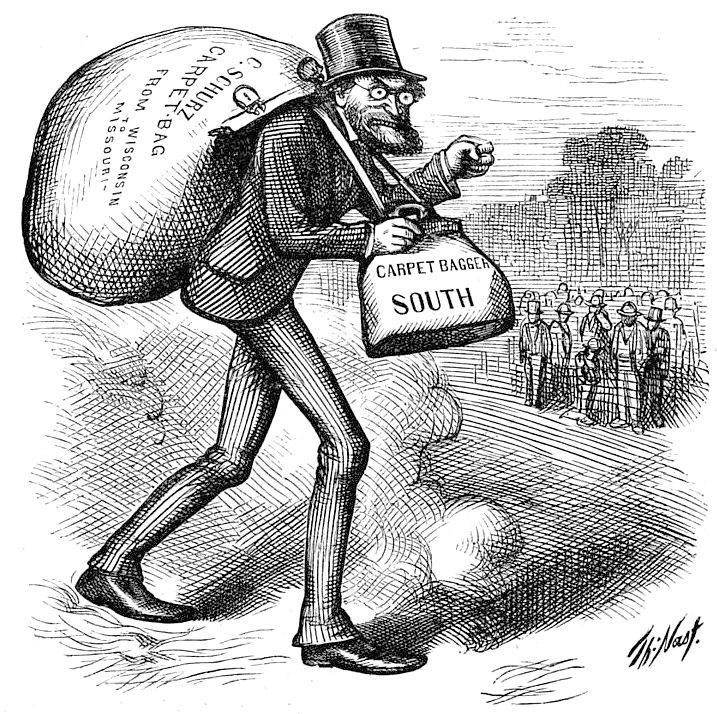
aditional” Reconstruction Histo Carole Emberton and Bruce Baker have edited a very nice collection of essays attempting make sense of the polarizing ti following the Civil War. Their focus is how the era is remembered, and how Reconstruction continues to influence America the present day. The essays are a litany of events and a repeti of political happenings. Remembering Reconstruction focuses o how the era was understood by the key players: white supremacists trying to claw back to th antebellum status following the devastation of the war, freed e slaves bravely trying to claim their rights, and how the memory of Reconstruction would infl ence the way Americans viewed their government and the South. The so-called “traditional” ing of the Reconstruction story the white supremacist view. Thi view holds that Reconstruction was a disaster, created by arro gant Northerners of the Radical Republican stripe, their “carpetbagger” allies who came to corrupt and profiteer off a van quished South, and their uneducated African-American lackeys. This crude thinking further sta ed that only the white elites h the special knowledge and experience to keep unruly blacks in their proper place. Never mind, of course, that this was the sa elite planter class which put t South into the horrible positio it found itself as losers of a structive total war. This narra tive was reinforced in Southern
literature and film, notoriousl by the movie Birth of a Nation, whose premise was that the horror of black rule and integrati of the South could only be coun tered by the alleged heroism an violence of the Ku Klux Klan. Beyond the media of popular cul ture, the white supremacist vie of Reconstruction also took on a scholarly gloss of acceptance through the “Dunning school” of historians from Columbia University. An essay by Natalie Ri of the University of Texas-Dallas, demonstrates how insidious this largely unknown group of academics could be, as many of Professor William Dunning’s stu dents would become the thought leaders of 20th century Reconstruction memory, and influence textbook and school curricula f years to come. The rebuttal to this unfortu nate yet entrenched orthodoxy would come from several black voices. Some would be tentative in their criticism of the white premacist recapture of the post war South. A fascinating essay Professor Emberton, who teaches at SUNY-Buffalo, focuses on the corruption of memory itself especially of former slaves. Sh cites the Federal Writers Project ex-slave narratives, and ho even into the 1900s, learned ap proaches to dealing with white violence was a core part of the Southern black existence. A sys tem built on abuse, rape and fa ily separations left many forme slaves hesitant to fully share
interviewers even decades late their experiences during slave and Reconstruction, never cert they would be safe in speaking against the prevailing white-d inated leadership if expressin their true feelings. The “revisionist view” of R construction would be told in scholarly form by notable Afri can-American writers W.E.B Dubois, Carter Woodson and later John Hope Franklin. To summarize the frustration in presen the black experience of the er Dubois said: “The chief witnes in Reconstruction, the emancip ed slave himself, has been lar ly barred from the court.” Oth courageous resistance against the dominant school of thought would come from journalists such as T. Thomas Fortune and the personal recollections of sissippi Congressman and forme slave John R. Lynch. Perhaps the most interestin essay in the collection is on subject that occurred 50 years the Civil War. Samuel Shaffer, a teacher and writer, focuses the impact of Reconstruction memory on one of the most controversial events of the 20 century: the ending of World W I and the writing of the Versa Treaty. President Woodrow Wilson was a Virginian by birt and spent his youth in Georgia and South Carolina, imbibing the view that Reconstruction’s goal was “not the rehabilitati of southern governments,” but “bent upon bringing the South
1872 Harper’s Weekly cartoon depiction of Carl Schurz as a carpetbagger.
to utter humiliation.” Former slaves, Wilson felt, were “unfit to exercise their new liberty.” Wilson would tell French Prime Minister Georges Clemenceau, “I was born in a conquered and devastated country.” Wilson was lauded for his stance in demanding self-determination, but as Shaffer points out, selfdetermination would not be for “less developed peoples read: darker skinned ones,” as Wilson took a condescending view of non-European, non-whites worldwide, people he viewed as less intelligent or mature enough to govern themselves. These nations, many in the modern Middle East and Africa, still suffer from having no say in the creation of their borders and the humiliation of requiring “tutelage” from their allegedly more enlightened European overseers. Emberton and Baker have done a very nice job of collecting a variety of essays explaining how the memories of Reconstruction have cemented themselves into the American consciousness and how this memory is more than just a trivial academic discussion. David Galli is a physician practicing in St. Louis, and a longtime book reviewer for Civil War News. Want To Advertise Your Book In Email us at
Vol. 42, No. 3 Battlefield Of Franklin Land Prese By GreGory L. Wade FRANKLIN, Tenn. — What is considered the bloodiest acreage i the Nov. 30, 1864, Battle of Frank is now being reclaimed as part of evolving Carter Hill Battlefield P Local preservation leaders recentl
from owners Reid and Brenda Lovell after a months-long process of coordinating various funding sources for the critical 1.6 acres adjoin the Carter House, a major battle landmark. Details were recently provided a press conference led by Franklin Charge board member Julian Bibb, who praised the “remarkable transition” of the Franklin battlefiel Franklin’s Charge is a coalition o civic and preservation groups who joined together more than ten year ago to purchase local battleground Over 150 years ago the Army of Tennessee stepped off in a series of charges to be virtually destroy by Federals under John Schofield i hopes of taking Franklin and later Nashville. At that time, most of the terra was open farmland on the outskirts of what was once a small Middle Tennessee farming community. Over time development covered much of the battlefield with houses, light dustry, and small businesses. All that remained of the critic area where the Confederates temporarily broke the Federal line wa the small farmhouse and a few acre known as the Carter House farm. The 1.6 acres purchased, which adjoin the southern boundary of th Carter House property, is comprise of two lots. Today, they are occup
Purchase that were turned over to the City of Franklin Parks Department by Franklin’s Charge and the Battle o Franklin’s Trust (BOFT), managers of the Carter House the nearby Car ton Plantation. The structures wil removed in coming months, possibly relocated for other use. The purchase is only the latest in a long and arduous effort to re build the Franklin battlefield. “It had to be a miracle,” quipp Civil War Trust (CWT) President James Lighthizer, referring to the most recent acquisition. Local res ident Michael Grainger, long time Trust board member and former chairman, said, “Local leadership has been incredible and will conti ue to be a partner [with the CWT]. In 2005, after years of frustra attempting to preserve Franklin ba tleground, local preservationists cided it would have to be done the hard way, by buying properties, of ten with buildings on them. The largest parcel of land was originally a local golf course sla to be sold to a developer to build houses on what was the right flank of the Confederate attack north to ward the Federal lines just south the town. It was then that Franklin’s Cha came into existence. Funds have
chase from private donors, the CWT the City of Franklin and others. T 110-acre segment, now fully interpreted and known as the Eastern Flank Battlefield, is what got the preservation ball rolling in Frank Since that time nine other parc in proximity to the Carter House have been purchased and have been, or will be, turned over to the Fra
at the Lovell purchase regory L. Wade photos)
lin Parks Department, according t Bibb. But it was the land just south Carter House, long considered the most bloodied ground in Franklin, and some say in America, that was the most coveted. BOFT Chief Executive Officer Eric Jacobson noted, “to not have this ground reclaimed and preserv would be like having Omaha Beach cut out of Normandy.” The most recent acquisition evolved when Franklin’s Charge an the BOFT began discussions with t Lovells, who have a strong sense the history of the land, having g up in Franklin. “I was born and raised in Fran lin on ground many believe should have been a national park,” said Lovell. He recalled when visitors came to town and had to envision what happened, not walk on ground where it transpired. “My great-grandfather, who fou here, and my parents would be pro of what we are doing here today,” said at the press conference. The Franklin Board of Mayor and Aldermen voted unanimously in February to fund part of the remaining debt on the Lovell property purchase. The previously
paid by the city on a non-interes basis over seven years. These funds will cover the bal now bridged by a local bank and w
be derived from the city’s hoteltel tax. Local banker Chuck Isaac was instrumental in working out t loans. All the city funds are all
by his employer, First Farmers an Merchants Bank.
Just Another Eccentric American A The Extraordinary Life of Charles Pomeroy Stone: Soldier, Surveyor, Pasha, Engineer. By Blaine Lamb. Photos, notes, bibliography, index, 276 pp., 2017, Westholme Publish-
One of the best things about studying the American Civil War is finding those participants who are intriguing individuals in the own right. Brig. Gen. Charles Pomeroy Stone is just such a person. Author Blaine Lamb, former archivist and Chief of the Archeology, History, and Museums Division of California State Parks, brings Stone’s unique story to readers in this enjoyable book. Unfortunately, Civil War aficionados best remember General Stone as the luckless commander at Ball’s Bluff who was chosen to take the fall for the well-meanin but inept work of Col. Edward D. Baker, sitting U.S. senator from Oregon and best friend of President Lincoln. The infamous Joint Committee on the Conduct of the War arrested Stone and sent him to Fort Lafayette for seven weeks Stone was denied a trial and evidence against him was withheld. Finally, Stone’s lawyer, James McDougall, was able to get Stone released because “a court could not be convened within the time prescribed by law.” Stone never again held a significant command
ider’s Look at Southposition in the U.S. Army and, on Sept. 13, 1864, he resigned his commission. Stone’s story does not end there, however. With a West Point education in engineering, he worked in Virginia until 1869, when now-Commanding General William T. Sherman recommended him for service in the Egyptian Army. From 1870 to 1883 he served as Chief of Staff and general aide-de-camp for Khedive Ismail Pasha of Egypt. While there he was given the rank of lieutenant general and the title of “Pasha,” which is the Egyptian equivalent of a knighthood. Stone served the Khedive faithfully, implementing a general staff, expanding Egypt’s boundaries, and establishing schools f the education of Egypt’s soldiers and their children. He remained in the service of Khedive Ismail (and Ismail’s successor, son Tewfik) for 13 years. When the British bombarded Alexandria and self-styled rebel leader Urabi le the revolt of the Egyptian army, Stone stayed with Tewfik in Alexandria, even while his wife and daughters were trapped in Cairo. Author Lamb’s attention to detail and almost hard-boiled style make Stone’s adventures in Egypt one of the most interesting and exciting parts of this biography. One waits anxiously for “Stone Pasha” to be safely reunited with his family, and relief is palpabl when it finally occurs. A side detail of Stone’s sojourn in the Egyptian Army was his reception of former president general Ulysses S. Grant. Grant and his family visited Egypt in January 1878 during their twoyear world tour, and the Khedive was very concerned that honor be shown to this American hero. Stone, whose now-completely white hair surprised Grant, met his former commander in Cairo. He hosted a dinner party in Cairo for the Grants, and glasses were raised in the former president’s honor. When the Grants returned a year later on their way to Indi Stone escorted them to Suez. In February 1883 the “last American pasha” returned to America.
Although Stone was now at least a B-List celebrity, he sti needed to support his family. Sherman and Grant again came to the rescue. They recommended Stone and his engineering expertise to the American Committee of the Franco-American Union, which was looking for someone to manage construction of the foundation and pedestal o Bedloe’s Island that would eventually hold the Statue of Liberty. This was Charles Pomeroy Stone’s last contribution to the national good. Three years and many squabbles later, on Oct. 28 1886, a dedication ceremony was held. The streets of New York were covered with the remnants of the first ticker tape parade, and the harbor around renamed Liberty Island was filled with boats. Former General Stone was the Grand Marshal of the event, and President Grover Cleveland headed the procession from Madison Square to Battery Park. The weather was rainy and cold, and the fireworks display had to be postponed. Stone maintained his office after the celebrations to be sur that everything continued to go well, but one evening in January 1887 he fell ill. He came home that night with a cold, and was dead within a week, at age sixty-two. To have packed that much adventure and excitement into so short a life is amazing, but Vic rian men and women seemed to do that all the time. Author Blaine Lamb brings Stone’s story to life in a way that makes the reader care about what happened to the general. From Civil War scapegoat to engineer in charge of mounting the Statue of Liberty, Charles Pomeroy Stone indeed lived an “extraordinary” life.
Meg Groeling, of Hollister, Cal. author of The Aftermath of Battl The Burial of the Civil War Dead published in 2015 by Savas Beati
west Missouri’s Guerrilla War Bloody Engagements: John R. Kelso’s Civil War. Edited by Christopher Grasso. Maps, photos, notes, index, 264 pp., Yale
John Russell Kelso was a complicated man. A self-disciplined and highly intelligent schoolteacher from a small town in Missouri, Kelso was said to have always carried a book in his sad dlebags. When he left his students and became a soldier in 1861, however, he proved ruthlessly efficient in battling con ventional Confederate forces, guerrillas and Southern sympathizers, becoming a hero to Missouri’s Unionists and a monster to his enemies. An Ohio native, Kelso moved to Missouri in 1840. By the spring of 1861 he had establishe a successful school in the south western Missouri town of Buffalo (Dallas County). When the Civil War began, he became an outspoken supporter of the Union cause helped organize the Dallas County Home Guard Regiment, and was elected the unit’s major. Th ambitious Kelso now entered the war “with all the energy of my restless nature.” When the Home Guard regiment dissolved, Kelso enlisted as a private in the 24th Missour Infantry, but also served as a s in southwest Missouri in the fal of 1861. That winter, when his home was burned by the secessionists, Kelso was transformed from a soldier motivated by “pur patriotism alone” to one who was driven by the “less noble” desir
of revenge. In fact, revenge became an “all-absorbing passion
ever appease.” Kelso’s services and sacrifice for the Union cause were rewarded the following spring,
when he was elected an officer in the 14th Missouri State
Militia Cavalry Regiment. After surviving a number of skirmishes and the successful Union defense
of Springfield, Mo., Kelso was elected to the U.S. Congress in 1864 as a Radical Republican. About ten years before his death in early 1891, Kelso penne an extensive “auto-biography” that now resides in California’s Huntington Library. Regrettably, Kelso’s surviving memoirs end in early 1863. Although a number of historians in southwest Missouri were familiar with Kelso’s manuscript and recognized its histor cal significance, none were will ing to tackle the complex job of transcribing and annotating the work. Fortunately for students of the war in the Trans-Mississippi theater, College of William and Mary history professor Christopher Grasso accepted the challenge. Kelso’s detailed and colorful memoirs make for interesting reading. Many of his spying forays and military expeditions against his Confederate foes are recounted in vivid detail, illuminating the personal nature of combat in Missouri and the mindset of a confident junior officer bent on using all his talents to defend the Union. On one occasion in the fall of 1862 for instance, Kelso served as second-in-command of a 60-man force that rode into Arkansas to attack four houses containing th “Medlock band,” “a large band of rebel thieves and cut-throats Kelso moved against one house alone, “feeling a kind of strange, wild delight in the ver madness of my undertaking.” Kelso managed to rout or kill al the inhabitants of the dwelling. Not all his expeditions were easy victories, however. A few months later, Kelso and his troopers captured and destroyed a Confederate saltpeter works, but narrowly avoided being destroyed by a large force of pursuing Confederates. Extensive reminiscences by Missouri officers like Kelso who participated in both conventional battles and guerrilla warfare (“aspects of the conflict that tore apart Missouri,” as Grasso writes) are quite scarce. Kel so’s valuable “auto-biography”
helps us understand, at least in part, how Union forces dealt wit
the guerrilla threat in Missouri Grasso’s superbly edited volume also allows readers a glimpse
into how and why a rural school teacher became a determined and
at Wilson’s Creek Nat Battlefield. He is currently wor on a study of the 2nd Kansas Colored Infantry.
ountain Another addition to the Emerging Civil War Series by Savas Beatie, well-known Battle of Chickamauga author David Powell addresses the “Battle Above the Clouds,” as it was titled by many witnesses to it. Powell’s extensive knowledge of these battles and familiarity with the area allow him to provide a quit reasonable review of the events
and characters involved. As I understand this series, i
is aimed to provide the reader with an easily readable, but not too in-depth or detailed version of this battle. For those intrig by Powell’s overview, additional more detailed books may be consulted. The author provides many interesting pictures as well as several very helpful maps to kee the reader orientated. The reader is not encumbered with either notes or index, which, for some, will be missed. While I found the story line very satisfactory, what I found most interesting were the appendices. Appendix A, “Myth
of the Cracker Line” by Frank Varney, describes in some detail Maj. Gen. William S. Rosecrans’ participation in events after the Battle of Chickamauga in and around Chattanooga. One of apparently many “facts” that we have been given to believe is that after the Battle of Chickamauga, Rosecrans sat around, doing virtually nothing to redevelop
his required supply line while his men and animals starved.
It took Maj. Gen. Ulysses S. Grant to be appointed to command and arrive on scene before any real action took place. Varney dispels this whole notion, pointing out that its origin come from Grant himself! This will change the minds of many readers as to their view of Rosecrans’ effectiveness after his los at Chickamauga. Appendix B, “A Tale of Two Paintings,” provides some detail on two of the paintings inspired by this battle, including James Walker’s now seen at the National Park Service’s Visitor Center
ocation: 1085 Table Rock Road Gett F o r Ti c k e t s , R e e n a c a n d A d d i t i o n a l I n f o r C a l l 1 - 8 0 0 - 5 (Limited Pre *Event Sc
at Lookout Mountain. Appendix C, “Civil War Tourism: Lookout Mountain,” explains that Union soldiers were just like any tourists desiring to visit where the tion above the clouds took place. This is another excellent addi tion to the Emerging Civil War Series and will be a helpful quic reference source for anyone interested in this battle. Powell’s
writing makes the historic events easily readable and understood.
Lawrence K. Peterson is the author of Confederate Combat Commander: The Remarkable Life of Brigadier General Alfred Jefferson Vaughan Jr. (University of Tennessee Press, 2013). He is president of the Rocky Mountain Civil War Round Table. His next book, Decisions at Chattanooga: The Nineteen Decisions that Defined the Battle the fourth book of the University of Tennessee Press’ Command Decisions in America’s Civil War series, is scheduled to be published in 2018.
rg, Pennsylvania r R e g i s t r a t i o n , m a t i o n Vi s i t . . . . - 3 8 4 9 - Ti c k e t S a l e s ed Seating) le Subject to Change
istory of the Weste Hemisphere since 1949. Membership includes a scholarl quarterly magazine ith an annual twelv print uniform serie