Reviews o St Collecting Gettysburg Rel J. Howard Wert’s Gettysburg: A Collection of Relics from the Civil War Battle. By Bruce E. Mowday and G. Craig Caba. Map, photos, appendices, bibliography, index, 144 pp., 2017. Schiffer Publishing
A shell whistled through the trees, clipping off branches a came. Exploding, it nearly hit Howard Wert, who was guiding General Strong Vincent’s men u Little Round Top. He picked it up, still warm, and thus it be one of the first items of what
War Books ovide our readers with timely an atriot’s Legacy turned into a fantastic collecti of battlefield relics. Wert came by his proclivity towards collecting rel honestly. He grew up in a patriotic family (members fought in all of the American wars from the French and Indian through the War of 1812) who valued their relics of the past and kep them in the family home. Among these treasures from the past were his maternal grandfather’s American Revolution sword; his father’s friend Thaddeus Stevens patriotic eagle walking stick, and a special gift from his fath Jacob’s friend and Revolutionary War comrade, Benjamin Rush. Dr. Rush gave Jacob President Washington’s official documents box. Another source of family relic were those associated with their anti-slavery efforts. J. Howard’ family was very active in the Ge tysburg area’s Underground Railroad. When he was just nine year old, he helped his father assist the escape of a slave. He guided the carriage containing his fath
and the escapee through a hideaway on Wolf’s Hill, pursued by slave hunters. Among these relics are a walking stick given to Adam Wert for his assistance in helping slaves escape and a first edition, custom leatherbound Uncle Tom’s Cabin. Attached to the book is a brass paper clip tha held Mrs. Stowe’s notes while she was writing this classic. J. Howard Wert took this existing family collection to a whole new level when the Civil War broke out. A local militia man after graduating from Gettysburg College, Wert ended up scouting under the command of Major Granville Haller, of the 7th U.S. Infantry. Haller had been ordered to recruit Gettysburg area citizen to fight the Confederates. His activities during the battle and the relics he collected are covered in great detail in the book. Suffice to say that he played an important part in the battle and an even more important part in preserving the history of the battle. An article about the collection by Robert Swift appeared in Gettysburg Magazine (#38, Jan. 2008). The article was well written, but only contained two pages of text and two pages of black-and-white photos, so it cannot compare with this book. It would be worth getting a copy of the magazine, however, if you want a very concise summary of J. Howard Wert’s collection as an adjunct to the study of the many color photographs in this book and did not want to read its much longer text. J. Howard Wert’s Gettysburg contains a partial list of books by Wert, which is a nice bonus. His A Complete Hand-book of the Monuments and Indications and Guide to the Positions on the Gettysburg Battlefield is an extremely useful guide to interpreting the meaning of these monuments. It is readily available as book in print and in a free online Google Books version. Mowday and Caba’s book also contains two samples of Wert’s poetry. Although wildly out of style, extremely patriotic and sen timental in nature, this reviewer found them to be excellent. Especially poignant is “Under the Oaks of Rock Creek. Culp’s Hill: 1853–1863–1883.” The poem takes the reader through time
from the peaceful picnic spot that Culp’s Hill was before the Civil
War, through the carnage of the fighting there during the battle of Gettysburg, to the sadness of a survivor’s walk in the woods there. There are only two areas of weakness in this book, which perhaps can be improved in later editions. One is the paucity of maps. There is only one in the book. It would be helpful to have more, including a map showing Wert’s movements on the battlefield during the battle and the location of places mentioned in the text, such as the Wert family farm. The other shortcoming consists of incomplete or missing identification in the captions of items photographed. Twenty-one groups of photographed items contain at least one relic that is not identi fied. The most glaring omission is the failure to identify the lec tern that President Abraham Lincoln used when he gave his Gettysburg Address. It took a bit of research online to find a photo of it to confirm that it is part of t Wert Collection. It is currently o loan to the Union League of Philadelphia and is probably the most valuable item in the entire collec tion, so the failure to identify i the book is startling. On the positive side, the text very well written and the photos are very often placed in conjunction with mention of the items in the text. The photographs themselves are of very high clarity, and are all in color. The book is printed on high-quality, glossy paper and is well bound. All in all, I strongly recommend this book to anyone with any interest in the battle of Gettysburg. It wi reward the casual reader as well as the student of the battle. Wert—who joined the 209th Pennsylvania Volunteer Infantry as lieutenant in 1864—created a magnificent collection of relics related to the battle of
Gettysburg, as well as from earlier periods in U.S. history, an bequeathed it to his son, Howard Houck Wert. He followed the instructions in his father’s will kept the collection intact. It w kept together by the family over the years until 1957, when it wa sold to family friends John and Vanita Cobaugh, who promised to keep the collection together. They in turn sold it, intact, to Craig Caba, a past president of the Harrisburg Civil War Roundtable and also of the Gettysburg Battlefield Preservation Associa tion. He is currently the CEO an curator of the J. Howard Wert Gettysburg Collection and has tried very hard to keep the coll tion intact, going so far as to
items (fortunately not important relics) from the collection turn up there. He has now teamed with noted author, Bruce E. Mowday, an award-winning journalist and author, to create this excellent book. And so J. Howard Wert’s patriotic legacy to his country lives on.
Joe Bordonaro has been covering 2016. A long time Civil War reenactor and living historian, he is currently in training for this year’s 155th Anniversary Commemoration of the Union Army’s Sixth Corps March to Gettysburg, which will involve a march in Civil War uniform, including brogans, from Edward’s Ferry, Maryland, to Little Round Top in Gettysburg National Battlefield.
Deadlines for Advertising or Editorial Submissions is the 20th of each month. Email to:
William Tecumseh Sherman is generally considered by Civil War historians as one of the bes generals of the American Civil War, while his most famous opponent, Joseph E. Johnston, is often considered among the worst. The Atlanta Campaign of 1864 cemented the reputations, good and bad, of both men and created a bond they continued after the war. Through his postwar letters and memoirs, Sherman explained his success while Johnston’s letters and memoirs explained his defeat. Interestingly, both men needed the other to substantiate their accounts and their generalships. Historian Edward G. Longacre’s Worthy Opponents examines this interesting story. Longacre is a prolific scholar, having written 24 books and some 100 journal and magazine articles on the Civil War. His T Cavalry at Gettysburg: A Tactical Study of Mounted Operations during the Civil War’s Piv otal Campaign, 9 June–14 July 1863 (1993) won the prestigious Fletcher Pratt Award as the best book of Civil War nonfiction; hi Pickett: Leader of the Charge—A Biography of General George E. Pickett (1995) was a finalist fo the Douglas Southall Freeman Award; and his Gentleman and Soldier: The Extraordinary Life of General Wade Hampton won that award in 2004. He also serv as a historical advisor to the 1 motion picture Gettysburg. Worthy Opponents is organized into 18 chapters that present pa allel biographies of both Sherma and Johnston. The final chapter is an epilogue that discusses th men in the post-Civil War period
r with Reconstruction until the death of Sherman. Longacre writes well, and he weaves an interesting story. He does not however, offer anything new on Sherman’s and Johnston’s military histories or their battlefie encounters during the Vicksburg, Atlanta, or Carolinas Campaigns. Indeed, the sections covering the battles are mere summaries of the events without much depth or detail. While the narrative does ex amine their generalship to a degree, the reader is left wanting more. Moreover, the most disappointing aspect of the book is th short epilogue that chronicles th generals’ postwar relationship. The title appears to promise more than the ten pages given. In sum, Longacre has written a basic biography of both generals that would come in handy for someone who only needs a brief overview with limited detail of these men and their Civil War careers. Despite its brevity, thi volume is more effective than the ultra-slim, 94-page attempt at a co-biography of the generals entitled Civil War Enemies, PostWar Friends: William Tecumseh Sherman and Joseph E. Johnston (Charles River Editors, 2013). Those wanting a more detailed account of the lives of both men must consult other biographies. Currently, perhaps the best biographies of William T. Sherman are James Lee McDonough’s William Tecumseh Sherman: In Service to My Country—A Life (2016), Robert L. O’Connell’s Fierce Patriot: The Tangled Lives of William Tecumseh Sherman (2014), and John F. Marszalek’s Sherman: A Soldier’s Passion for Order (1993). Additionally, while not a biography as such, Burke Davis’s Sherman’s March: The First Full-Length Narrative of General William T. Sherman’s Devastating March through Georgia and the Carolinas (1980) offers great insight into the man and his generalship. Likewise, perhaps the best modern biographies of Johnston include Gilbert Govan and James Livingwood’s Joseph E. Johnston: A Different Valor (1994) and Craig L. Symonds’ Joseph E. Johnston: A Civil War Biography (1992). Historians have not delved into Johnston’s life as much as Sherman’s, and there is a need for a new monograph on that general.
John D. Fowler, Ph.D, holds the B. J. and Dicksie Bandy Chair of American History at Dalton State College. He is co-editor, with David B. Parker, of Breaking the Heartland: The Civil War in Georgia (2011).
The Republic for Which It Stands: The United States during Reconstruction and
Richard White. Maps, photos, notes, index, 941 pp., 2017. Ox-
After almost thirty years, the Oxford History of the United States has at last provided the s quel to James M. McPherson’s Battle Cry of Freedom: The Civil War Era. McPherson’s 1988 book ended with a somewhat suspect anecdote, attributed elsewhere to Rock Island Prison: “In 1865 a black soldier who recognized his former master among a group of Confederate prisoners he was guarding called out a greeting: ‘Hello, massa; bo tom rail on top dis time!’ Would this new arrangement of rails las That is a question for subsequent volumes in this series to ponder. Given the omission of the whit Southern majority, this was a ten dentious question, to be sure. Nonetheless, anyone McPherson had made curious about the “Sequel of Appomattox” received almost immediate gratification. Emerging a few months later, the Reconstruction volume of Harper’s competing multi-volume series, The New American Nation, practically collided with McPherson’s Civil War opus, then on its way to becoming the still-reigning bestseller of the Oxford seri That book, Eric Foner’s Reconstruction: America’s Unfinished Revolution, 1863–1877, was meant to update the matching volume in Harper’s original American Nation series, William A. Dunning’s long-lived Reconstruction, Political & Economic, 1865–1877 (1907; 1962 [paperback]). Inspired by Marxist colossus W.E.B. Du Bois’ Black Reconstruction (1935), Foner set about with some success not only to replace Dunning, but also to destroy him as a respectable historical source. Foner argued that Dunning’s view of Reconstruction was irredeemably racist, but
he must also have been displeased by Dunning’s spirited attacks on radicalism and revolution. Although Foner’s Reconstruction became revered and widely assigned in the universities, the Oxford study of Reconstruction met more than its share of delays. Sadly, now that the missing volume has finally appeared, it seems unworthy of such a long wait, given its cursory glance at Reconstruction, its patchwork treatment of the turbulent twenty years that followed, and its emphatic devotion to leftist pietie Foner’s Reconstruction lives again in the scant eighty pages which form the new book’s major focus on the immediate postwar period; it does yeoman’s service, along with mostly 21st-century secondary sources, especially Gregory P. Downs’ After Appomattox: Military Occupation and the Ends of War (2015). Judging by the footnotes for the Reconstruction section of the book, it would collapse if Foner and Downs were subtracted. Furthermore, dependence on more doctrinaire recent works often robs the book of necessary context and detail and makes some passages resemble polemic more than history. This is partic ularly true where white Southerners are concerned. The book presents quite a pitiless view of the impoverished ex-Confederate states through 1896, a land where whites seemingly fell victim neither to sharecropping nor lynching The book’s author, Richard White, elsewhere proclaims himself to be a historian of the Ame ican West above all. His chosen subject certainly receives his un divided attention, but White’s disciplinary concentration suggests that much broader expertise was needed to synthesize a historical period of such scope and complexity. Nonetheless, in the academy White’s book has garnered those obligatory hosannas reserved for an orthodox entry in a prestigious, prize-winning series. Only time will tell if approval will a come from that general readership ostensibly targeted since th series’ earliest days under origi editor C. Vann Woodward, mentor of current series editor, Dav M. Kennedy. Unequaled as Southern historian, Woodward regrettably also promoted both presentism in history and conspicuous political engagement for historians. Nonetheless, his initial recipe for the Oxford History volumes called for a balanced mixture of the New History and the Old, the latter characterized by a self-co sciously objective narrative, wit
concentration on historical figures from the “top down,” and emphasis on political, military and diplomatic history. But White, like most contemporary academic historians, strongly favors the New History: left-of-center ideologically, concentrating on “the people” from the “bottom up,” and emphasizing social, racial, and gender themes. Arguably, such history is directed less at a general readership than White’s fellow university historians and their students, since (although unmentioned among the Oxford series’ goals) the potentia for lucrative textbook sales has always been given considerable weight. In terms of actual weight, White’s book will find few challengers. From the first, the Oxford volumes were meant to be lengthy and hefty—“ample” was Woodward’s word. But these tomes, several nearing one thousand pages, have also been described, with some hyperbole, as “hernia-inducing.” White’s style, fortunately, is much less ponderous than his book. He writes compellingly and clearly, while also providing generous flashes of wi Additionally, his minimalist coverage of Reconstruction aside, his book’s last seven-hundred-orso pages constitute a reasonable outline of the principal events of 1877–96, although fully fleshed with identity liberalism. Gordon Wood, author of the elegant Empire of Liberty (most balanced of the Oxford volumes to date) has advised the present generation of historians to “be less eager to judge the past by th values of the present and less kee to use history to solve our present problems.” Unfortunately, White’s book embodies the practices Wood decries: it relentlessl maintains the politically correct, presentist interpretation of the a tivist historian. Consequently, it seeks social justice over truth, a signs agency with a lavish hand, demonizes disfavored historical actors and valorizes favorites. Consequently, readers are left less with a convincing factual record of a pivotal period than with a tool deliberately fashioned to affect the present and the future. “If you like this sort of thing,” Miss Jean Brodie famously said, “this is the sort of thing you wil like.”
Retired from college teaching, William Harris Bragg has published widely on the Civil War and Reconstruction. Most recently, he has edited, introduced and indexed the recent republication of C. Mildred Thompson’s classic Reconstruction in Georgia.
ritic ’ s C orner history,” along with almost every genre of historical writing, continues to be reinterpreted to sui the predilections of the present. That’s why I recently enjoyed looking again at Harwell’s In Tal Cotton: The 200 Most Important Confederate Books for the Reader, Researcher and Collector (1978). Confederate history is, unfortunately, being erased, covered up, hushed, closeted, even re-written in our current cu ture. In his time Dr. Harwell was able to write about it unabashedly, even affectionately. Perusing his listing is like traveling bac through history. Harwell (1915–1988) was perhaps the most renowned scholar of Confederate bibliography, second only to Douglas Southall Freeman. The latter’s “Confederate Book Shelf” I discussed in th space back in November 2016. Dr. Freeman compiled a list of al most three score important books on Confederate history, published as an appendix in his The South to Posterity (1939). Inspired by that listing and wishing to bring up to date, not to mention expand it, Harwell prepared his list of 200 most important Confederate books, as he saw them. Expand it he definitely did. While Freeman’s compilations largely featured works of history in such categories as basic reference works, biographies and memoirs, Harwell did not categorize his entries at all, listing manner of book, such as specialized works on Confederate railroads, newspapers and warships. August Dietz’s The Postal Service of the Confederacy
Programs for Civil War Round Tables and Historical Societies
(1929) is included; so is Harwell’s own Confederate Music (1950). Moreover, he included novels published from wartime to Gone With the Wind. Best of all, he mashed them all together naming them alphabetically by author. Number 1 is E P. Alexander’s Military Memoirs (1907). Number 200 is Stark Young’s novel of a Mississippi plantatio So Red the Rose (1934). “This list is a guide to an i inary collection designed to hel an imagined reader find his own version of the Confederacy,” Harwell wrote in his Introduction, emphasizing the breadth of experiences one may derive from literature. Part of the fun of In Tall Cotton is to turn to page—any page—and discover what he saw fit to include. Page 46 has John Singleton Mosby’s Reminiscences (1887), a history of White’s battalion of Virginia Cavalry (1871) and Robert Manson Myers’ epic The Children of Pride (1971). For each book chosen, Harwell offers commentary that is at onc expository and personal. And erudite: for James Boyd’s novel Marching On (1927), he quoted an opinion offered in the New York Herald Tribune Books of May 9, 1927. Harwell spent his last workin years as director of the University of Georgia’s Hargrett Rare Book & Manuscript Library. It’s not surprising that In Tall Cotton showcases his knowledge of rare Confederate titles. Example Francis P. Porcher’s Resources of the Southern Fields and Forests, Medical, Economical, and Agricultural, published at Richmond in 1863, was an attempt
and shrubs for their useful medicinal extracts. Harwell terms
Porcher’s “probably the most important work produced in the Confederacy.” I was fortunate to have known Dr. Harwell (he received an honorary doctorate from New England College in 1966) when he
was still in Athens. I’ll never get the time he interrupted my research at Hargrett to ask if h could take me—a poor graduate student!—to lunch. (Who could ever forget that?) Rick, as I came to call him, appreciated the value of fiction as a way of embracing the Confederate experience. Among his
200 titles, I count a dozen nove including those by Joel Chandler Harris and William Faulkner (that’s cool). But Dr. Harwell was much
more interested in personal narr tives. Emma LeConte’s When the World Ended (1957) he deems “a truly exciting view of Columbia,
South Carolina, in 1865 through the eyes of the teenage daughter of …one of the most capable Southern scientists.” What strik me is that Rick found Miss LeConte’s book exciting—that’s the kind of book-lover’s world he lived in. I don’t think it’s too much to say that Richard Barksdale Harwell—he was related to the famed general from Mississippi, and always used his middle name—spent his life pondering the question of what it meant to be an enlightened Southerner with a passion to study the Confederacy. I was therefore not su prised that he wrote so positive ly of Robert Penn Warren’s The Legacy of the Civil War: Meditations on the Centennial (1961). Harwell quoted Warren’s meditation that “only at the moment Lee handed Grant his sword was the Confederacy born.” In other
words, Southerners lost their wa for independence, but in fightin
and losing it, they gave us a se experiences which I suspect will continue to fascinate Americans for a long time to come.
ly printed by Jenkins Publishing Company of Austin, Texas, in a limited edition of 1,500 copies. 2006 it was reprinted by Broadfoot Publishing Company of
Publishers/Authors: Please send your book(s) f
Wilmington, N.C. Unfortunately, Harwell’s opus is currently out print; I bought my copy last ye from Marc Ramsey when Owens & Ramsey had a table at a big Civil War meeting. In 2006 Tom Broadfoot also published In Tal er Cotton: 200 More Important Confederate Books for the Reader, Researcher, and Collector, work he intended both to emulate and update Harwell’s listi of 1978. To select this newer 2 he enlisted the services of Gar W. Gallagher, Nathaniel Cheairs Hughes, Jr. and Robert K. Krick Watch for a future column on Taller Cotton.
Stephen Davis is the Book ReAmong his publications is an ar cle, “Eastern Theater” in Steve E. Woodworth, ed., The American Civil War: A Handbook of Literature and Research (Greenwood
Press, 1996), in which he lists more than 200 books and article
Deadlines for Advertising or Editorial Submissions is the 20th of each month.
the 20th of each month for the following CWN issue.
from Stephen Davis A Long and Bloody Task The Atlanta Campaign from Dalton through Kennesaw Mountain to the Chattahoochee River May 5–July 18, 1864
narrative history of the Atlanta gn is divided into two paperfrom Savas Beatie’s Emerging
War Series. Volume One, A Long oody Task, carries Sherman’s from Dalton in northwest Georgia Chattahoochee River. There the erate government was forced to e its army commander, Joseph E. on, and replace him with Gen. . Hood. Paperback, 192 pages.
All the Fighting They Want The Atlanta Campaign from Peachtree Creek to the City’s Surrender July 18–September 2, 1864 With the Yankee a
which is all Pres asked. Davis’ com the Fighting They Hood’s efforts to fall in early Sep mortal blow to Co for independence Lincoln’s hopes f election. Paperback,
order a signed copy from author Stephen Davis
“As soon as they saw his high forehead and large, popping eyes, they christened him ‘Old Brains.’” Who was this major general who became the Union army’s chief of staff? A leader of Confederate forces in the Trans Mississippi, this majo general, nicknamed “Old Pap,” led a raid into Missour in the fall of 1864 that led his defeat at Westport. Who? This Union major general was a devout Christian who liked to hand out religious tracts to his troops. “But among the Germans of the Eleventh Corps, many of whom were freethinkers, the activities of ‘Old Prayer Book’ were not so welcome.” Name him. The name his soldiers liked t call him was not, according t
Complete information on web Or Call 4 Known as the “CROWN JEWEL”
James I. Robertson, the on he earned at First Manassa but “Old Jack.” Answer? Soldiers of his Army of th Cumberland referred to him as “Old Slow-Trot,” from h days as West Point instruc of cadets, ordering their horseback pace. Of whom are we thinking ? “Contrary to popular belie writes biographer Donald Pfanz, “there is no eviden of Ewell being widely know by this or any other nickn during the Civil War.” What was the nickname for Confederate Lt. Gen. Richa S. Ewell? “Old Fuss and Feathers” was a nickname, biographer Timothy D. Johnson writes, “that he had acquired as a result of his pedantic nature and love of showy uniforms.” This officer—who was older than the U.S. Constitution—was
forces at the start of the Who? is Confederate nickname of “Old Blizzards” was earned on March 13, 1863, when Union gunboats approached Fort Pemberton, M “Shouting and cursing purpl oaths, his spittle flying,” biographer writes, he shout “Give them blizzards, boys! Give them blizzards!” “Old Blizzards” stuck, through his subsequent service in t Army of Tennessee. Who? ne of the lesser-known nicknames of this Union major general is “Old Pills,” as John Marszalek writes, because his troops Kentucky in the fall of 186 “found him such a ‘bitter p to swallow.’” Who? “Old Jube” and “Old Jubilee were the nicknames for this lieutenant general in Lee’s army. To whom are we referring?
Recollections of a Civil War Medical Cadet. Edited by Richard M. Reid. Illustrations, note bibliography, index, 148 pp., 2017. Kent State University Press, kentstateuniversitypress.
In 2010, Richard M. Reid published Practicing Medicine in a Black Regiment: The Civil War Diary of Burt Green Wilder, 55th Massachusetts, a wonderful book that reproduces the diary of an assistant surgeon who served in a black regiment from May 1863 until September 1865. Now Reid offers Wilder’s earlier wartime experiences as a medical cadet at the Judiciary Square Hospital in Washington, D.C., through a memoir that Wilder compiled, but never published, more than a half century after the war. Burt Green Wilder was an undergraduate studying anatomy at Harvard in 1862 when he decided to leave Massachusetts for the nation’s capital. Stationed the Judiciary Square Hospital in Washington, D.C., Wilder served as a medical cadet—a position authorized by Congress to “act as dressers in the general hospi tals and as ambulance attendants in the field.” Wilder’s “recollections” describe the hospital setting, the arrival and care of wounded soldiers, surgeries, autopsies, his criticism of doctor and other events he witnessed. Wilder’s writings gi uncommon glimpses into the medical profession during the
Civil War era. For instance, whe one amputee was rapidly losing weight, a surgeon recommended that “Port wine would be better for him than Sherry, the only ki provided at the dispensary.” Lik many Union soldiers, he toured the nation’s capital, even takin in a play at Ford’s Theatre. Alo
the way, he encountered famous people. Abraham Lincoln once came to the hospital and spoke kindly to every convalescing soldier there. “The President als shook hands with the hospital staff,” recalled Wilder, “and of course we cadets were gratified; but for many years I have felt that presidents and governors should be exempt from official handshaking.” After describing a second meeting with Lincoln— this time at a White House reception—Wilder wrote, “I have often recalled the weary face and much abused hand of the President, and have recently declared my conviction that the time and strength of high officia should be saved for something better than pandering to the snobbishness of the crowd.” By the summer of 1863 Wilder decided to cast his lot with the 55th Massachusetts, a newly formed black regiment. “I have heard that the rebels make dire threats against the officers of c ored troops,” he wrote, “but some must go so why not I?” His story continues in Practicing Medicine in a Black Regiment. Wilder’s “recollections” are a hybrid document. When drafting them in the early twentieth century he copied or summarized portions of his original wartime letters to his fiancée, while als incorporating material from a friend’s 1862 diary, postwar correspondence with doctors and patients, original hospital records and postwar reminiscences written by others who had worked at the hospital. Wilder pulled these sources together, using italics, rentheses, and other notations to indicate the sources of his “reco lections.” The editor reproduces the book in the form that Wilder had originally written it (which good as it helps readers know the sources of the material); however, the format takes some getting used to. One wishes at times that Wilder had offered greater detail whe describing some of the people he met or the scenes he witnessed. Nevertheless, readers interested in the medical history of the war will find much to commend this short volume.
Jonathan W. White is associate professor of American Studies at Christopher Newport University and author of several books, most recently Midnight in America: Darkness, Sleep, and Dreams during the Civil War (UNC Press,
The Long Civil War in the North Georgia Mountains: Confederate Nationalism, Sectionalism, and White Supremacy in Bartow County, Georgia. By Keith S. Hebert. Maps, tables endnotes, bibliography, index, 282 pp., 2017. University of Ten
Bartow County is located in hilly northwest Georgia. Its cou ty seat is thirty-five miles nor west of Atlanta and almost sixty miles south of Chattanooga. The area was settled by whites after the Cherokees were expelled; the state legislature created the co ty in 1832. Agriculture was the antebellum economic mainstay, yielding wheat, cotton and tobacco. Slaveholding plantations developed in the Etowah River valley; yeoman farmers without slaves tilled the Piedmont uplands. Ore deposits gave rise to iron works such as Mark Cooper’s plant on the Etowah. Completion in 1850 of the Western & Atlantic Railroad, combined with the cotton boom of the ‘50s brought increased population and prosperity. Not everyone enjoyed the latter, though; tenant farme comprised a third of households in 1860. This is the backdrop provided by Keith S. Hebert in his The Long Civil War in the North Georgia Mountains. The author, who teaches at Auburn University, came upon his subject naturally. He grew up in Bartow, and went to school there before attending the University of West Georgia (he took his Master’s and Ph.D. at Virginia Tech). Hebert thus brings local knowledge
and the historian’s skills to th study. When war came, white men rallied to the Confederate cause Poor farmers flocked to the colors alongside the well-off valle planters. All were motivated, as Hebert writes, by “kin networks and a desire to defend their
homes from Federal invaders.” Beneath this, the author astutel concludes, lay a “shared understanding” of what many Confederates were fighting for: “white supremacy, black inferiority, an optimism that the future protection of slavery might provide an avenue for upper mobility for all white men.” Over 2,000 men from the county joined the Confederate army, including ¾ of those aged 18 to 35. They enlisted in such companies as the Bartow Yankee Killer and went off to the front, many them to Virginia with Col. Francis S. Bartow’s 8th Georgia. Aft Bartow was killed at Manassas, local lawmakers called for the state legislature to change the county name. Originally it had been Cass County, named for Lewis Cass, President Jackson’s Secretary of War (who had helped with the Indian removal). By vote of the General Assembly it became Bartow County; the county seat, Cassville, was also renamed Manassas. War came to Georgia in 1864, when Sherman launched his Atlanta campaign. As Johnston’s army retreated through north Georgia, soldiers from Bartow felt tempted to fall out and sli away. “Many went home,” Hebert writes; “30 percent of all Bartow County soldiers serving in the Army of Tennessee deserted during the Atlanta Campaign, most in May of 1864.” When the Yankees neared, many civilians fled, but a number stayed behind to guard their property. The area’s Unionist minority, of course, was thrille at the sight of Federal troops, as were slaves. Even when the front moved south as Sherman approached Atlanta, Federals remained in Bartow, guarding the W. & A. Railroad. Civilians coming into contact with the occupi ers experienced a baffling range of behavior, both gentlemanly kindness and ruffian cruelty. Fe of looters was constant. Hostilities returned in early October when Hood marched through the area en route (eventually) to north Alabama. Union forces followed, and their presence provoked increased guerrilla attacks, especially along the railroad. Sherman ordered reprisals, including the burning
of civilians’ homes; the town of Cassville/Manassas was burned on November 5. When Sherman left Atlanta for the sea, the Fed erals gave up the railroad. In th vacuum of authority, bands of irregulars and Confederate deserters preyed on civilians, particularly Unionists still in the area A semblance of order returned when C.S. authorities created a Department of North Georgia, commanded by Brig. Gen. William T. Wofford. Three weeks after Appomattox, Wofford surrendered his troops to Union Brig. Gen. Henry M. Judah at a house in Kingston. It’s still sta ing, as I saw on a recent visit. Professor Hebert’s research is impressive, from county census records to the papers at Chapel Hill of the Barnsley family (prominent Bartow landowners), to Lucy Cunyus’ county history, to a mountain of scholarly secondary literature. His work, though, is not without error. General Henry Judah appears as “Benjamin.” I was puzzled not to see Jenkin Lloyd Jones’ History of the 6th Wisconsin Battery listed in the bibliography, even though the author refers to it (a beit as “Jenkins”). The Wisconsin artillerymen occupied a fort overlooking the Etowah River for several months. (The earthwork is still there, if you choos to climb up the brambled slope.) Lacking from the index is any listing for Cass or Bartow County; I had to scour for the county population in 1860. As a work of local Confederate history, Hebert’s study ranks to me as unmatched. Kudos to this scholarship from a historian who grew up there and, as we often like to say, walked the ground.
Steve Davis of Atlanta is a regul is the Book Review Editor. His book, A Long and Bloody Task: The Atlanta Campaign from Dalton through Kennesaw Mountain to the Chattahoochee River May 5– July 18, 1864, was published as part of Savas Beatie’s Emerging Civil War paperback series. The companion volume, All The Fighting They Want: The Atlanta Campaign From Peachtree Creek To The City’s Surrender, July 18– September 2, 1864, was published Spring 2017.
Voices from the Civil War: North and South, Men and Women, Black and White. By George J. Bryjak. Suggested
Let me say right up front—th is a work of fiction. However, this fiction is taken from pri ry sources and is influenced b
some of the newest thinking in secondary sources, such as Michael C.C. Adams’ Living Hell: The Dark Side of the Civil War and Drew Gilpin Faust’s This Republic of Suffering: Death
History Brought to Life and the American Civil War. Author George Bryjak, a teacher of sociology and criminology at the University of San Diego for twenty-four years, has done a sensitive, scholarly job of weaving together the words of those touched by the war into a manuscript that reads like a one-act play—one I would love to see. Bryjak is, in fact, a playwright well as a history buff. The premise of Voices is this: twenty-six fictional persons are given a “voice” created from primary sources pertinent to their character. The result is a relatively short (averaging two-tothree pages) piece told in his/he own words. There are thirteen women and thirteen men; half are from the North and half from the South; eight are African-American and two are children. Each piece is preceded by a “short, fa tual introduction about a particu lar event or situation,” according to author Bryjak. Then the fictional narrators “provide insight into these events by giving them a face, a voice, and a cohe-
sive story.” I have used Bryjak’s words because they perfectly describe the process by which this book is constructed. Letters, diaries, interviews, a touch of creativity bring these
fictional characters to life. For in- confined to a hospital after the stance, in the chapter “Take Me war. He suffers delusional ideas Jesus,” a seventy-one year-old from the stress of nearly being black female living on a Geor- buried alive, intense survivor’s gia plantation in December 1864 guilt, and sees no future ahead o expresses the feelings of many him worth living. when she says, “I stayin’ right George Bryjak has carefully here.” Even Sherman’s promise chosen his characters to represen of freedom doesn’t tempt this all ages, both sexes, and many older slave. She is fully aware life positions. In his introducthat racism and discrimination tions it is impossible to find an will continue, North as well political bias one way or anothas South. All she asks for is a er. Each person is an example of “good rest and a life o’ not bein’ many, and is an amalgam of priafraid all the time.” Through her mary sources. This approach has words, the reader is transported helped him bring each individual into the mind of an elderly en- “person” to life. They are neithe slaved woman who has lived on named nor pictured but anyone a plantation all her life. Freedom who has read the collections of is something she cannot imag- diaries, letters and slave interine and frankly, she is not certain views will immediately find him/ she can live as a free person. She herself on familiar ground. sings: Rather than toss this book int some heap labeled “Civil War “Take Me Jesus, Fiction,” this little gem ought t Take me now.” be read and then reread. After al fiction is a very common genre Another character is a fifty-two with which to introduce any year-old white male preacher topic, and many will attest that who presents a sermon based on reading a fiction book or viewing the Biblical interpretation used in a movie was the “gateway drug”
the South to justify the enslave- into a lifelong passion of some ment of almost four million peo- variety. I am hopeful that someple. Yet another is an elite Rich- one creates a one-act play from mond matron during the bread its pages. The passages ring so riots of 1863, and still another is true, and it would be one more a relatively young Union soldier way to get others interested in t GALVANIZED VIRGINIANS In The INDIAN WARS They Hanged the Wrong Man! The Union hanged Major Henry Wirz, commandant of Andersonville. They should have hanged Confederate Brigadier General John Henry Winder and, if the South had won, they would have been justified in hanging Union Colonel William Hoffman. A detailed study of prison nutrition (and Malnutrition), and who was responsible, forms the introduction to the dramatic stories of 292 Virginia rebels who escaped prison by joining the US Volunteers and going West to fight Indians.
Civil War. Also, if the reader ca suspend disbelief long enough to take each character at his or her word, this book is a safe way to examine the ideas of those who might have thought differently from the preconceived ideas of others. In today’s politically charged atmosphere, that opportunity is rare.
com, is a contributor to the blog Emerging Civil War, author of The Aftermath of Battle: The Burial o the Civil War Dead, and is curren working on First Fallen: The Life Times of Colonel Elmer Ellsworth. She resides in Hollister, Cal.
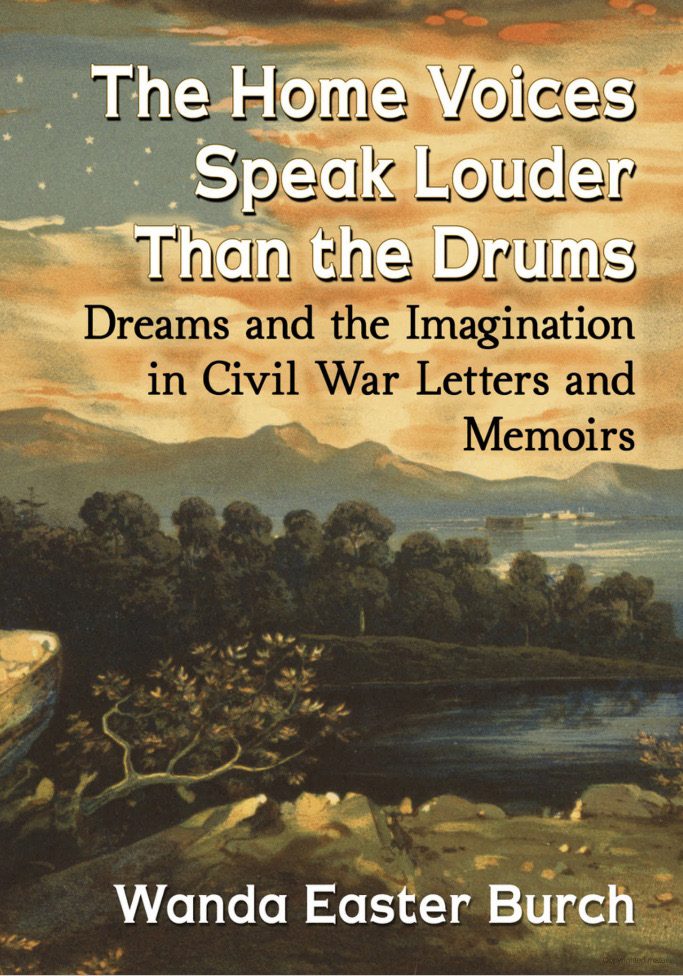
“Dream A Little Dream With Me” “Che The Home Voices Speak Louder Than The Drums. By Wanda Easter Burch. Notes, index, illustrations, bibliography, 277pp., 2017. McFarland,
Reading this book was a new experience for me. I was completely unaware that there was such a study as the dreams of Civil War soldiers. I presume it is the least written aspect of the war My only other experience is reading the tale of Lincoln dreaming of his death.
CWN Book Review Editor, Ste 3670 Falling Leaf Lane, Cummi
Civil War Catalo Featuring a large assortment o War autographs, accoutrements, insignia, buttons, GAR, docume
and Become a Good Custodian” This book is very well annotated and researched. It has an ampl bibliography, and provides an extensive supply of letters home from participants. The story is broken into 18 chapters covering every aspect from homesickness to fantasy, to portents of life a death. Most readers will surmise that we all have dreams. What is so unique about this book? Well, the “uniqueness” is getting a glimpse into the mindset of ordinary soldiers as they faced troubled time Many wrote home to allay their fears. We read of their fears and pain of loss. Some even tell of their dreams concerning death in combat. We have read of several prominent participants discussing omens of death. Two such examples are Col. Edward Cross at Gettysburg and the other is Lincoln. Here we see these same issues among common soldiers. The value of this effort is tha the student can gain significant insight into the effects that war has on the common soldier and how they are carried with him long after he returns. I found this aspect of the book the most rewarding and feel it can lead to a more complete understanding as to how the stress of war affects the participants. you have an interest in this aspe of study, by all means get a copy and delve into it. However, there
back. The cost may prevent the advancement of this genre to a larger audience.
Joseph Truglio, of Manchester, N.J., is president of the Phil Ke Civil War Round Table.
vil War and Indian orabilia, medals, photos, & books.
Discovering Virginia’s Colonial Artifacts. By Bill Dancy. Photos, notes, index, 392 pp.,
As an academic, professional archaeologist I had misgivings about this book because it dealt with an amateur who was a metal detectorist as well. The book alleviated my concerns for just about everything I’d long been taught but since come to see as overly restrictive. The change for the professional archaeological community came with the brilliant work Doug Scott and Rich Fox conducted at the Little Big Horn (Custer’s Last Stand) battle site using volunteer metal detectorists. Their detailed artifact recovery changed our understanding of how the battle was fought as well as moving the professional community to better utilize the equipment and knowledge of collectors. After all, collectors metal dectetorists study “their” sites and regions in much greater depth than many archaeologists do. A second aspect was that the time and labor involved by archaeologists using traditional te pitting did not result in recovery of much meaningful data on a battlefield, whereas the metal detector recovered materials that revealed the patterning archaeol-
ogists traditionally look for. In this lavishly illustrated, glossy format text, longtime metal detectorist Virginian Bill Dancy provides a very useful “how to” example of good metal detecting. It is divided into fou sections, plus nine appendices that more than adequately cover how to locate, recover, conserve and display relics from the past. Four chapters make up Part I – Research and Recovery. These are the key basics to any archaeologi cal effort and his lead-in chapte “Research is the Key,” should be required reading. Dancy includes archival, cartographic and aerial photography as basic tools. He
follows with advice about obtaining permission, something often overlooked before going onsite. His discussion about reading the landscape to find clues matching the research to the prospective site is important for stating the obvious about the often intuitive process of assessing where to dig His long experience resulted in developing a tool kit that should be emulated as time and finances permit. His discussion of how to find trash pits would help many archaeologists obtain a site’s type collection that could then be used to educate crews about what they find using traditional methodology. At this point, a jump to chapter 25 is important. Dancy focuses on recovering materials. If he were to add sections on photographing trashpits and find sites so as to reveal their stratigraph most archaeologists would probably be happy with his effort, even though he does not do this basic recording in lieu of drawin up stratigraphic cross sections o the various layers encountered. He does, however, keep records of what was found and where. Fourteen chapters make up Part II – The Artifacts. This section that will get the most attention from collectors, because Dancy presents what he found here in a series of topical chapters that include coinage, weights, buttons and buckles. His presentation on pipe stems is very good and draws heavily from archaeological material to help interpret them. Since he spends much time with trash pits, he provides sections on non-metal artifacts including glass and ceramics. For the Civil War collector, he includes a shor section on post-colonial artifact Part III deals with cleaning, documentation and ethics. The first two chapters are pretty bas discussions of cleaning materials without damaging them. The chapter on documentation is interesting because Dancy gives many of his finds to the landown-
ers because they are interested i them. He records materials by sit
rather than type. He photographs the artifacts and sites where he works and when, after they have been cleaned and stabilized. This recording is computerized and represents a solid data base of historical information. This sort of depth has been made possible by development of digital cameras and GPS locational systems to put artifacts back with their sit Dancy also publishes a lot of material in relic hunter magazines and posts from detectorist forums. He maintains files of these documentary efforts and says that this text is the ultima presentation of his finds. Dancy’s display is more
personal and cluttered than often sparse museum displays, but mass has a quality of its own. There is a Civil War metal detector museum (White Oak, in Falmouth, Va.) open to the public where D.P. Newton and a host of local collectors present their co lections and research in similar fashion. His discussion of ethics is si ply stated in the introduction to chapter 22 as “Always do the right thing.” He presents his own code of ethics and his last state ment that one should not pursue the hobby for monetary gain mirrors archaeological standards. He advocates reporting sites to loca historical authorities and suggests reporting illegal activity. His cooperation with archaeologists has resulted in significan finds and represents a continuation of the efforts first made a the Little Big Horn that are now being practiced in Europe, Britain, and most states. Part IV is a recapitulation of Dancy’s work titled “Best Sites and Finds” that represent the rar items as well “memorable trash pits” he has found. Some Appendices are a surprise because they include key identifi cation marks on clay pipes, mint and assayer marks, and how to preserve coins and iron artifacts through electrolysis as well as a coin inventory, tool check list, and three research case studies. The Index allows rapid searching for artifact types and some sites Some professional archaeologists will be appalled at excavation site photos and this may turn them away from using this text. That would be a mistake, as there is a lot of ver useful information for even experienced metal detectorists and professional archaeologists contained here. The photography is outstanding and presents key artifacts in clear illustrations to aid archaeologists and collectors in identifying finds. Archaeologists routinely use
texts on specific artifact types (canteens, bullets and buttons, for example) recovered by antiquarians, relic hunters, and collectors because they represent the broad scale of material culture. Here is much of the same in a single text, collected by on person in Tidewater Virginia.
Larry Babits is, among other things, a rear rank private in the First Maryland Infantry and formerly Director of the Program in Maritime Studies at East Carolina University. He worked on Civil War wreck sites including t USS Otsego, Maple Leaf, Star, and CSS ram Neuse. His main areas of interest are the private American soldier and musketry.
how terrible conditions were for prisoners in the North as well as the South. They know about the poor rations whose portions were reduced as the war dragged on—or sometimes no food at all. Readers know about the dangerous drinking water, sometimes downstream from latrines, and the smallpox, measles and other communicable diseases which swept through the prison camps. Those illnesses spread quickly because there was seldom enough room in the small prison hospital to isolate the infected prisoners from those who were in reasonably good health. This is a very well done review of those terrible conditions in t prisons in both the North and the
Shades of Green: Irish Regiments, American Soldiers, and Local Communities in the Civil War Era. By Ryan W. Keating. Maps, illustrations, notes, bibliography, index, 316 pp., 2017. Fordham University Press,
Ryan Keating examines three Northern regiments, the 9th Connecticut, 23rd Illinois, and 17th Wisconsin, which were comprised predominantly of soldiers of Iris heritage. His analysis delves int how the Civil War affected these men, their families, and the communities that sent them to war. The Civil War was their attempt t prove Irish loyalty to their adop ed country while simultaneously
isoners and Those in Charge of The South, which sometimes meant dozens were buried in mass graves. Those burials, however, sometimes took place only after their surviving comrades, who were poorly-clad and perhaps starving themselves, would take from their bodies any salvageable clothing, blankets, shoes or boots. This book might very well be a “tour de force.” That’s a French expression which means “an exceptional achievement by an artist, author, or the like, that unlikely to be equaled by that person or anyone else; a stroke of genius. In this reviewer’s opinion it fits those criteria. Yes, I obviously enjoyed reading it despite the fact that doing so was a chore. This lengthy paperback was printed in 2017 following the 2005 hardcover version. But its history goes back to 2001 when it was written as author Sanders’ doctoral dissertation, which degree he was awarded by Kansas State University that year. Those academic roots, necessary for a dissertation, slowed down this non-academic journalist-reviewer. There are footnotes on almost every page. I had to regularly clean my glasses from staring and blinking at the smaller-than-usual type in the book itself, as well as in the footnotes. But that is my only serious complaint about the work. It may seem to be pedantic, but the excruciating detail was probably necessary for a dissertation. viewed books about Civil War prisons. What may be new to readers are details of the behindthe-scene intrigues in both Washington and Richmond. They involved the presidents on each ing Glory, Overcoming Prejudice protecting the republicanism that they hoped would spread back to their native Ireland. While 150,000 Irish joined the Union army, the 5,029 men that comprised these three regiments provide the lens through which the motivations, occupations, sufferings, tenacity, courage and fighting pluck of Irish volunteers shon forth. Full participation in the w effort meant they would earn for all Irish immigrants full citizens rights and privileges. The author expands on the work of previous historians such as Susannah Ural’s Ye Sons of Green Erin Assemble and Christian Samito’s Becoming American Under Fire to use extensive demographic data showing that each Irish regiment was unique in composition, exposure to battle, and postwar adjustment. Yet all three regiment
side, cabinet secretaries and senior military officers. Their primary goal was to reduce the costs of holding tens of thousands of men in captivity. The fact is, as the author writes, that at the sta of the war neither side had spent much time or money in planning what to do with prisoners. Like most Americans, military and civilian leaders—North and South—assumed their side would win in a matter of a few weeks— or a few months at most, so why worry about prisoners? However, as thousands of captured Yankees were first sent to Richmond and just as many Rebels were being moved in boxcars to remote facilities in the North, the civilian and military hierarchies were making promises to improve living conditions for their wards. Those promises were seldom honored as the war dragged on. This book begins with a look back at how the Americans and British in the Revolutionary War of 1775–1783 and the war of 1812–1815 faced many challenges in caring for prisoners, as did Americans during the Mexican War of 1846–48. The handling of prisoners had been difficult in each of those wars, and those Americans in charge had written detailed reports on how they coped. But during the Civil War those reports were gathering dust on library shelves, rather than gi ing information to those in charge on either side during 1861–1865. It was what 21st-century observers might call OJT—“On the Job Training.” Civil War civilian and senior military officers on both sides were derelict; they should have had enough foresight to have
used the impact of war with an aim to join America’s melting pot as full participants. Military ser vice would debunk xenophobic attitudes in the North and fears o a lack of effectiveness as a fight ing force. The casualty rates and loss of men from disease clearly showed their commitment to defending the Constitution of their adopted country. For Civil War historians, this book provides more than a plethora of data on ethnicity, occupations, court martials and disabili ties. It personalizes the war on t home front as well. How important were bounties and military pay to the survival of families left behi What mental problems manifested themselves after the war? What marital strains from years of separation did military service cause How did returning troops live up
prepared at least some preliminary plans about what to do if they became overseers of thousands of enemy soldiers and sailors. They failed to do so and many who were in charge, especially in the South, were still looking for places to house prisoners in the spring of 1865, just as the war was ending. As stories about the terrible conditions in the camps reached the North and South home fronts, civilians, politicians and the newspapers began to clamor for an exchange of prisoners, under a “cartel.” Today that term often describes questionable agreements among specific organizations or even countries in the same business—such as the Mexican drug cartel which sets the price of illegal drugs. But “cartel” has a second meaning—an agreement between two or more warring countries. President Lincoln did not want to strike such a specific agreement with the Confederacy because that would mean he recognized the seceded states as, indeed, a separate country, not just “rebels.” But the pressure throughout the North from families, newspapers and elected officials to save their fathers, sons and brothers from their hell-holes forced him to reluctantly agree to the prisoner-exchange cartel. Discussions between the North and South eventually did lead to exchanges of troops in two ways: a one-for-one exchange, with one soldier or sailor on each side being exchanged for another of the same rank, or, an exchange of one senior officer for a specific number of enlisted men, such as one general for 40 privates. But there were a number of obstacles to overcome regarding
to the glorified and romantic news stories of their service? This commingling of demographic data and individual stories creates a unique picture for readers that Irish regiments were not monolithic but local in their orientations. Thus previous studies, using ethnic data alone, could not paint a true pictu of the diversity and sacrifices of Irish regiments and their families. Without including the home front, half of the story of Irish service struggle is missing. This book is highly recommended for its treatment of Northern Irish regiments as diverse and dedicated defenders of the Union. Perhaps a future study would benefit greatly by including Irish soldiers fighting for the Confederacy. The parallels would provide a more complete understanding of the Irish contribution to the respectiv
the exchanges. A major stumbling block involved one specific group of U.S. soldiers: Negroes. The South refused to treat those troops as legitimate fighters and, when captured, wanted to return them to their owners or sell them
on, Robert Ould, the designated Confederate in charge of Union prisoners, claimed to be eager to resume exchanges which had ended in an earlier controversy. But in one of this book’s few direct quotations, the author wrote, “…He (Ould) insisted on exceptions, adamantly asserting that Southerners would ‘die in the last ditch’ before giving up the right to send captured slaves back into slavery.” It is details such as that quot which make this worthwhile for those who have a keen interest in Civil War prisons. A plus would have been a map showing the locations of all the prisons, thei names and the years they were used. Finally, readers might enjoy the book even more if they could find the 2005 hard cover version, which ought to be easier to handle and read.
J. Lee Bailey of Gahanna, Ohio, is a journalist who earned a TV EMMY for an investigation of security problems at a major U.S. airport. He is a member of the Civil War Trust, the Central Ohio Civil War Roundtable and Ohio History Connection. He is now trying his hand at fiction by writ Thunderbolt Raiders—50 years after the Civil War, a Southern general shares his memories and his heart with a young female reporter from the North, about Confederate cavalry Gen. John Hunt Morgan.
war efforts. The book reads as a novel, in which every chapter adds statistical data around personal s ries that make the reader eager to read the next chapter. The softcov
Wayne L. Wolf is Professor Emeritus at South Suburban College in Illinois and Past President of the Lincoln-Davis Civil War Roundtable. His current research is directed at discovering, transcribing, and publishing previously unknown Union and Confederate letters to provide researchers with new primary source material.
Flag Rotation at the New Je By Joseph Bordonaro When the boss wants your office, you move. What is true in private enterprise is equally true in state government. Hence, when New Jersey Governor Chris Christie decided to move his offices from the State Capitol Building to what had been th State Archives Building, the N.J Civil War Flags Collection had to relocate to the nearby State Museum. This no doubt entailed a lot of work, but the end resul turned out to be a win for the f collection. In its new home it will be se by all the visitors to the State seum, a much larger group than the numbers of people who visited the smaller State Archives Building. Another plus is that, unlike the Archives Building, th Museum is open on the weekends. Now the flag collection can be seen by many people who work during the week, or by thos who don’t want to drive into the state capital on busy week days. Parking is also much more available on the weekends. This fact was made apparent to those who attended the annual flag collection rotation when they found that they were able to park in a nearly empty government lot immediately adjacent to the Museum, at no cost. This convenience was especially appreciated by th attendees, as sub-freezing temperatures and a light fall of sn greeted them on Saturday, Dec. 30, 2017, as they arrived for th unveiling of 2018’s grouping of flags on display. Those who braved the weather
Dr. Martin tells the history of battle flag on display in the fl
ate Museum the presenter and shared many fascinating facts about the flag Included in this year’s grouping are the national colors of the 4 Inf. Regt., NJ Vols., the nation colors of 4th Inf. Reg., NJ Vols the regimental color of the 2nd Inf. Regt., NJ Vols., a guidon o the 2nd Cav. Regt., NJ Vols., an a Confederate battle flag captur by the 7th Inf. Regt., NJ Vols., the Battle of Chancellorsville, May 3, 1863. Also present at the unveiling was Nicholas P. Ciotola, Curator of Cultural History at the N.J. State Museum. Mr. Ciotola is responsible for the flag coll tion and has been instrumental in its preservation and display to the public for many years. He has done an outstanding job of moving the collection to its new home and the State of New Jersey should be commended for doing so much to create what is probably the premiere display of Civi War battle flags in the nation. Dr. Martin’s assiduous resear was evident as he regaled the au dience with the history of each of the five flags and told inter esting anecdotes about each. He was assisted, in a small way, by this writer, who presented infor mation about the 2nd NJ Cav.’s guidon. One of the most interest ing stories that Dr. Martin rela ed was how the 4th New Jersey’s flag was recovered at the end of the war. It had been captured by 5th Texas soldier during the Bat tle of Gaines Mill in 1862 when the regiment was completely overrun by the climatic Confederate charge near the end of
their front and both flanks. Af its capture, the flag was displ in a war trophy room in the Con federate capital in Richmond, V When that city was near capture itself, the flag, along with th other captured battle flags, wa boxed up and sent south by trai The train was then captured in turn by Federal troops. Included among these troops was the 9th NJ Regt., NJ Vols. Imagine their surprise when the first b opened on the captured train co tained the now re-captured flag And on the top of the pile in t box was the National Flag of th 4th NJ Inf. Regt! An especially poignant bit o information about the flag, and which speaks powerfully about the fierce pride that soldiers in it, is the fact that a soldi from the 40th NJ, Private Frank E. Fesq, of Company A, was awarded a Medal of Honor for capturing the battle flag of th 18th NC Inf. during the final assault on the Confederate line at Petersburg, Virginia, on Apr 2, 1865. Another telling fact i the information that was put on brass plate that was affixed to staff of the 2nd NJ Cav.’s guid in the collection. The brass plate commemorates the death of color bearer Jesse Harrison, killed in action at Guntown, Mississippi. It is really quite moving to look at these flags a realize that soldiers literally to defend them against capture, and likewise risked their lives capture those of their enemy. While designed to denote the location of units on smoky and
This guidon was presented to th the Ladies of Salem. Salem is a
chaotic battlefields, these fl actually meant much, much more to the soldiers. Their preserv tion by the veterans after the and their continued preservati these many years later are pro that the old flags are still i ant to today’s citizens. For those who want to visit collection, it is located in t State Museum. The museum is located at 205 West State Stre Trenton, NJ, and is open Tuesday through Sunday, 9 am to 4: pm, except for state holidays. a bonus for history lovers, if visit the museum before Aug. 2 3028, you will also be able to view an excellent exhibit on t flags and posters of World War
College graduate (1980), Catholic school teacher (St. Josep Pro-Cathedral, 1983-198 and retired public school teac er (Mullica Township School,
He has been involved with Civil War reenacting/living hi tory since 1999. Joe began sub mitting articles to the Civil News in 2005 and has been covering events for the News on a regular basis since 2016. He h also recently begun to write b reviews for the News. Joe live Mount Laurel, NJ, and has been married to his wife Karen for 29 years. If you wish to conta Joe, you may send an email to
w Jersey Cavalry by the southern part of NJ. (Photos by Joe Bordona
holas Ciotola stands by a roduction of a New Jersey ruiting poster in the brand display area created for flag collection.
Vol. 42, No. 3 Battlefield Of Franklin Land Prese By GreGory L. Wade FRANKLIN, Tenn. — What is
considered the bloodiest acreage i the Nov. 30, 1864, Battle of Frank is now being reclaimed as part of evolving Carter Hill Battlefield P Local preservation leaders recentl
from owners Reid and Brenda Lovell after a months-long process
of coordinating various funding sources for the critical 1.6 acres adjoin the Carter House, a major battle landmark. Details were recently provided a press conference led by Franklin Charge board member Julian Bibb,
who praised the “remarkable transition” of the Franklin battlefiel Franklin’s Charge is a coalition o civic and preservation groups who joined together more than ten year ago to purchase local battleground Over 150 years ago the Army of Tennessee stepped off in a series
of charges to be virtually destroy by Federals under John Schofield i hopes of taking Franklin and later Nashville. At that time, most of the terra was open farmland on the outskirts of what was once a small Middle
Tennessee farming community. Over time development covered much of the battlefield with houses, light dustry, and small businesses. All that remained of the critic area where the Confederates temporarily broke the Federal line wa the small farmhouse and a few acre known as the Carter House farm. The 1.6 acres purchased, which adjoin the southern boundary of th Carter House property, is comprise of two lots. Today, they are occup
that were turned over to the City of Franklin Parks Department by
Franklin’s Charge and the Battle o Franklin’s Trust (BOFT), managers of the Carter House the nearby Car ton Plantation. The structures wil removed in coming months, possibly relocated for other use. The purchase is only the latest in a long and arduous effort to re
build the Franklin battlefield. “It had to be a miracle,” quipp Civil War Trust (CWT) President James Lighthizer, referring to the most recent acquisition. Local res ident Michael Grainger, long time Trust board member and former
chairman, said, “Local leadership has been incredible and will conti ue to be a partner [with the CWT]. In 2005, after years of frustra attempting to preserve Franklin ba tleground, local preservationists cided it would have to be done the hard way, by buying properties, of
ten with buildings on them. The largest parcel of land was originally a local golf course sla to be sold to a developer to build houses on what was the right flank of the Confederate attack north to ward the Federal lines just south
the town. It was then that Franklin’s Cha came into existence. Funds have
chase from private donors, the CWT the City of Franklin and others. T 110-acre segment, now fully interpreted and known as the Eastern Flank Battlefield, is what got the preservation ball rolling in Frank Since that time nine other parc in proximity to the Carter House have been purchased and have been, or will be, turned over to the Fra
at the Lovell purchase regory L. Wade photos)
lin Parks Department, according t Bibb. But it was the land just south Carter House, long considered the most bloodied ground in Franklin, and some say in America, that was the most coveted. BOFT Chief Executive Officer Eric Jacobson noted, “to not have this ground reclaimed and preserv would be like having Omaha Beach cut out of Normandy.” The most recent acquisition evolved when Franklin’s Charge an the BOFT began discussions with t Lovells, who have a strong sense the history of the land, having g up in Franklin. “I was born and raised in Fran lin on ground many believe should have been a national park,” said Lovell. He recalled when visitors came to town and had to envision what happened, not walk on ground where it transpired. “My great-grandfather, who fou here, and my parents would be pro of what we are doing here today,” said at the press conference. The Franklin Board of Mayor and Aldermen voted unanimously in February to fund part of the remaining debt on the Lovell property purchase. The previously
paid by the city on a non-interes basis over seven years. These funds will cover the bal now bridged by a local bank and w
be derived from the city’s hoteltel tax. Local banker Chuck Isaac was instrumental in working out t loans. All the city funds are all
by his employer, First Farmers an Merchants Bank.