e our readers with timely miss ificant Civil War research and
Dunkerly and Crenshaw, two veteran authors with ties to t Richmond National Battlefield, have produced an excellent boo aimed at the casual reader. It both an introduction to what t city was like during the war a guide book for anyone wanting visit it today. The book is divided thematically into twelve chapters. A one might expect, popular visi destinations like museums and battlefields are covered. In a tion, the authors discuss pris and hospitals. Also mentioned numerous little known, and out the way sites. There are also chapters dea ing with difficult subjects li slavery in Richmond and the Reconstruction era. In the cha ter about monuments, they discuss the on-going controversie regarding the many Confederate monuments around the city and the recent removal of some of them. To the author’s credit, subjects are discussed in a ve
For anyone who wants to kno more about Richmond during the
ar in Missouri and By William Garrett & John C. Rutherford.
zarks Studies Institute ouri State University, ield. https://ozarksstudies. e.edu/book-series.
In December 1862, Brigadier General John S. Marmaduke led a Confederate cavalry raid north from Arkansas into Missouri. The raid was directed at the Federal supply depot located at Springfield, Missouri. The purpose of the raid was to destroy sufficient Federal supplies to prevent the Federal’s planned 1863 spring offensive against Little Rock, Ark. Springfield was the Federal forward supply base supporting the advance of Missouri troops into Arkansas. Marmaduke’s raiding force was built around Colonel Joseph O.
Joseph C. Porter’s Brigade. Thes two brigades formed the core of the 4th Cavalry Division, Army
edge of the raiders intended tar get, and the real time location
of the Confederate’s main force. The lack of current knowledge was compounded by Federal
commanders using a communication system dependent upon
written messages delivered by horseback and made worse by the Federal need to defend numerous
points thus negating their overall strength. Favoring the Federals were their earthen defensive lines supplemented by fortified log strong points. These fortified supply bases were defended by determined men who, faltered at times, overall stood their ground and denied raiders access to the Federal supply depots.
The authors concentrate their tale of Marmaduke’s failed 1863
raid around two Confederate defeats: Springfield on Jan. 8, 1863, and Hartville on Jan. 11, 1863. The tale of these two Missouri battles is well told, allowing the reader to follow the flow of the fighting. The authors do not simply report battle events but provide critiques of what went right and what went wrong. They speculate about what would have happened to Federal strategy if the raid had been successful. A much more important topic, however, is the Federal response to the raid. They launched an 1863 spring-summer offensive designed to knock Arkansas out of the war. The results of this Federal campaign were that the Missouri Confederate state government would never return to Missouri, and the Arkansas Confederate state government would be deprived of its capital city, Little Rock. The text of the book is supported
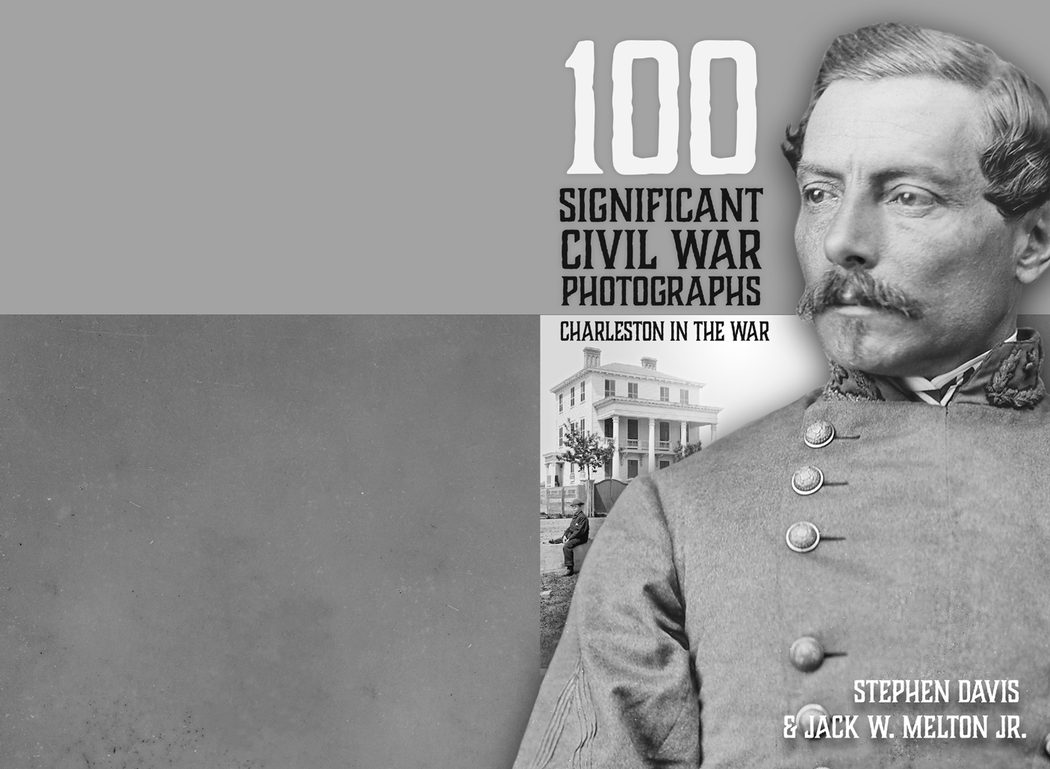
IN THE WAR 100 Significant Civil War Photographs: Charle in the War features newly restored images of
IN THE includeWAR scenes in the famed city, taken 1860–1865. The cameramen the better as GeorgeCharleston Photographs: N. Barnard in and George the War fe the as famed somecity,lesser-known taken 1860–1865. ones: Sam
es Osborn Quinby, the partners Haas & Peale better-known, such as George N. Barnard and & Durbec. me lesser-known ones: Samuel Cooley, C & Peale, Text Osborn & Durbec.Davis and Jack Melt by Stephen k accompanies Melton accompanies eacheachfeatured featured p
ibing ttings: the surrounding and the history that portion surrounding pictured scenes them. ofThe Charleston selected
variety ston (the areaof known of settings: the city destroyed Arsenal, as TheandBattery, the many the by th that portion churches
heirs “the Holy City.” Special sections of this boo
area of the city destroyed by the Great Fire ly guns imported from England by the Confederates ews. December 1861), the Charleston Arsenal, and
leston the many churches that allow Charlestonians t goes back call theirs “the The Defense to Holy City.” of Charle Special
derate major of engineers, and to Reminiscences of
in 1860-’61 imported (1876) by Capt. Abner Doubleday, Fed Charlestonians have contributed to the history and from England by the C rt N.close-ups Rosen andof Barnard’s views.III. Th Richard W. Hatcher icant Photographs draws on these and other works. nce upon the writings of actual participants, such 1914) and Emma Edwards Holmes (1838–1910). The history of Civil War erature, 100 Significant CivilCharleston War
in theThe War Defense of Charleston offers rewards Johnson, serious student. Confederate Harbor ( for all readers, major of Reminiscences of Forts Sumter and Moultrie in 1860-’61 (1876) by Capt. Abner Doubleday, Federal second-in-command. Since then Charlestonians have contributed to the histor of their city, notably Robert N. Rosen and Richard W. Hatcher III. The historical text surrounding 100 Significant Photographs draws on these and other works. A unique feature is reliance upon the writings of actual particip such as Augustine T. Smythe (1842–1914) and Emma Edwards Holmes (1838–1910). As a contribution to this literature, 100 Significant Civil War Photographs: Charleston the War offers rewards for all readers, from casual novice to the serious student. 160 pages, Over 100 Photos, Maps, Index, Bibliography, Softcover. ISBN: 978-1-61850-167-7
The Southern Dream of a Transcontinental Empire. Notes, bibliography, index, 372 pp., The University of North Carolina Press, Chapel Hill, pa-
Research about the Civil War generally focuses on the eastern part of the United States, yet, Kevin Waite points out in West of Slavery, slavery-related issues led to confrontations in fa Western states and territories a well. While on a smaller scale, fallout over slavery and related forms of bondage in California, New Mexico, Arkansas, and Utah led to political maneuverin and deadly conflict among partisan groups. The author labels this landmass the “Continental South,” and notes, “Proslavery partisans transformed the southwest quarter of the nation … int an appendage of the slave states California was the scene of confrontation between northern and southern oriented combatants, with the southerners endeavoring to achieve independence as a slave state. The author sheds light on the “southern powerbrokers” who schemed to bring the western region into their “political and commercial orbit.” He explains why residents in these states embraced the pro-slavery agenda of their counterparts in the southeastern states; and how the idea of westward expansion shaped Confederate grand strategy during the war. He labels thi
dreams deferred, schemes interrupted, and plans forestalled….” “West of Slavery” deals with the South’s desire for participation in the Asian market and its “600 million consumers.” This required construction of
a transcontinental railroad that Northerners labeled “the great slavery road.” As early as 1852, October 2021
ber of the Confederate presidential cabinet, commented that the Eastern world’s “commerce makes empires of the countries to which it flows….” The transcontinental objective had been under consideration since Thomas Jefferson’s presidency led to the Louisiana Purchase, and was later extended by the Republic of Texas and acquisition of territory including present-da California, Nevada, Arizona, Utah, New Mexico, Colorado, and Wyoming. The discovery of gold motivated Southerners to transport as many as 1,500 black slaves to California, despite a stipulation in its constitution: “Neither slavery, nor involuntary servitude … shall ever be tolerat ed in this State.” Regarding the location of a transcontinental railroad destined to enhance commerce in the area it traversed, Mississipp Senator Jefferson Davis argued it was needed to maintain political and military control over newly-acquired areas in the West. He favored the railroad running through the South, and, after tha region won the right to build an overland mail route in 1857, expectations were the future railroad would run over that same area. Later, as Secretary of War, Jefferson Davis envisioned the railroad running from St. Louis to San Francisco; and, after the “Gadsden Purchase” acquired land along the Mexican border with Texas, plans moved ahead for another Southern railroad ter minating in San Diego. Despite these railroads not be ing built during the antebellum p riod, the South still established self politically in California, N Mexico, and the area later known as Arizona. Emigrants from the South managed to acquire positions in legislatures, courts, an as members of Congress, enabling them to influence politica decisions. Eventually, railroad builders employed black slaves, captive Indians, and Mexican peons to extend the roads further westward. Slaveholders and Democrat Party officials in California and other western areas looked to Jefferson Davis for guidance and support from his influential position in the U.S. Congress. In Utah, Mormon leader Joseph Smith believed the “African race was divinely destined for slavery…;” both Utah and New Mexico passed laws that protected slaveholders, and attracted “a mass migration of
southerners.” As a result, Waite concludes, “By 1860, slaveholding prospects in the Far West had
So, when the people elected Abraham Lincoln as president and he took the oath of office in March, the Union not only divided between North and South, but also to a certain extent in th West, and Jefferson Davis was intimately involved in causing these divisions. Many Californians opted to join the Confederate military, and others posed a threat to generate an uprising within the state. Southerners in the U.S. mil itary assigned to the Department of the Pacific, including such well-known stalwarts as Albert Sidney Johnston, George Pickett, Lewis Armistead, and Richard Garnett “resigned their commissions and fled east.” During the Civil War, Southern California remained strongly anti-Union and pro-South. Following the collapse of the Southern rebellion, the surrender of Gen. Robert E. Lee’s army, and the arrest of President Jefferson Davis, the situation out West stabilized. As the author points out, however, in his closing analysis titled “In the Shadow of the Confederacy,” the South rose again, so to speak, through the efforts of such organizations as the United Daughters of the Confederacy to sustain the memory of the Southern cause. The mindset and lifestyle of the South lived on through dogged efforts of “Lost Cause” revisionism. This too was true in the “Continental South,” including California, New Mexico, Arizona, and Utah. For example, “No other free state housed more Confederate monuments than California.” In West of Slavery: The Souther Dream of a Transcontinental Empire, Kevin Waite has created a fascinating study of a subject glossed over in other Civil War histories. This is a unique view of our country during the time of its greatest trial that all tho interested in this period will fin intriguing in its depth of researc and clarity of narration. Readers will come away with a much expanded view of a conflict heretofore limited in both space and time.
Thomas J. Ryan is the author of the multiple award-winning Lee is Trapped and Must Be Taken: Eleven Fateful Days after Gettysburg, July 4-14, 1863 (along with co-author Richard R. Schaus), and the multiple award-winning Spies, Scouts and Secrets in the Gettysburg Campaign: How the Critical Role of Intelligence
Impacted the Outcome of Lee’s Invasion of the North, June-July 1863.
Unsung Hero of Gettysburg: The Story of Union General David McMurtrie Gregg. By Edward G. Longacre. Illustrated, index, notes, bibliography
David M. Gregg was the beau ideal of a mid-nineteenth cavalr officer. After graduating from t United States Military Academy, he spent six years honing his skills in the Southwest and on the Pacific coast fighting Nativ Americans and protecting frontier settlements. At the outbrea of the Civil War, he returned ea and was appointed Colonel of the 8th Pennsylvania Cavalry. Thus began the Civil War career of a modest, humble cavalry leader who would win the trust of superiors and the loyalty and affect of those who served under him. Efficiently carrying out a va riety of duties including supply routes and trains, skirmishing with Confederate raiders, and never holding back from an offensive assault when he thought an advantage could be gained, he still cared for his men and neve needlessly placed them in danger. This philosophy held throug engagements at Malvern Hill, Stony Creek Station, Second
Todd’s Tavern, Samaria Church, and countless other engagements in the Shenandoah Valley and during the Overland and Peninsular campaigns. Promoted to brigadier general in November 1862 upon General Bayard’s death, he inherited command of the 2nd Division. Cavalry Corps,
Army of the Potomac, a position he was to hold for the remainder of the Civil War.
Gregg’s moment of lasting glory however came on July 3, 1863, when in conjunction with General George Custer, he attacked and successfully prevented cavalry under Gen. J.E.B. Stuart from coordinating a rear attack on Union lines with General Pickett’s fron tal assault. His preventing of this dual attack saved the Union line and ultimately the victory a Gettysburg for Union forces. For the remainder of the war Gregg was attached to the Army of the Potomac and, except for a few tactical errors at Brandy Station (perhaps due to ill healt he competently led his cavalry through actions at Aldie, Middleburg, Upperville, and Sulphur Springs, then engaging General Lee’s forces on their retreat route while simultaneously acting as General Meade’s eyes and ears. After the war, General Gregg served a brief stint as counsel a Prague and a term as auditor general of Pennsylvania. Yet, he was always cash strapped, never lived in a home he owned, and devoted most of his time to organizations that were military related, inclu ing the Loyal Legion where he served as Commander-in-Chief. He died on August 7, 1916, largely forgotten for his Civil War service. Edward Longacre expertly combines primary source material with accounts of military engagements to craft a very readable, historically accurate, and unbiased biography of General Gregg. This is a much-needed biography of a general who gave much yet never sought publicity or self-promotion. Any student of Gettysburg would be well served by having a copy of this book close at hand.
Wayne L. Wolf is Professor Emeritus at South Suburban College, past president of the Lincoln-Davis Civil War Roundtable and the author of numerous books and articles on the Civil War, including Two Years Before the Paddlewheel and The Last Confederate Scout.
Juneteenth: The Story Behind the Celebration. By Edward T. Cotham Jr., Photographs, index, chapter endnotes, and bibliography. 344 pp. State House Press, Schreiner University, Kerrville,
com/consortium/texas-am-university-press. 2021. Distributed by Texas A&M University Press
Union Major General Gordon Granger’s General Order No. 3, is among the most misunderstood of all military orders iss during the Civil War. Its first contains the phrase “all slaves free.” It was issued and signed off on by a staff officer of the Headquarters District of Texas, Galveston, Texas, June 19, 1865. “Mr. Civil War Galveston,” Ed Cotham, was intrigued by this rather simplistic statement and decided further research was needed. Ed has written numerous other books and articles, but th is perhaps his best work. He cor rectly asserts that readers need great deal of background information and context to understand this order’s significance and it multiple impacts. Civil War Artillery Book 392 page, full-color book, Civil War Artillery Projectil The Half Shell Book. For more information and how to order visit the websit
Ed’s meticulous resear makes Juneteenth a seminal work. A military order is more than the paper it is written on. General Order Number 3 affected various aspects of everyday life. Some of these included race relations, political considerations military policies and procedures, and social and economic impacts. Ed analyzes each of these topics thoroughly. As a result, readers gain a deeper understanding of how military orders are created, enacted, and enforced. Race relations are the hub of this study’s focus. Readers are challenged to determine exactly what freedom is for all parties and how it can be achieved. Lincoln and his Cabinet were conflicted about when and how to publish the Emancipation Proclamation which provided the foundation for General Order Number 3. Enforcement of General Granger’s order was very problematic for military troops trying to provide for free Negroes and simultaneously conduct a war with the Confederates. Ed also provides interesting discussions about how Negroes were employed and reintegrated back into some Galveston area’s plantations, as well as in military s vice with the Union Army. Juneteenth is a fascinating an provocative exploration of why June 19th of every year is celebrated in Texas. Cotham’s book is
Excellent research, a detailed bibliography, and numerous photographic images make this book one that should be on everyone’s reading list.
Richard J. Blumberg has reviewed ly twenty years. Three of his art cles have been published in vari-
The Human Side of War My Enemy, My Friend. By Georgiann Baldino. Illustrated, notes, Pearl Editions, 2020, 272
Georgiann Baldino has fashioned this fictional novel aroun two composite portraits—one Union (Archie Ryan) and one Confederate (Elias Goodson). Likewise, Archie’s wife Jennie and Elias’ fiancée Liz Becker ar fictional characters symbolic of women’s profound political and moral differences on the home front and their sufferings durin the war. The battles noted represent engagements fought by the 99th Pennsylvania Infantry for the Union and the 2nd South Carolina Infantry for the South. An additional main character, Mary Morris Husband, was an actual Civil War nurse who saved both Archie and Elias from their war injuries. Mrs. Husband epito mizes the sacrifices of those wh risked their lives and health to
minister to the boys in the hospitals and prisons. The author’s story is more than a simple recounting of two soldiers wounded in battle and serving their respective causes. Five themes that form its message emerge from this novel. First, despite a brutal war, combatants can put aside their differences af ter the war and work together for the common good of the country. Secondly, war has horrific costs for those left behind, years of separation, loss of affection, struggles to care for families, an death unattended by absent soldiers. Third, war is hell. Battles are not the sanitized versions recounted in newspapers. Instead, they are the blood, gore, pain, an suffering of human beings whose commitment by politicians with their rhetoric does not match brutal reality. Fourth, being exposed to war changes soldiers. In this novel, attitudes toward slavery morph into abolitionism. The soldier is deprived of his freedom in the army, is exposed to arbitrary military commanders, and is subjected to brutal punishments. Finally, shared wartime experiences can make enemies into friends. Soldiers come of age on the battlefield and realize the have more in common than supposed differences. Reconciliation is not only possible but preferred While this novel does not contribute new insights into battles or campaigns, it does present the human side of war, using both fact and fiction to illustrate war complex challenges. Readers of fiction will like this book for it character development and moral message. It is recommended for those who wish to forget the