analysis of the latest and scholarship. Contact email:
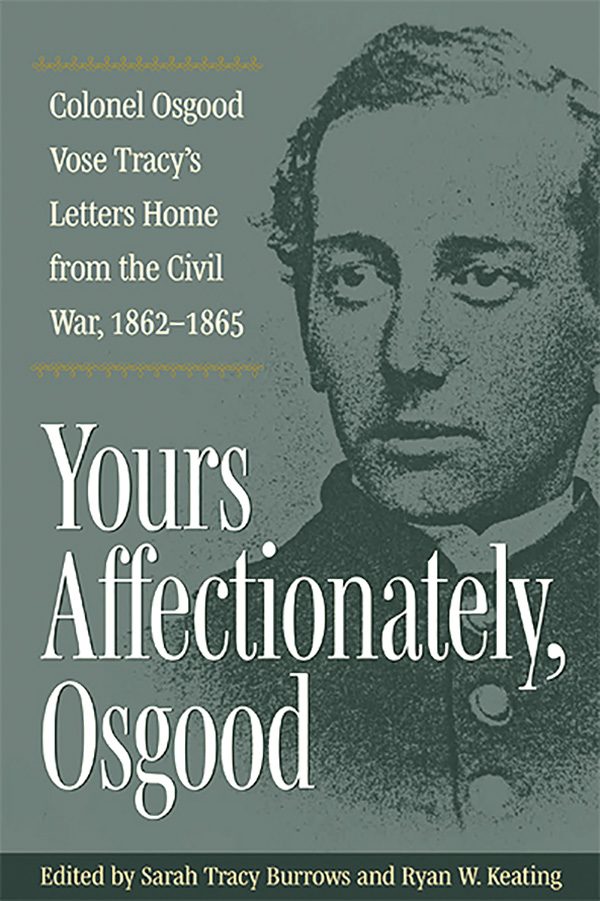
Yours Affectionat Osgood: Colonel Osgood Vose Tracy’s Letters Home from t Civil War, 1862–1865. Edite by Sarah Tracy Burrows and Ryan W. Keating. Photograph and drawings, maps, notes, index, 296 pp., The Kent State University Press, www KentStateUniversityPress.co
A countless number of Union Civil War letter and diary collections have been published over the past cen and a half. One cannot help wonder why many of these we published in the first plac the often uneducated author only recounted mundane dail
de our readers with timely nificant Civil War research and
matters such as what he ate and that seemingly favorite topic, the weather. Every now and then, however, a work appears by a well-educated soldier who wrote in a clear style and plac thoughtful observations within the larger context of what was going on around him. Osgood Vose Tracy of the 122 New York Volunteer Infantry was one such man. His previously unpublished and unseen letters from the eastern theater to his home in upstate New York were written between September 1862 and the war’s end in May 1865. Tracy’s address many pertinent social and political issues of day, as well as provide ample battlefield descriptions. Tracy was twenty-two years old when he enlisted in August 1862 at Syracuse. His regiment was mustered into service with Trac initially holding the rank of sergeant major. Within weeks it was on the march arriving at th Antietam battlefield the day af that bloody clash. That would be the regiment’s lone dodged bullet; over the rest of the wa 122nd saw hard fighting at ever major engagement along the Washington to Richmond corridor including Fredericksbu Chancellorsville, Gettysb Rappahannock Station, Mine Run, the Overland Campaign, the Shenandoah in 1864, Richmond and Petersburg, and then the fi dash to Appomattox. The two
gaps in Tracy’s dutiful letters home are from January through March 1864, when the regiment was detached for prison camp guard duty at Johnson Island near Sandusky, Ohio, and again in May 1864 when Tracy was captured during the battle of th Wilderness but escaped soon thereafter. Over the course of his development from childhood into adulthood, Tracy became an ardent abolitionist. His antebellum letters (not included in this collection) suggest that learning of an escaped slave who had lived peaceably in Syracuse for two years but was then arrested under the terms
of the 1850 Fugitive Slave Act may have influenced his growing abolitionist sentiments. Like
many if not most men of his era, however, his firm antislavery principles did not equate into a racial equality convictions. His occasional racist descriptions o African Americans were typical of the era. The book contains 127 letters written primarily to his widowed mother, Sarah Osgood Tracy. To add additional context into Trac world, the editors also included thirty-eight letters between Tra and his brothers, friends, cousi and his sweetheart, Ellen “Nelli Sedgwick. Tracy’s younger brother, William, also served in the Union army and received the Congressional Medal of Honor for his role during the Battle o Chancellorsville. Osgood Tracy rose through the ranks and ended the war as a brevet major, which was awarded for gallantry at the 1864 battle of Cedar Creek. After the war ended, he received the rank of brevet lieutenant colonel for gallantry in the final Petersbur and Appomattox campaigns. Editors Sarah Tracy Burrows, a great-great granddaughter of Osgood Tracy and current owner of these family letters, and California State University San Bernardino Professor of History Ryan W. Keating have collaborated to present these Civil War letters. Burrows’ detailed family history and Keating’s excellent wartime analysis firmly sets the subject abolitionist sentiments and army experiences within the broader
military, social, and political context of the era.
Paul Taylor is an award-winning author and editor of eight books pertaining to the Civil War era.
His current manuscript is titled “Tis Not Our War”: Avoiding Military Service in the Civil Wa North and is currently under
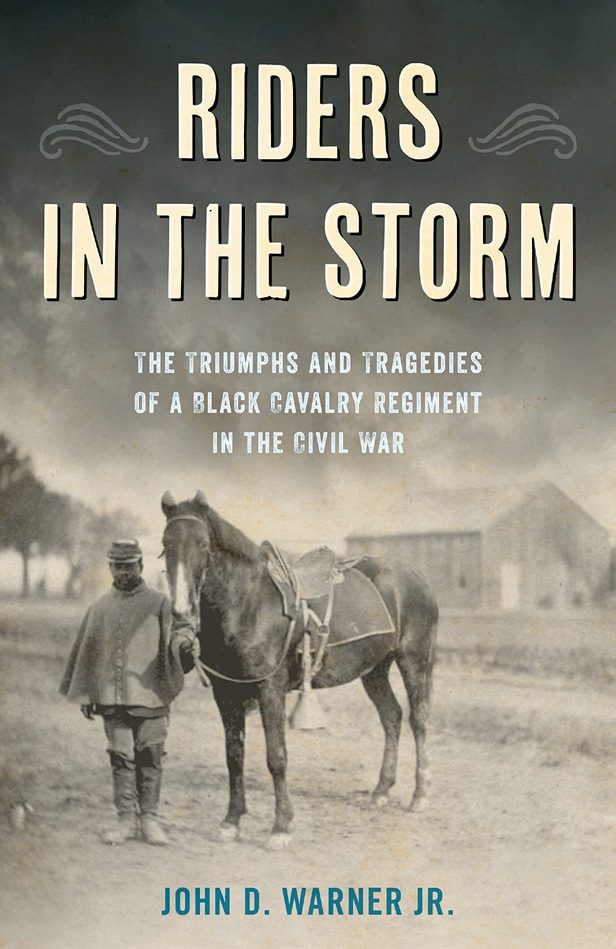
Riders In The Storm: The Triumphs and Tragedies of a Black Cavalry Regiment in the Civil War. By John D. Warner, Jr Illustrated, index, bibliography notes, 407 pp., Stackpole Books,
The 5th Massachusetts Cavalry was the first black cavalry regiment raised in the North. Recruits, over 1,000, came from all over the North and even as far west as Hawaii. Free blacks, escaped slaves, and white officers filled the ranks as thi biracial experiment materialized in late 1863. The new regiment, following in the footsteps of th courageous 54th Mass. Infantry, started out at Camp Meigs in Readville, Mass., where their only blemish during training was the desertion of 37 men. After their initial training, the 5th Mass. Cavalry (dismounted) was assigned to guard Confederate prisoners at Point Lookout. This assignment lasted until June 1864 when they participated in attacks around Fredericksburg, principally at Bermuda Hundred and Baylor’s Farm. Here they captured a few
prisoners and a howitzer while sustaining only 16 wounded men and 3 officers. Two of their own men were killed accidentally by their comrades. General Hicks, however, was generally displeased with their performance and transferred them to picket duty along the Appomattox. Here they remained until near the end of the war wh they were transferred to Texas where they served guard duty in Brazos until being mustered out.
The author devotes nearly half of his book to the selection by John Andrews of the officers for
this new cavalry regiment. This use of Gov. Andrews’ archives provides a valuable look into th political machinations wherein the governor was trying to fill ranks with devoted abolitionists and the elite of Boston society. However, the actual service of the 5th Mass. Cavalry at Baylor’ Farm, guard duty at Point Lookout, marred by the murder of two Confederate prisoners, duty along the South Side Railroad, and the sand of the Brazos might have been better chronicled in a journal article. This would have eliminated the need to fill the text with extraneous material no directly related to the 5th. Whi this unit should be remembered for its volunteer spirit and breaking the race barrier in the cavalry, the reader should reali direct information on the 5th, although readable and historical accurate, is sparse.
Dr. Wayne L. Wolf is Professor Emeritus at South Suburban College and the author of numerous books and articles on the Civil War including Two Year Before the Paddlewheel and The Last Confederate Scout. He is Past President of the LincolnDavis Civil War Roundtable and a frequent lecturer at events an roundtables.
between Abraham Lincoln and African Americans has become
a topic of historical interest i recent years. At least four book were published on the subject in the last twelve months, includin my own A House Built By Slaves: African American Visitors to the Lincoln White House (2022) and Michael Burlingame’s The Black Man’s President (2021). Now Fred Lee Hord and Matthew D. Norman have provided an extensive collection of writings by African Americans about the nation’s sixteenth president Twenty-two documents are letters sent by African American to Lincoln (twenty-one of these appear in my book, To Address You As My Friend: African Americans’ Letters to Abraham Lincoln [2021]). The majority of this fascinating boo consists of speeches, essays, editorials, and poems written by black men and women, from Frederick Douglass’s 18 observations about the LincolnDouglas Debates, throu Barack Obama’s remarks at the banquet of the Abraham Lincoln Association on Lincoln’s 200th birthday on February 12, 2009. Hord and Norman have accomplished something quite extraordinary. Mining a large number of sources, they have unearthed voices that have been
lost, in some cases, for a centu or more. While some early writers were critical of Lincoln
the overwhelming majority saw something admirable in him. In 1863, for example, a church February 2023
in Beaufort, South Carolina, sent Lincoln a set of resolution offering him “our hearty thanks for the Proclamation,” issued on New Year’s Day that year. More than four decades later, in 1904 the Voice of the Negro newspaper similarly saw January 1, 1863, as a central moment in American
history: “Abraham Lincoln, the Emancipation Proclamation and
the Negro are the three most suggestive words of the last hal of the Nineteenth Century. . .. Negro looks upon the first day of January as his natal day. The whole nation should celebrate it as the day when the freedom proclaimed in the Declaration of Independence became a living
reality to the whole people.” To be sure, Lincoln had black critics during his presidency, including H. Ford Douglas, Frederick Douglass, a soldier who wrote under the pseudonym “Africano,” and others. However,
in the twentieth century. In 1922, W. E. B. Du Bois wrote in
The Crisis, “Abraham Lincoln was a Southern poor white, of
illegitimate birth, poorly educa and unusually ugly, awkward, ill dressed. He liked smutty stories and was a politician down to his toes.” By the 1960s, black assessmen of Lincoln were reaching new lows. In 1963, Malcolm X rejected the notion that Lincoln was “a god who brought us out of slavery into the promised lan of freedom.” Five years later, in 1968, Lerone Bennett, editor of Ebony magazine, argued that Lincoln was a white supremacist who “was exposed from the very beginning to racism” and could never rise above his upbringing. As an adult in both public and private “he was a firm believer white supremacy.” That same year, Julius Lester wrote in Look Out, Whitey! Black Power’s Gon’ Get Your Mama!, “Blacks have no reason to feel grateful to Abraham Lincoln. Rather, they should be angry at him. After all, he came into
office in 1861. How come it too him two whole years to free the slaves? His pen was sitting on desk the whole time. All he had to do was get up one morning and say, ‘Doggonit! I think I’m gon’ free the slaves today. It just ain’t right for folks to o other folks. It was that simple
Lester concluded that it was “a lie, to depict Lincoln as the G
Emancipator.” Today’s ambivalence of many African Americans tow Lincoln is captured in a 2005 essay in Time by then-Senator Barack Obama. Obama praised Lincoln as “Illinois’ greatest
citizen and our nation’s greate President” who “kept his moral
compass pointed firm and true” during the throes of the Civil War. But at the same time, Obama wrote, “I cannot swallow whole the view of Lincoln as
the Great Emancipator.” Obama was “fully aware” of Lincoln’s “limited views on race.” And
the Emancipation Proclamation, he wrote, “was more a military
document than a clarion call fo justice.” Knowing Him By Heart traces an incredible arc in black thou revealing how Lincoln went from being almost universally revere to viewed with skepticism, disdain, and even anger. This marvelous book, in conjunction with the other recent scholarsh will help readers recapture the special relationship that developed between Lincoln and African Americans during the crucible of the Civil War, as w as how and why things changed over time.
Jonathan W. White is professor of American Studies Christopher Newport University and the author or editor of 13 books, including A House Built By Slaves: African American Visitors to the Lincoln White House (2022) and To Address You As My Friend: African Americans’ Letters to Abraham Lincoln (2021). Visit his websi
Gateway to Vicksburg A different regimental The Battle of Jackson, Mississippi, May 14, 1863. By
Chris Mackowski. Illustrated, bibliography, index, Savas Beatie Publishing, 2022, 171 pp.
Jackson: Long ignored by historians, Chris Mackowski has written a comprehensive, eminently readable, lavishly illustrated, and historica accurate account of the Battle of Jackson fought May 14, 1863. The battle itself was shor essentially a delaying action to allow Gen. Joe Johnston to evacuate the city with as many supplies and equipment as he could carry. A small Confederate force, primarily from Gen. Alber Thompson’s 3rd Kentuc Mounted Infantry and Col. Peyton Colquit’s command of States Rights Gist’s Brigade, along wit a small artillery support group, managed to hold off Generals Sherman and McPherson long enough for the wagon trains and entire command of Joe Johnston to retreat northeast. These delaying troops then likewise withdrew, and the city fell. Jackson’s occupation by Union forces destroyed not only a major Confederate supply base, transportation hub, and industri production facility, but removed threat to General Grant’s rear a
520 Folly Road, Suite 25 Charleston, SC 29412
turned west toward his intended target of Vicksburg. Sherman was left behind to destroy Jackson’s infrastructure and its ability t transport troops or supplies to Pemberton’s beleaguered troops in Vicksburg. Sherman completed his destruction, along with looting and pillaging much of the town, before his withdrawal. Later, Union forces would return in July 1863 and complete the destruction of Mississippi’s capital. Grant was now free, with his r protected, to take on Pemberton’ s forces at Champion Hill and then to proceed to lay siege to Vicksburg which fell July 4, 1863. Grant had thus successfull crossed the Mississippi River, won engagements at Grand Gulf, Raymond, and Port Gibson, forced Johnston to retreat, thus surrendering Jackson, the third state capital of the Confederacy to fall, forced the capitulation of Vicksburg, and opened the Mississippi River to Union control. As Lincoln believed, the “key” to Union victory was now in Federal hands and he had found his fighting general. Chris Mackowski tells the stor in his clear, engaging style, re with primary source material, an including the battle’s human sid He concludes with a chapter on the battlefield as it exists tod and provides the reader with a map for a driving tour that poin out how and where the battle unfolded. This book is highly recommended as a must have on the shelf of any historian interested in the western theatr or the fall of Vicksburg.
Dr. Wayne L. Wolf is Professor Emeritus at South Suburban College and the author of numerous books and articles on the Civil War including Two Year Before the Paddlewheel and The Last Confederate Scout. He is Past President of the LincolnDavis Civil War Roundtable and a frequent lecturer at events an roundtables.
Tar Heels in Gray – Life in t 30th North Carolina Infantry in the Civil War by John B. Cameron. Photos, figures, notes index, bibliography, 177 pp. McFarland & Company, https://
John Cameron’s study of the 30th North Carolina is quite a bit different from the usual regimental studies; it doesn’t focus on the military activity much as it does on the soldiers their backgrounds, and what happened to them over the cours of the war. By Appomattox, 1,506 men, officers and enliste had served in the Thirtieth. The regiment was composed of companies largely raised in eastern and central North Carolina with one company from Mecklenburg. Over the war years, men’s height ranged from 4'8" to 6'4" with the most common height being 5'10," a little taller than today averag enlistment, the most common age was 18 (11.9%) followed by 19 (6.9% and 20 (6.9%). The oldest was a 58 years old substitute, at least a dozen were in their and over 125 in their 40s. At t youthful end, there were six at years, 24 aged 16, and 71 aged
17. As conscription grew more intense, the average age jumped to 33.2 in 1863 but in 1864, it dropped to 19.6 because younger men who had just reached 18
were called up. Three chapters deal with survival; one on battle casualt
one on survival/death in the regiment, and one on disease. Th latter two are most instructive for looking at why regiments were never at full strength. Coupled with another chapter titled starvation and desertion, these four chapters portray a near disaster for the Tar Heels. In some respects, it is a wonder so many were present at the fina surrender. There are chapters on the regiment’s beginning and its initial service before being sen to Virginia and the Seven Days battles in the early summer of 1862. Those chapters are followe by studies relating to who fough and their attitudes to slavery. The author states in the preface that his conclusions, drawn from this one regiment, about social status, slave ownership, free me of color and motivation differ from samplings of larger units (brigades, divisions, and armies because they are only increments of a wider population that tends to mask smaller unit distinction Cameron uses two chapters to discuss inter-related questions about the war; was it a “Big Man War and a Small Man’s Fight,” and what was the relationship of slavery to the men in ranks? To do this, he created his own social/economic categories based on the regiment’s men. These were laborers, small farmers, including craftsmen, middling farmers, and wealthy farmers. He points out that others would cal his middling famers “wealthy” but points out the 30th’s soldie would have been surprised to find themselves described as wealthy. This difference is somewhat due to Cameron’s taking the regiment as a whole, not a sample, for his data base. He found that 83 percent of the regiment were agriculturalists. Related to the issues of wealth in many historians’ eyes was the ownership of slaves. From the 1850 and 1860 censuses 880 men (82%) came from families that owned no slaves. Of the slave
owners, 64 (7.3% had from one to eight slaves, 57 (6.5%) owned nine to 25, while only 34 (3.9%) held 26 or more. To compare the 30th with the sample drawn from
the Army of Northern Virginia, h used 694 men in the 1860 census. In every case, the 30th had many
fewer slave owners and did not resemble the Northern Virginia sample. The basic difference is that one is a sample, the other draws from an entire stand-alone unit. The presence of soldiers of color was also covered. The Thirtieth had at least five men of color in the ranks; three wer from one family, the other two may have been related to each other. No military records show these men were of color. North Carolina’s racial law was not based on color anyway, but on one’s grandparents. Cameron said it was surprising there wer any soldiers of color but other researchers have found them, including one North Carolina man who fought for a year and a half, requested a discharge because he was of “mixed race,” got out, then six months later went back into the same company and was slain during the spring June 2020). The regiment suffered a 14.3% (215 men) loss due to death in combat or mortal wounds. Another 10.7% were either prisoners or absent wounded, indicating a quarter of the regiment’s strength was lost to combat. That total was almost matched by noncombat deaths (23%, 349 men). Another 20% (300) deserted, but 153 soldiers (10.5%) were still with the colo at Appomattox. This book is not a typical military oriented regimental history. It tells the other side the regiment, focusing on the men, not the battles. Any seriou student of the men in ranks should have this book at his fingertips. Students will find i challenges what many are being taught and can better prepare them for analyzing “statements of historical fact.”
Larry Babits is a student of the American private soldier. He is also a battlefield archaeologist
with experience on sites ranging from French and Indian War forts to World War II POW and forced labor camps. He is currently working on books about
the last three engagements of Nathanael Greene’s 1781 Southern Campaign.
James Longstreet and The American Civil War: The Confederate General Who Fought the Next War. By Harold M. Knudsen, Lt. Col. (Ret). Appendix, Bibliograph Index and About the Authors. 288 pp., 2022. Savas Beatie
This work is not a traditi biography but a doctrinal analysis and comparison to other time-periods, wars, an generals. Knudsen does a goo job illuminating how and why James Longstreet’s execution of battles affecting the Arm of Northern Virginia and the Army of Tennessee were on Iowa and the Civil War
Iowa and the Civil War; Volume 3: The Longest Year
This is the final volume i Lyftogt’s trilogy of Iowa in American Civil War. Volume 1 covered the period 1850–1862 Volume 2 examined the years February 2023
The First Modern General the right track, and were often Confederate victories. writing provides readers with a more militarily informed understanding of Longstreet. Lt. Col. (Ret) Harold Knudsen uses his U.S. Army training and years of modern experience to validate that there was more to Lee’s “Ol Warhorse” than most readers of Civil War history have learned o read about. James Longstreet is one of the most debated Civil War figures, but perceptions about him changed over the past sixty years as historians including Bruce Catton, Shelby Foote, Ed Bearss, Glenn Tucker, Bill Piston, and Jeffrey Wert, added to the literature. He was the ta of character assassination by Jubal Early, William Pendleton, and some Southern Historical Society Papers writers after 1870. These Confeder soldiers saw him as a traitor fo becoming a Republican after the War, endorsing Constitutional amendments to secure citizenship and voting rights for freedmen, and supporting President Grant during Reconstruction. They made him a scapegoat for the surrender at Appomattox and changed his stellar war record a retribution. The author pointedl observes that “Lost Cause” propaganda was utilized by William Dunning in the 1880’s, and Douglas Freeman the 1930’s
1862–1864. During the course of the Civil War, Iowa provided the Federal government with 48 infantry regiments, nine cavalry regiments, and four artillery batteries. Iowans would fight in the Trans Mississippi, the Easte and the Western Theaters. The highest commanding officer from Iowa was Major General Grenville Dodge who commanded XVI Corps. The author skillfully weaves the story of Iowa’s involvement in the various theaters into a comprehensive narrative. He details Iowa’s involvement in General William Sherman’s campaign that led to capturing Atlanta, the efforts to bring General John Bell Hood and General Nathan Forrest to battle following the capture of Atlanta the march to the sea, taking Savannah, and the final battles in South Carolina and North Carolina. During this period, Iowa soldiers also participated in the Battles of Franklin and Nashville, took part in the capt
and 1940’s, both of whom expanded the anti-Longstreet misrepresentations. Knudse reveals that Freeman ignored Longstreet’s innovations and developments on future warfare. Readers will gain a military lesson in “James Longstreet and the American Civil War.” Lt. Col. Knudsen contends that Longstreet understood the effectiveness of the tactical defense in a way mos people did not. He asserts that h came out of the Mexican War with a thankfulness of this realism, that the tactical defense was tru greater than the strategic offens when invaders try direct tactical assaults in open ground. Knudsen points out that Longstreet came up with a mobile defense on a small-scale at First Manassas tha was used in the twentieth century with motorized and tracked vehicles. Additionally, he saw the casualties the Confederates inflicted on the Union as they ca directly toward the Sunken Road at Antietam and were only able to take the position by out flanking it. This lesson Longstreet carrie forward to Fredericksburg, where he enhanced his strategic defense even further in advance of the battle. In fact, his defensive ef at Fredericksburg created a “modern,” doctrine called a kill zone, that has become a standard method of today’s armies of how to formulate a kill zone. Furthermore, he recognized of Mobile, the defeat of General Jubal Early in the Shenandoah
Valley, rode with General Wilson during his raid into Alabama and Georgia, foiled General Sterling Price’s invasion of Missouri, and fought various guerrilla groups on the Western Frontier. The book’s story of Iowa in the Civil War is enhanced by the author skillfully weaving first-hand accounts of events under discussion into the text. The contemporary accounts provide the reader with a feel of the emotions generated within individuals, families, and communities by the political turmoil and battlefield casualtie taking place around them. Chapter Eight details the 1864 Presidential election and is a must read. Many forget that in 1864 the American people were not only deciding who would be President of the United States for the next four years but whether the war would continue and slavery be ended. Also, the people would be electing a new Congress whose new members might finally approve placing
that Longstreet theorized “the mutations of war” needed new ways to break an enemy’s formations strategically that shaped operational thinking and caused the Germans problems during World War 1. Furthermore, Knudsen concludes that the general’s vision of the function staff officers helped commanders achieve tactical success. Finally he determined that Longstreet was a pioneer for using mission analysis. Knudsen points out that readers should look at his treatment from the standpoint of what military operations the general executed in his era that became accepted methodology in the early 20th Century. Moreover, he concludes that what Longstreet accomplished, and what he advised Lee and Bragg to do at Gettysburg and Chickamauga respectively, was corre contrary to what detractors said of him following the war. He concludes by stating Longstreet was innovative, forward thinking, and “modern” in his approach to his job fighting Yankees. Harold Knudsen’s conclusions rely heavily on Longstreet’s memoir From Manassas to Appomattox, the ORs, Longstreet’s contributions to Battles & Leaders, letters, repor and other firsthand accounts, as well as additional public comments, as being the most
the 14th Amendment before the states. This chapter provides a
clear summary of the emotional issues that tugged at Iowa voters The Republican Party itself was not in total agreement with Lincoln’s war policies, some finding them too lenient and some too demonic. How this all played out in Iowa is a fascinating stor I personally found the last th chapters of great interest. Here, the author looked at the effect the assassination of President Lincoln had on Iowa’s soldiers and the state’s home front. Plus, he delves into post war Iowa. Hopefully this examination of post war Iowa will become an additional book in this series on Iowa in the Civil War. The author touches upon the fact that the fighting war did no end with the surrender of Robert E. Lee’s Army of Northern Virginia. The war continued for some time in the TransMississippi Theater; the effects would continue to plague and shape the social and political patterns of Iowa long after fighting ended. I was amazed that
important primary sources due to these being the general’s public record. The author did a good job providing readers with specific details as well as providing the larger context throughout. The main purpose for Knudsen writing this treatise was to corr wrongs about this misunderstood person. “James Longstree and the American Civil War” provides readers with an accurate portrayal and reconsideration of the person, as well as much that will not be found in other monographs. This work is well researched, engagingly written, and important. It also provides an appendix on the failure of Pickett’s Charge, ten helpful maps and ten drawings that will help readers better understand th narrative.
David Marshall is a high school American history teacher in the Miami-Dade School district for the past thirty-five years. A life-long Civil War enthusiast, David is president of the Miami Civil War Round Table Book Club. In addition to numerous other publications, he has given presentations to Civil War Round Tables on Joshua Chamberlain, Ulysses S. Grant, Abraham Lincoln, the Battle of Gettysburg and the Common Soldier.
some post-Civil War political and social problems that plagued my home state of Kentucky, a border state, also played out in Iowa. I found this book to be a fascinating read, and I have ordered volumes 1 and 2 of the series. The author provides a thoughtful insight into why Iowa believed it needed to support the Union cause both politically and militarily. I only wish the autho had covered Iowa’s involvement in the purchasing of Federal revenue bonds that were issued to fiance the war. All in all, this is a great addition to the histor accounts of the American Civil War.
Charles H. Bogart has a BA from Thomas More University and an MCP from Ohio State University. He is employed as a tour guide at the Fort Boone Civil War Battle Site in Frankfort, Ky., serves as President of the Frankfort Civil War Roundtable, and is a board member of the Kentucky Civil War Roundtable. He has written several books and articles on military and naval history.