The Carnage Was Fearful: The Battle of Cedar Mountain. August 9, 1862. By Michael E. Block. Maps, photos, illustrations, appendices, orde of battle,168 pp., 2022. Savas
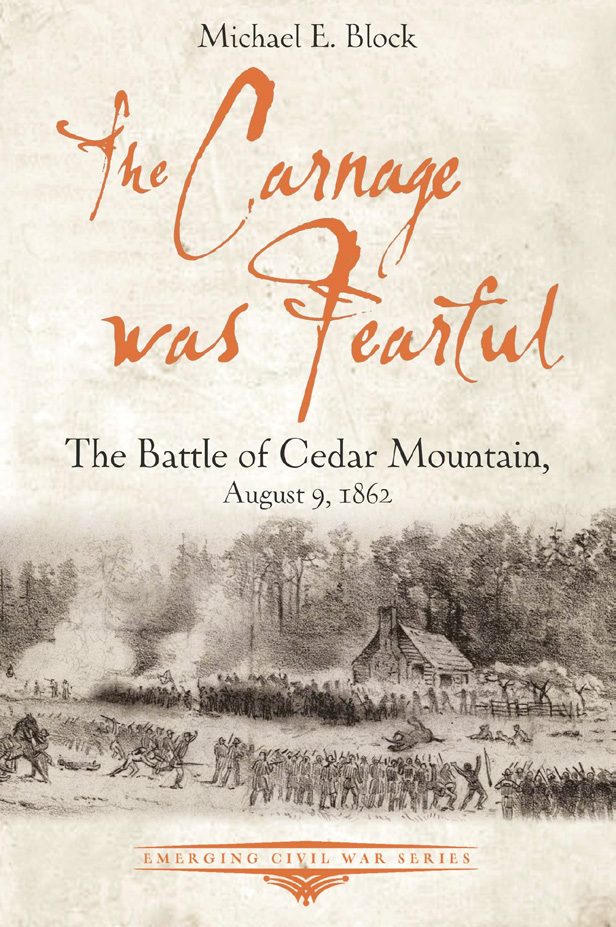
As a boy, my grandmother often told me, “Good things com in small packages.” This most aptly describes this thoroughly researched book about, until recently, a long-forgotten batt The Battle of Cedar Mountain, being overshadowed by Second Manassas and the Maryland Campaign, has remained a footnote in the pages of Civil history. For the veterans who fought and left friends and fam dead upon the field, it lingere their memories. All wars involv seemingly insignificant actions like Ball’s Bluff, Chantilly, and Cedar Mountain, that have not received the attention they deserved. The men who fought them did not consider them insignificant. Neither should w Michael Block has spent some two decades studying the rich history of Culpeper County, Va. As the vice president of th Friends of the Cedar Mountain Battlefield, he has actively worked to preserve this ground
for future generations. Michael has thrown his heart into this worthy endeavor, and it shows. His thorough knowledge of the battle and the intricate maneuvering which preceded it shine through in this book. He devotes the first four cha describing the social, political and military situation in Northe Virginia that contributed to the three-hour conflict on August 9, 1862. Hal Jasperson’s excellent maps succinctly illustrate the movements of Maj. Gen. John Pope’s Federal Army of Virginia through Culpeper to ferret out and engage Maj. Gen. Thomas J. Jackson’s Army of the Valley. Two Federal cavalry brigades under Brig. Gens. John Buford and George D. Bayard intercepted Jackson’s slow-moving column and initiated several skirmishes On August 9, the Federals advanced southwest on both sides of the Culpeper Road. They engaged Confederate infantry and artillery head on and initia achieved some success, including attacking a battery from behind. Then Confederate reinforcements arrived, broke the Union center, and “crossed the T” on the far right of the Federal line. As darkness overtook the field, the Confederates chased the Federals toward Culpeper. The nasty fight cost the Union 2,382 casualties and the Confederates 1,276. As part of Emerging Civil War Series, this book also includes self-guided tour of the battlefi and surrounding areas and pays meticulous attention to sites on private property. This small but extremely detailed work should be read slowly and repeatedly with pen in hand to note the fin details the reader will glean wi each sitting. I keep finding new details every time I go through It is a gift that keeps on givin
Mike Priest is author of Antieta The Soldiers’ Battle (1989) and Before Antietam: The Battle of South Mountain (1992).
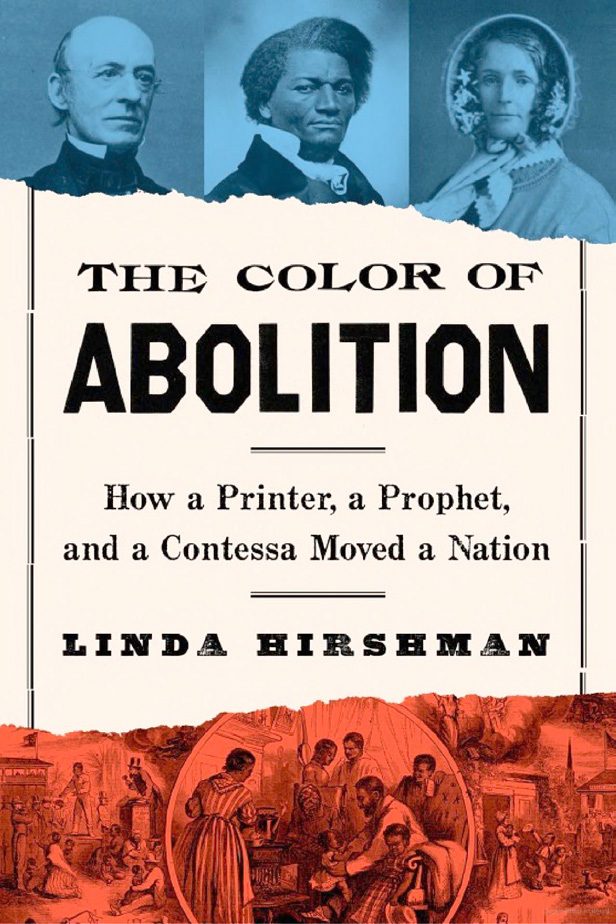
The Interracial Fight for Emanci The Color of Abolition: How a Printer, A Prophet and a Contessa Moved a Nation. By Linda Hirshman. Notes, illustrated, Mariner Books,
Linda Hirshman focuses her treatise on the history of the abolition movement around three of its most prominent exponents: the printer (William Lloyd Garrison), the prophet (Frederic Douglass, originally Frederick Bailey) and the Contessa (Maria Weston Chapman). From the 1830s, William Garrison, the quarrelsome, moralistic, selfrighteous, vivid, and imaginativ newspaper editor of The Liberator pursued his vision for total abolition. Garrison was undeterred by financial pressure a short jail sentence and fine, divided anti-slavery movement, and his own weak constitution. Frederick Douglass, t escaped slave from a Maryland plantation, eloquent, focused, and uncompromising, toured the country and Europe spreading his messages on the evils of slavery the brutal repression of the Neg as property, and the humanity of every man. To promote their quest for abolition Maria Weston Chapman, married to an ardent abolitionist, was behind the scenes organizing their travel itineraries, raising fund through fairs, and promoting the Boston Anti-slavery philosophy. These three stalwarts formed an alliance that lasted a decade before it dissolved in doctrinal disagreements and procedural avenues of achieving freedom and equality for all. From the first issue of the Liberator on January 1, 1831, to its last on December 29, 1865,
n William Lloyd Garrison strove end slavery using nonresistanc and moral suasion. It was not until the 1850s that he recogn political activism as a tool u the newly founded Liberty Part the Liberty League, the FreeSoil Party, and the Republican Party. By this time, it became
translated into electoral succ to accomplish full equality of men. Frederick Douglas, initially aligning himself wit Garrison, eventually rebelled against Garrison’s vision and methodology. He also broke wit the Boston Anti-slavery cabal, published his own newspaper, The North Star, and with the help of Maria Weston Chapman, and later Julia Griffiths, set own agenda, freeing himself by being managed by white supporters. He gained such a national prominence that he wa invited to the White House by President Lincoln, related his demands for full equality to t Chief Executive, and instilled in Lincoln his vision for true humanity for the Negro and all men and women. Hirshman does a commendable job of weaving the personal attributes and ambitions of al three prominent abolitionists
into an explanation of how the abolitionist movement evolved in the three decades before the Thirteenth Amendment. Likewise, she sheds new light on the role Maria Chapman played in controlling both William Lloy Garrison and Frederick Douglass, and how their split had its seed
author’s judgmental analysis appears excessive, e.g., calling Gen. McClellan “cowardly,” and throwing around the label racist to characterize organizations and people. Yet, for an historic review of the different ideologi and rivalries inherent in the abolition movement, this book could be a valuable resource. The primary source material, voluminous as it is, is welcome to any historian. The illustrati are of inferior quality and, whi relevant are hard to see, read, analyze. This book would be a valuable asset for any student o the abolition movement.
Dr. Wayne L. Wolf is Professor Emeritus at South Suburban College and Past President of the Lincoln-Davis Civil War Roundtable. He is the author or editor of numerous Civil War books and articles and a frequent contributor to Civil Wa News.
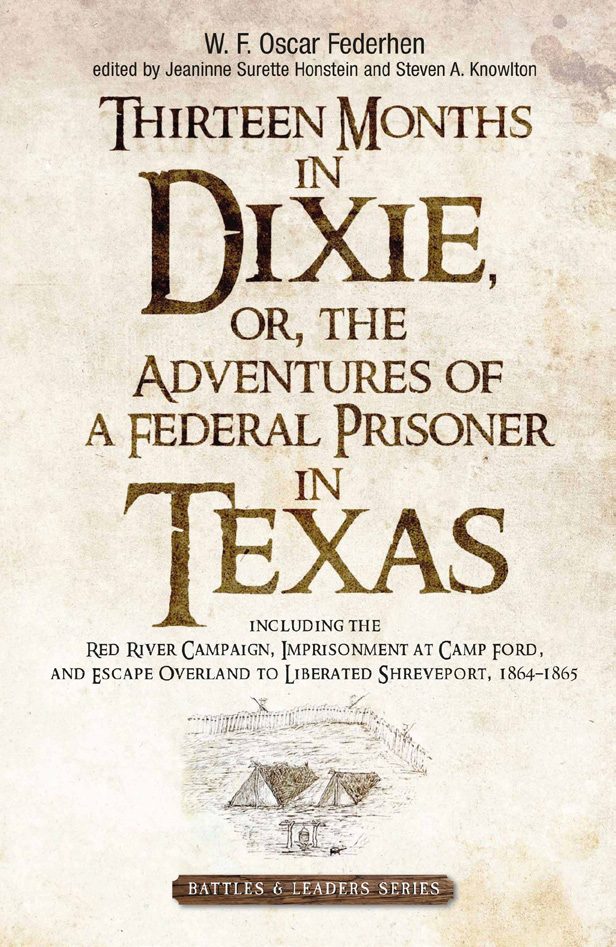
William Francis Oscar Federhen. Thirteen Months in Dixie, or, the Adventures of a Federal Prisoner in Texas. Edited by Jeaninne Surette Honstein and Steven A. Knowlton. Bibliography, index, maps, photographs, 170 pp.,
W. F. Oscar Federhen enlisted in the 13th Independent Battery, Massachusetts Light Artillery, o March 25, 1864; he never saw combat. Soon after arriving in Louisiana, on May 3, Federhen was captured. The Confederates stripped him of his money, possessions, gun, and most of his clothes. With little left to name, he was sent to Camp Ford, a stockade prison in Tyler, Texa There, he suffered indignities, starvation, and disease, includi a fiery sunburn he called Satan’ itch. Federhen’s descriptions of prison life are detailed and compelling. Prisoners punished thieves among them by burying the culprits in mud up to their
necks. To pass the time, inmates made playing cards from tree bark, and skinned cats to make
banjo’s head and “some part of the cat’s innards” for strings. Federhen suffered permanent
physical damage in prison as burns and scurvy left scars on h feet. After several unsuccessful
attempts, Federhen escaped. He walked through Texas for many, miles, hiding in woods, thickets and swamps, and seeking help from local civilians. These chapters offer readers an intima April 2023
picture of life in Confederate Texas, the squalor, poverty, and fear that Confederate civilians lived in, their decrepit cabins, beds of straw, shrinking quantities of food, and fear of Home Guards who might execute them for harboring a Yankee or for expressing Union sympathies. Throughout the course of his narrative, Federhen was recaptured and escaped several times. In one instance he escaped from captivity with one of William Clarke Quantrill’s men. Federhen and the Confederate guerrilla broke free by walloping their guard over the head with a piece of wood. They then made their way to Quantrill’s camp, where Federhen had a long conversation with “Bloody Bill” Anderson. This detailed account which has not been utilized by Anderson biographers, conflicts with some known facts about Anderson. The next few chapters describe guerrilla raids in brutal, graphic detail. Federhen saw and participated in robbery, murder, fistfights, and plunder. In one particularly horrifying scene, he witnessed the literal butchering of a black man. In another, he witnessed guerrillas ripping out an elderly man’s fingernails when the old man would not reveal the hiding place of his gold and silver. Federhen wrote, “I stood over the bed looking at this barbarous action but could say nothing to prevent it lest they should turn on me.” After more captures and escapes, Federhen finally made it home to Boston in July 1865. His mother was elated to see him, for
In Honor of a Fallen Nation Gould B. Hagler, Jr
memorial transcri upon the informat and the them. Th eloquent nation’s soldiers pay homa they fou
she had thought him long dead. Federhen’s memoirs will be of great interest to scholars the Texas home front, guerrill warfare in Arkansas, and prison life in the Confederacy He was a talented writer, much more so than many of his postwar contemporaries. As with all memoirs written long after the war, Federhen’s recollections are not entirely reliable even though he claime to be writing “undisputable facts.” Nevertheless, this is extraordinary primary source that offers valuable insights some of darker aspects of the Civil War. The editors of this volume conclude, “Readers will have to judge for themselves t reliability of Federhen’s acco we have faith few will deny that it is a gripping tale and you won’t soon forget.” They are correct in this assessment Federhen offers an unforgettab Civil War narrative.
Jonathan W. White is professor of American Studies a Christopher Newport University and the author or editor of 13 books, including A House Built By Slaves: African American Visitors to the Lincoln White House (2022). In 2023 he will publish Final Resting Places: Reflections on the Meaning of Civil War Graves with Brian Matthew Jordan, as well as a biography of convicted slave trader Appleton Oaksmith
ue work contains a complete hic record of Georgia’s
to the Confederacy, a full tion of the words engraved , and carefully-researched on about the monuments rganizations which built se works of art and their inscriptions express a profound grief, praise the bravery and patriotism, and e to the cause for which ht.
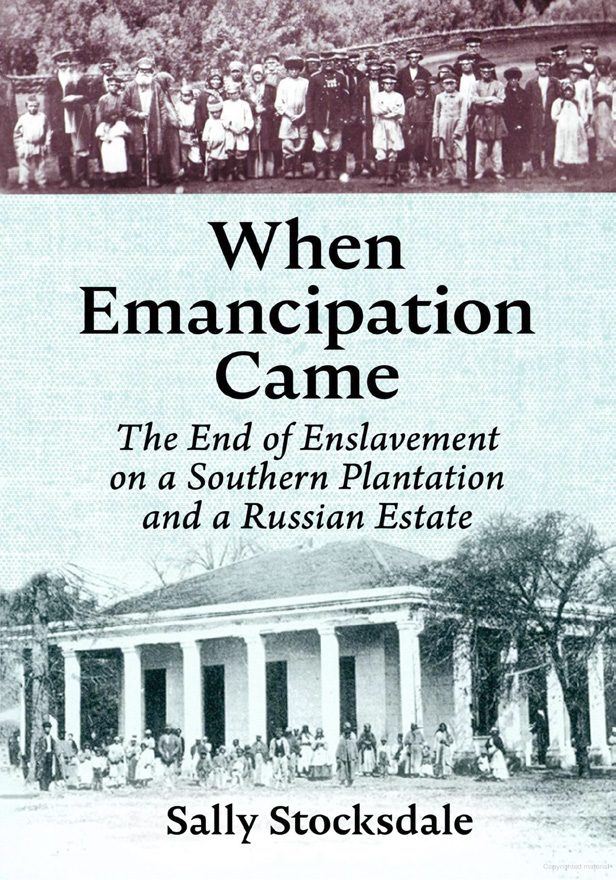
Freedom’s Trailblazers When Emancipation Came: The End of Enslavement on a Southern Plantation
and a Russian Estate. By Sally Stocksdale. Illustrated, Notes, Index, Bibliography, McFarland and Company, https://
Sally Stocksdale crafts a unique picture of two plantation (demesnes) Palmyra Plantation in Mississippi and Yazykovo Selo in Russia to compare the meaning and effects of freedom on slaves and serfs. She explores the origins, structure, requirements and reception on those who endured the lengthy process towards true freedom endured. For Russian serfs “freedom” came in February 1861 with the stroke of a pen by Tsar Alexande II. For slaves held on Palmyra Plantation their freedom came on January 1, 1863 when Abraham Lincoln signed the Emancipation Proclamation. From this point on freedmen in both locales played role in determining and defining themselves and their new roles. Authorities in both countries prioritized their chief aim as social control while maintaining
the economic integrity of the land and its productivity. The
main difference between the two settings was evidenced in how Russian serfs would gain
total freedom in stages after buying land from the nobility and agreeing to contract terms o service to their former masters.
Mississippi, no provisions were made for gradual freedom. It was immediate and unstructured, yet formalized by Union officials
and the Freedman’s Bureau so labor was assured and land productivity encouraged Emancipation in both locales did not solve problems of the demand for cheap labor nor did it modif
the attitude of the elite toward the previously enslaved. Both groups struggled for land of the own, autonomy for their choices, and self-determination. During this struggle, what predominated was confusion by competing narratives of what freedom meant, rumors as to what newly freed people were entitled to, and the elites tryi instill the notion the labor was heart of and key to freedom. Fre people were being told that they should grow into their freedom and their labor was the vehicle that transition. Yet, free peopl in both Russia and Mississippi ultimately desired to act in the own self-interest while moving to work within the constraints imposed by the institutional and traditional constraints they fou themselves in. This book paints a fascinating picture of two groups of formerl enslaved people fighting for true total freedom where they could own land, travel, decide where they would labor and under what conditions, and elect those who would govern them. Both landowners, Gen. John Quitman and Vasili Yazynov, represent the archetypical owner of slaves; both are faced with t dilemma of accepting freedom, yet maintaining their economic status in society. It is a wellresearched, historically accurat interdisciplinary study which addresses the social, cultural, economic, geographic, political aspects that impacted the newly acquired freedom in two societies not as different a previously supposed. This book is recommended as a new conceptualization of what happens throughout the emancipation process, a process that does not happen with the stroke of a pen but may take decades to be fully realized.
Dr. Wayne L. Wolf is Professor Emeritus at South Suburban College, past president of the Lincoln-Davis Civil War Roundtable, and the author of
numerous books and articles on the Civil War including Heroes and Rogues of the Civil War (4 Volumes) and The Last
Confederate Scout. He is a frequent Roundtable speaker, book reviewer, and manuscript editor.
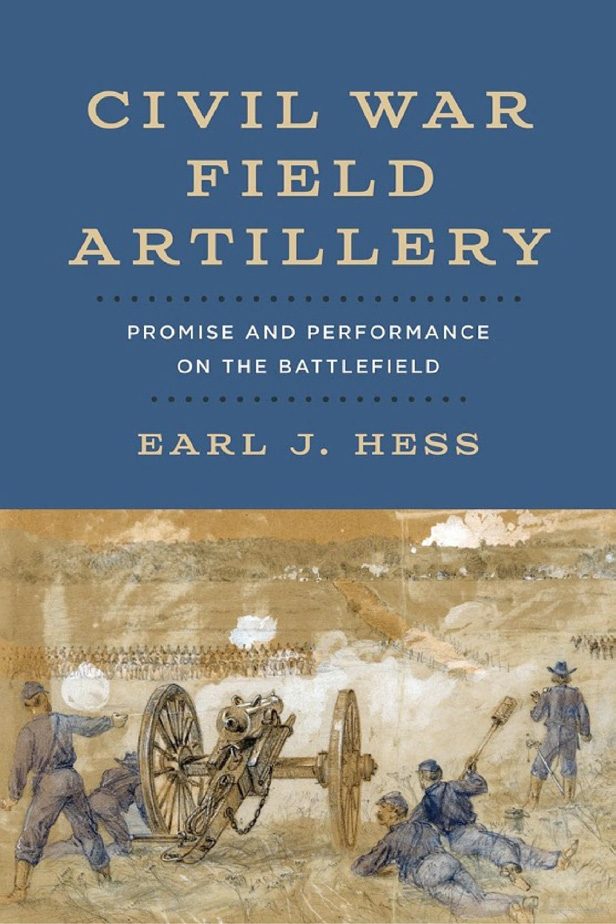
Civil War Field Artillery: Promise and Performance on the Battlefield. By Earl J. Hess. Photos, notes, index, 440 pp., 2022. Louisiana State
Arguably no Civil War historian has been more prolific during the past few decades than Earl J. Hess. Known for the depth of his research, detailed analytical skills, and impeccabl writing, Hess has produced some of the most important scholarshi in the field and transformed the way historians think about personalities, campaigns and technology. Hess’s latest volume, the first in-depth and scholarly examination of field artillery during the conflict, i exception. The objectives of Hess’s volume are, as the author freely admits in the introduction, “to in much of the historiographical omission” about field artillery and to analyze “its effectivenes in the field.” To meet the study
goals, Hess mined an exhaustive number of unit histories, battle reports, memoirs, reminiscences,
and archival collections. After providing a concise overview of the history and evolution of field artillery in
four centuries prior to the Civi War’s outbreak in the book’s first two chapters, Hess spends
a considerable portion of this handsomely crafted history
addressing various technical aspects of field artillery. Hess covers every conceivable topic including examinations of every type of cannon, the array of
shells fired, types of fuzes, and discusses every piece of hardware employed in an artillery battery. The author includes seventeen tables with information vital for any historian who writes about battles, leads battlefield tours, has the awesome responsibility of developing interpretation at battlefields. Tables include such useful information about each type of cannon, ranges, specifications of artillery shell and statistics about field artill in combat. Additionally, Hess offers a thorough exploration of how field artillery units were structured, organized, managed, and trained. Hess masterfully explores all the skills artillerists had to proficiently learn, including cross training on every role, and procedures batteries employed to be prepared for battle and maintain combat readiness. Hess’s analysis of the various techniques units employed is fascinating. While target practic with live rounds proved one of the most valuable means of training, as it was the best way artillerists could improve their adeptness in estimating distance to target, the author illustrates that the desire for a battery to prepared for battle was always weighed against the cost of an artillery round and ammunition supply. Hess also explores the use of sham battles as a beneficial training tool. Althoug “comparatively rare,” Hess demonstrates how artillerists believed them beneficial and “stimulating.” The author’s explorat of training also includes the 261,672 horses who proved critical to any field artillery u success. While Hess recounts
the various qualities batteries sought in horses (including being
and weighing between 1,100 and 1,200 pounds), drilling methods,
and diet, the author explores the bonds that artillerists formed
with their horses. Drawing on the perspectives of artillerists such Lewis Sykes and Frederick Wild, Hess demonstrates how in “the process of training and serving
together, man and beast often developed bonds of affection.”
While the depth of Hess’s exploration into the myriad technical aspects of field artill makes this volume indispensable, the author’s deep analysis of the
effectiveness of types of artille magnifies this book’s worth. In a effort to challenge a long-standi convention that rifled cannon outperformed smoothbore guns, Hess analyzed hundreds of reports which revealed that the average maximum distance cannon fired in battle was 1,122 yards, well within the range of both types of guns. While technically accurate at a greater distance, the fact t batteries which employed rifled cannon in battle customarily did not fire at targets greater than 1,122 yards “fails to support,” in Hess’s estimation, previous assumptions “that rifles were hugely successful or were used in dramatically different fashion than smoothbores under battlefield conditions.” Another convention Hess convincingly challenges is that artillery dominated the battlefie during the conflict. Critical analysis of primary materials reveals that while the “long arm was important as support for infantry and cavalry,” artillery “did not dominate the battlefield consistently or clearly.” While there are certainly exceptions to this and Hess is careful to point out that the psychological impact the presence and sound of artille had on troops, the author argues compellingly that various factors including ability of gun crews, quality of ammunition, and the natural environment oftentimes limited field artillery’s overall usefulness in battle. Accounts from figures such as Confederate generals Daniel Harvey Hill and William Hardee bolster Hess’s assertion. Once again Earl Hess has produced a masterpiece of scholarship that is engagingly written, exhaustively researched,
and accessible. Hess’s study immediately becomes single most important volume
for anyone to consult when desiring an understanding of any conceivable facet of Civil War field artillery.
Jonathan A. Noyalas is director of Shenandoah University McCormick Civil War Institute in
Winchester, Virginia, a professor in Civil War Era Studies at
Shenandoah University, and founding editor of Journal of the Shenandoah Valley During the Civil War Era. He is the author or editor of fifteen books
including most recently Slavery and Freedom in the Shenandoah Valley during the Civil War Era, published by the University Press of Florida.
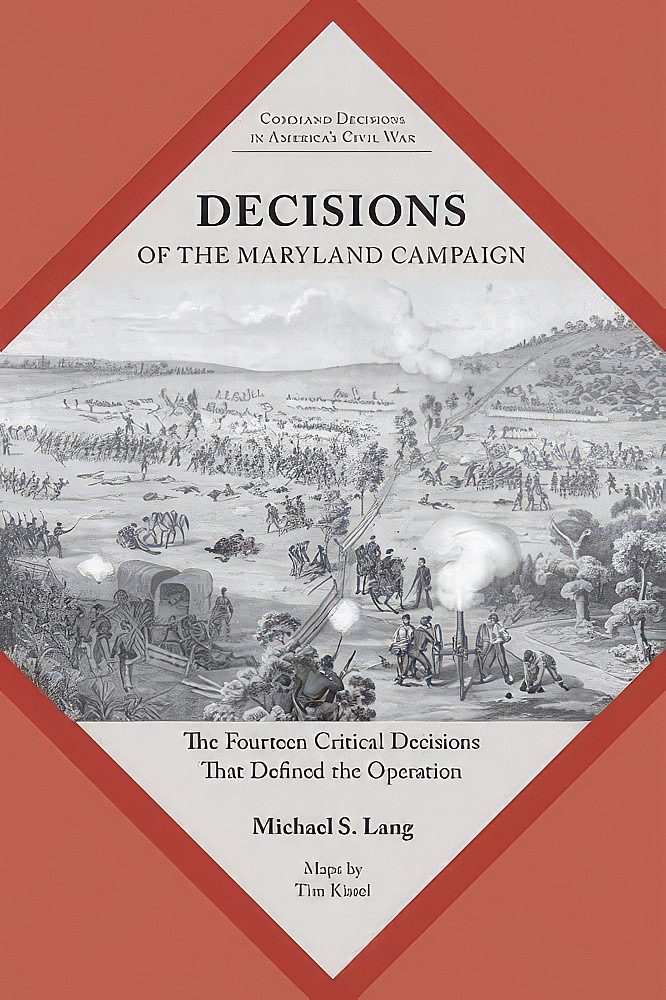
Decisions of the Maryland Campaign: The Fourteen Critical Decisions That Define the Operation. By Michael S. Lang. Appendices, Photos, Illustrations, Maps, Notes Bibliography, Index. Universit
As with many books of this type, the scenario deals with premise of “what if.” However, this volume seems to present the scenario of ‘what was’ and perhaps, ‘what could have been The author indicates, early on that this presentation is for students who are familiar with the events and not the novice. The text on the campaign is relatively short. It consists three chapters and a conclusio comprising 140 pages of the book’s 322 pages. Little time
– The Half Shell Book. For more information and how to order visit
spent on actual battle informatio but rather on its reasoning and results. If the reader is interes in combat results I suggest you peruse the authors companion volume in this series, The Battle of Antietam. Mr. Lang does a very creditable job in presenting the mindset of the principals as to why they made decisions. He even includes an alternative scenario/decision following the results of the actu decision. This is done with a minimum amount of speculation. I found this to be a fair and balanced presentation. Although I am not an admirer of McClellan’s ability as a field commander, I think the author does justice to decisions during the campaign. Perhaps the best and most valuable section of the book is the driving tour of the decisions This gives the reader the ability to follow in the footsteps of the participants and gain a clearer understanding of the decisions made. I plan to do this on my nex visit. Overall, I recommend this book to all students of the Maryland Campaign. I also suggest you read his companion volume on the Battle of Antietam in order to obtain a fuller perspective of events. I plan on doing just that
Joseph Truglio, of Manchester, N.J., is a retired Motion Picture Technician who has a lifelong interest in the Civil War. He is past President of the Phil Kearny CWRT in N.J.
Engineering in Confederate Heartland. Larry J. Daniel. Photos, illustration index, bibliography, appendices 204 pp., 2022. Louisiana State University Press. https://lsupr
Military history has always been an all-inclusive subject covering far more than just the
bugles and bullets of a militar engagement. Leadership, morale, medicine, logistics, and a host of other aspects of war are equally important in determining the outcome of battles, campaigns, and wars.
Civil War & Military Show 2023 • SATURDAY April 22 Sept. 23
1,000’s of Civil War T Revolutionary War • Spanis
Indian Wars • Mountain Me Collector Arms • Fur Trade
Rebel Engi One of the most important aspects often overlooked is engineering, the subject of Larry J. Daniel’s Engineering in the Confederate Heartland. Daniel, a noted and prolific Civil War historian, is well known for his studies Western Theater studies. This volume seeks to place the experiences and contributions of Confederate engineers into proper perspective. Daniel places his examination primarily within what historian Thomas L. Connelly called the Confederate Heartland, which included Tennessee, north-central Alabama, north-central Georgia, and northeast Mississippi Daniel expands this area a bit to include parts of Louisiana and Vicksburg where engineering proved critical to the republic’s war effort. He argues rightly tha engineers played a key role in the campaigns stretching across this vast expanse and details the exploits in both chronological and thematic chapters. For example, he points out the important contributio of Confederate engineers to
defending the Cumberland, Tennessee, and Mississippi
Rivers early in the war. He goes on to discuss the critical effort of engineers out in the field on campaign, especially in relation to building bridges and pontoons.
Daniel’s work will offer studen of the war a chance to learn abou
ng key figures in engineering who are often overlooked. Names such as Andrew “Asa” Gray, Minor Meriwether, Bushrod Johnson, Jeremy Gilmer, David B. Harris, Lemuel P. Grant, Martin L. Smith, and Samuel L. Lockett are primarily known only to those who read widely in the history of the period. The author delves deeper to examine the reorganization of t Confederate engineering corps in 1863 and offers readers an interesting analysis of Souther efforts to produce accurate map Indeed, Andrew Jackson Riddle’s
maps is a captivating story of ingenuity and necessity. Daniel also includes a glossa of engineering terms, extensive notes, and a bibliography, as w as two appendices listing all t Rebel engineers he could locate and the civilian occupations of some of those who served in the Confederate engineering regiment assigned to the Wester Theater. Scholars who wish to continue exploring the subject will find Daniel’s work here
valuable in their endeavors. Considering the herculean
efforts of Southern engineers to devise the near impregnable defenses of Vicksburg and Atlanta, the skill of the ponto that allowed Hood’s misguided
campaign even to function, and the countless unassailable fiel
works constructed throughout the struggle for the Heartland, one can’t help but be awed by their accomplishments. Daniel goes beyond demonstrating their achievements, however, to challenge the notion that these engineers were not skilled professionals and were often incompetent. Contrary to these claims, he finds them to be crit to the Confederate war effort. Engineering in the Confederate Heartland is not a dynamic page turner the casual Civil War afficionado will want to read. There are no dramatic charges or gut-wrenching tales of sacrifice and valor. Instead, the volume offers students of the war a deeper understanding of a small but important group of engineers and sappers who played a vital role in allowing the Confederate army to wage a war against a numerically and logistically superior foe. More information i available on Union engineering efforts. For example, see Thomas F. Army, Engineering
Publishers/Authors Send your book(s) for review t
520 Folly Road, Suite 25-379 Charleston, SC 29412
Victory: How Technology Won the Civil War (Baltimore: Johns Hopkins University P 2016). Daniel’s work joins James L. Nichols’s Confederate Engineers (Tuscaloosa, Alabama: Confederate Publis Company, 1957) as the major studies of the Rebel side. Nich work is small at 122 pages, but when studied in conjunction with Daniel’s monograph, one would come away with a solid grasp of the subject. Daniel has written an important work for those interested in a deepe understanding of Southern effor to defend the Heartland, and it adds to his reputation as one o the foremost scholars of the fi
John D. Fowler, Ph.D., is the author of several books and articles on the Civil War Era. He is the author of Breaking the Heartland: The Civil War in Georgia. He is currently a Professor of History at Dalton State College.
es & Belts fied Relic & Document & Head Gea & Currency Flags
ar Show rgia Trade Ingle Park GA 30720 & 5, 2023