analysis of the latest and mos scholarship. Contact email: Bo
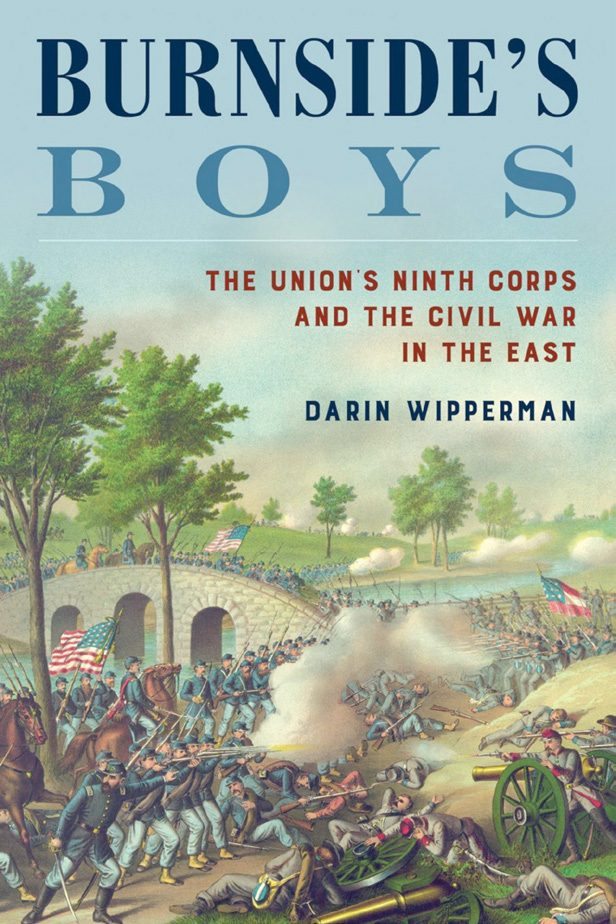
Burnside’s Boys: The Union’s Ninth Corps and the Civil War in the East. By Darin Wipperman. Photos, maps, notes bibliography, index. 510 pp.,
The IX Corps’ nucleus came from General Ambrose Burnside’s 1862 expedition in the Carolina Sounds. After thi successful campaign, they and other regiments were formed into the IX Corps in time to j General John Pope’s Army of Virginia for the Battle of Sec Bull Run. One of their most memorable battles occurred at Antietam where, as part of the Army of the Potomac, they suffered nearly 25 % casualtie at Rohrbach’s Bridge, now bett known as Burnside’s Bridge.
e our readers with timely ificant Civil War research and
They were actively engaged in the disastrous Battle of Fredericksburg, where Burnside commanded the Army of the Potomac. The corps found itself again under the immediate command of Burnside in the Western Theater. The Ninth was called “a wandering corps” because they covered more ground than many. Since Wipperman’s book is concerned with the Civil War in the East, the Ninth’s Western experience covered only briefly. When the Ninth returned to the Army of the Potomac, they took part in the costly Overlan Campaign, then the siege of Petersburg. The Battle of the Crater, a highly promising engagement that turned into a disaster, spelled the end of Burnside’s Civil War career. Wipperman’s bibliography is extensive, and he skillfully le the soldiers in the IX Corps te their experiences in battle, on march, and in camp. The soldier accounts bring an excellently recounted story to life. Burnsi Boys belongs on every bookshelf of those with special interest the campaigns and battles of th Army of Virginia and the Army of the Potomac.
Robert L. Durham is retired from the Defense Logistics Agency. He is a freelance write who has had many articles published in numerous historica publications. A life-long histo buff, he recently went back to college for his history degree.
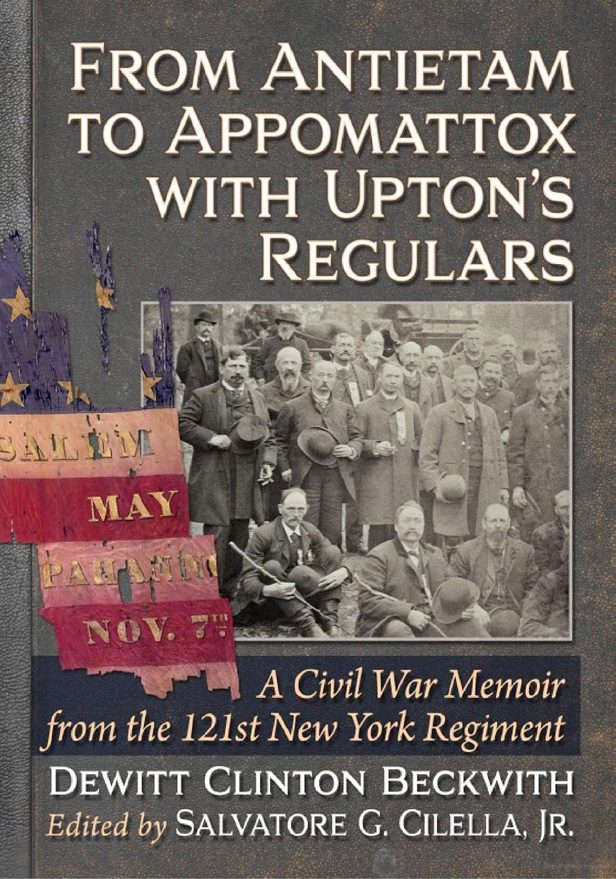
New Yorkers at War: A Memoir From Antietam to Appomattox with Upton’s Regulars: A Civil War Memoir from the 121st New York Regiment, by Dewitt Clinton Beckwith. Edited by Salvator G. Cilella Jr. McFarland Publishers
In August 1862, the 121st New York Infantry Regiment was mustered into Federal service. I joined the Army of the Potomac just after Antietam, and served the way to Appomattox. Behind a regiment’s record, though are the vastly more interesting writings of its offi and men. One of them was Cpl. Dewitt Beckwith of Utica, New York. He enlisted in the 91st New York in November 1861 at the age of 15. Nine months later Beckwith joined the 121st and stayed with it throughout the wa Decades later, as many soldiers did, he wrote his memoirs, which were published in his hometown newspaper, the Herki Democrat, from July 1893 to July 1894. Enter Salvatore Ci of Atlanta, who discovered Beckwith’s memoir while writing Upton’s Regulars: The 12st New York Infantry in the Civil War (2005). He saw that it was worth publication, deeming it “colorfu and entertaining.” It is. In his Introduction, Ci warns that “Beckwith’s thirtyyear-old memories are to be take carefully.” Most of us know this about soldier reminiscences, whose value lies really in the charm of their composition and the value, including readerly interest, of their contents. On these criteria, From Antietam to Appomattox with Upton’s Regulars sh Soldiers’ memoirs are meant to be anecdotal, and Beckwith’s is chock-full of ‘em. Early in
the war, when his regiment was stationed for a while at Key Wes he describes the icky feeling when “one of those darting chameleon lizards would slip up your trousers leg” or a borer cr crawled over you at night. Beckwith’s term with the 91st was limited, and he mustered into the 121st as corporal in August of ’62. “In these days,” recalls, “our ranks were full, o uniforms bright, our faces clean and untanned.” But not for long. The regiment missed Antietam, but just barely; Beckham arrived on the battlefield before all of the dead were buried. “The weather being extremely hot,” he observes, “gases formed and the corpses swelled up to enormous proportions….eyes would bulge out from the sockets,” while among the bodies “many had burst.” Such was Beckwith’s firs encounter with war: “everything seemed quite different to me fro what it did when hearing the war speeches.” In camp the men drank “dirty, muddy and polluted water” and soon succumbed to dysentery and diarrhea, which proved deadly. “The romance of war had departed forever,” he declares, with understatement. Thinned by disease and desertion, the 12st did not char at Fredericksburg, but was heavily engaged on the third day of Chancellorsville (97K/ MW of 453 men). Beckwith avoids critiques of McClellan, Burnside and Hooker, but is sort of snarky when he writes that Stonewall Jackson was killed at Chancellorsville while “cruising around to find an opening to make another of his slapdash movements.” He is able to slough off Hooker’s defeat, although of the XI Corps’ skedaddle on May 2, he quips that the Germans could claim that they “runs mit Howard and fights mit Sigel.” The New Yorkers saw no action at Gettysburg, but were bloodied at Rappahannock Stati November 7. (“I heard a number of our men say that they were no particularly anxious to get into another such scrape.”) I couldn’t help thinking of Kat, the cagey old veteran in All Quiet on the Western Front, and his advice to young Baumer when I read how Col. Emory Upton, Beckwith’s briga commander, upbraided his men for squirming under shellfire: “Stop that ducking, it’s foolish The shot that strikes you you will never hear.” By this time, Beckwith was a vet, to the point of knowing that a blanket roll
across the chest “afforded some protection, because a bullet would not have much force after passing thro’ it.” And by this time, veterans knew as much about tactics as their officers, a evidenced by Beckwith’s disgust with orders which called for “the old result over again, no doubt, o assaulting fortifications manned by veteran troops, skilled in thei defense.” The 121st was part of Upton’s famous charge at Spotsylvania, May 10, 1864. With losses of 49 killed, 106 wounded out of 346 muskets, “a splendid regiment had been nearly destroyed,” he judges. Yet on they fought, under Sheridan in the Valley. Beckwith was at Cedar Creek and witnessed his comrades’ flight from Early’s surprise attac (“They were simply insane with fear”). During the winter the unit was transferred to the Petersburg trenches, from whence the New Yorkers marched on to Appomattox. Upon word of Lee’s surrender, Beckwith saw “grave and dignified General officers behave like mad men, and cut up antics that would have made a reputation for a circus clown.” Cilella’s endnotes add even more value to the Beckwith’s remembrances, confirming them when factually correct, but calling them out when they’re not. Subjects can be both big and small. When the corporal was cutting brush for an open-air bed, “I felt a burning sensation run up my left arm. I let go the bush to see what was the trouble and saw it was swarming with large, black pismires.” (Editor’s note: ants.) Beckwith was with the 121st when it was mustered out on July 4, 1865. During the course of the war the regiment had enrolled 1,426 men; of them 347 died. As for the lucky survivors, Beckwith concludes by sagely commenting, “there is a mystic bond between soldiers, men who have shared battle, privation, and hardship together, not to be found in any other association.” You can almost feel that “mystic bond” in the cover photograph of Cilella’s fine new work. When they held a regimental reunion at Gettysburg in 1893, Dewitt Beckwith was there, as he is pictured with Van Dyke beard, top hat, walking stick and all. He had not only survived the war; he had prevailed.
Stephen Davis, of Cumming, GA, has been writing on the war for decades. His latest work is an edition of Georgian Eliza “Fanny” Andrews’ memoir (Mercer, 2023). November 2023
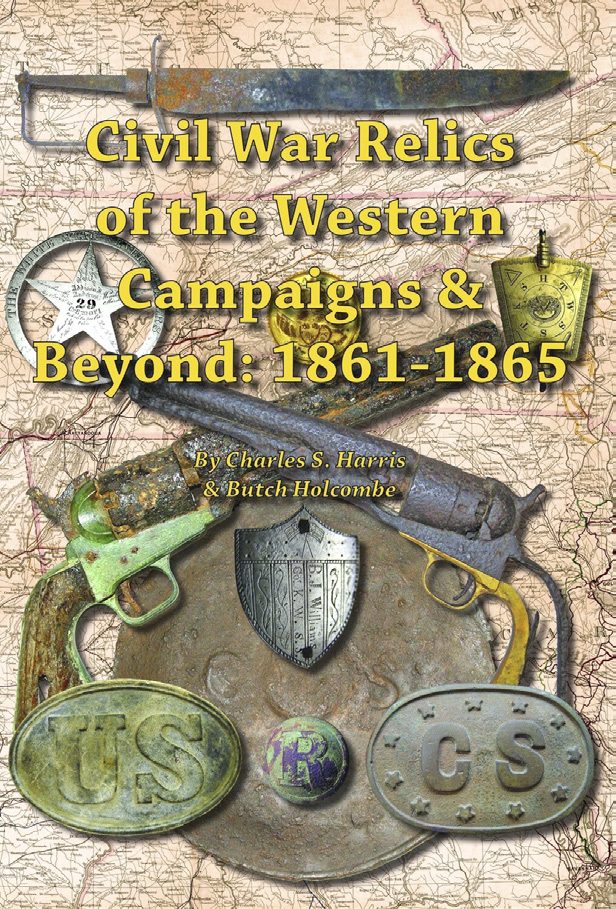
S. Harris & Butch Holcombe. Greybird Publishers, 245 pages.
This book is an exemplary tome that serves as a magnum opus for enthusiasts, historians and relic hunters with a keen interest in the Civil War. Harri a seasoned authority in the field, masterfully presents an all-encompassing examination of artifacts left behind during the tumultuous years of the Civil War, focusing on the less commonly covered Western Campaigns. The schol precision and attention to detai make this book a remarkable addition to the historiography of the American Civil War. From the onset, the book delves into the provenance and historic significance of relics ranging f firearms, uniform accouterments, and personal items to ephemeralike letters and diaries. Harris Holcombe deploy a chronological framework, tracing the path of battles and skirmishes through the Western front. The timeline not only lends context but allow
the reader to follow the war’s progress and its corresponding
material culture coherently. While many books about the Civil War focus on the battles o
the leaders, Harris’ work shines a light on the very personal aspects of the war, captured in the relics that have survived. H eloquently bridges the temporal gap, offering readers a tactile link to the past. The quality of the accompanying photographs is striking, allowing even the most minute details to be observed.
replete with its historical cont is executed so meticulously that
one might feel as though they ar November 2023
experiencing a curated museum exhibit through the book’s pages What sets this book apart is Harris’ inclusion of ‘Beyond’ in the title. Not content with merely showcasing artifacts, the book delves into their post-war journey, exploring how they have been discovered, preserved, and even manipulated in some cases. This provides a fascinating laye to the narrative, contributing to ongoing discussions about historical memory and the ethics surrounding relic collection. The textual content is enriched by first-hand accounts, military dispatches, and diary entries, making the narrative factual and emotionally resonant. As a reade you aren’t merely observing a collection; you are engrossed in the lives of those who once possessed these items. One canno underestimate the value of such a perspective in understanding the profoundly human aspect of a conflict that has defined America’s collective memory. The prose is both articulate and accessible, appealing to a broad audience. The author avoids the pitfall of academic jargon, ensuring that the book is inviti for amateur historians and exper alike. In conclusion, Civil War Relic of the Western Campaigns &
compelling, visually stunning, and rigorous exploration of the Civil War’s material culture. Co-authors Charles Harris and Butch Holcombe have crafted a masterful book that serves as both a historical record and a tribute to the lives impacted by the war. This book deserves a spot on the shelf of anyone who seeks a comprehensive and deeply engaging study of Civil War artifacts, particularly the
lesser-explored aspects of its Western Campaigns.
Melton is an avid collector and the publisher of specialized periodicals such as Civ
War News, The Artilleryman Magazine, the Military Antique Collector Magazine, and the Colt Collectors Association’s The Rampant Colt Magazine. Additionally, he has authored three books on Civil War artille projectiles, including his lates 392-page, full-color volume, Civ War Artillery Projectiles: The
is a comprehensive resource for scholars, collectors, and histor
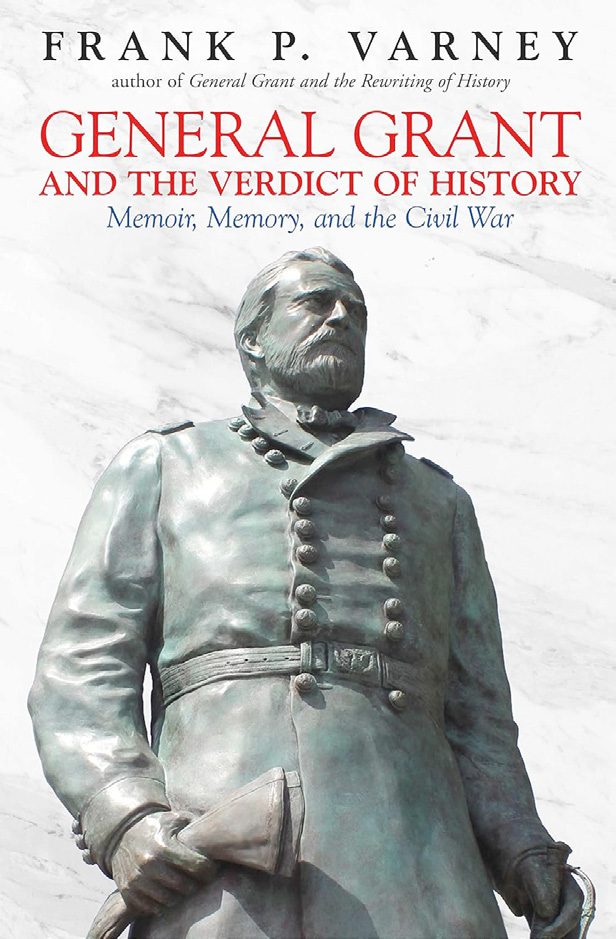
Author Pulls No Punches General Grant and the Verdict of History: Memoir, Memory, and the Civil War. By Frank P. Varney. Maps, photographs, appendices footnotes, bibliography, index. 226 pp., 2022. Savas Beatie,
The book under review is the second volume of a twopart work by Frank Varney. It follows General Grant and the Rewriting of History, published by Savas Beatie in 2013. Volume I examines the military record Maj. Gen. William S. Rosecrans and discusses history’s view of this record, a generallynegative view largely shaped by the memoirs and other writings of Gen. Ulysses S. Grant. This negative view is unwarranted. Varney argues with evidence from various sources, especiall Grant’s dishonest accounts of Rosescrans’ actions at Iuka, Corinth, Chickamauga, and Chattanooga. In General Grant and the Verdict of History, Varney pick
up where he left off and consid Grant’s treatment of three othe
officers. Joseph Hooker, George H. Thomas, and Gouverneur K.
Warren were all major generals who, like Rosecrans, served par of the war under Grant and who,
Varney asserts, were all victim of Grant’s malice. The portrait of Grant painted by Varney is that of a man who held grudges, hogged credit for himself, dismissed and belittled the accomplishments of others, blamed others for hi own mistakes, and tailored his accounts of successful operatio
that all went according to his masterful plan.
and Thomas at the Battle of Chattanooga. If you think that Hooker’s assault on Lookout Mountain was a difficult thing to pull off and one that contributed to the Federals’ success, you nee to listen to Grant. In an intervi he said, “There was no such battle, and no action even worthy to be called a battle on Lookout Mountain.” Did Grant order the assault on Missionary Ridge? Most accounts say that after taking the rifle p as ordered, the men in Thomas’s Army of the Cumberland charged on their own accord. Not in Grant’s version. He wrote that they were “effectually carrying out my orders of the 18th for the battle and of the 24th for th charge.” Was Thomas slow, always slow, ponderously slo Grant said so again and again. Thomas’s refusal to attack at Nashville until he was ready was not due to atrocious weather and supply problems. It was just the general’s dilatory habits. Grant planned to fire him but could not very well do that after Thomas’s smashing victory in a battle that all but destroyed the Confederate Army of Tennessee. Warren paid the heaviest price for earning Grant’s disfavor. After his corps helped win the Battle of Five Forks, Warren was stunned to find himself abruptly stripped of command. No court of inquiry was convened until 1879. The discussion of this court is, perhaps, the most interesting par of Varney’s book. Lieut. Gen. Philip Sheridan, who “was doing Grant’s bidding” when he axed Warren, testified, as did Preside Grant, two years or so out of office. Grant’s testimony was less interesting than Sheridan’s. The ex-president was evasive, repeatedly using phrases like “I
not recollect.” Sheridan was less evasive and attempted to defend
the decision to dismiss Warren. He was not persuasive. The officers on the court determined that the action Sheridan took in
Original Colonial, Revoluti Antebellum & Civil War, Doc Orders, Newspapers, Images,
removing Warren from command was not justified. The members the court knew that Sheridan wa in line to succeed Sherman as Commanding General of the U.S. Army. He did so in 1883.Warren never learned that he had been exonerated. He died before the court’s decision was published 1881. Frank Varney does not pull his punches. Regarding Grant’s various statements and actions, the author uses phrases such as “disingenuous,” “false legend,” “patently untrue,” and “pattern of deceit.” He discusses the historiography as well as the history and points out instance in which historians should have examined Grant’s writings with more critical eye. Varney presents arguments based on government records and accounts written by the princip actors and others who were present and wrote about what they did, heard, and observed. The notes are where they belong at the foot of the page, for th convenience of the careful read Moreover, the book ought to be read with care. It is not for t novice, but for readers who already know the plot and the characters in the drama.
Gould Hagler is a retired lobby living in Dunwoody, Ga. He is a past president of the Atlanta Civil War Round Table and the author of Georgia’s Confederate Monuments: In Honor of a Fallen Nation, published by Mercer University Press in 2014. Hagle frequently speaks on this topic and others related to different aspects of the Civil War and has been a regular contributor to CWN since 2016. His email is
Civil War Sharpshooters A Power American Civil War 1861-65: Combat, Union Sharpshooter versus Confederate Sharpshooter By Gary Yee. Photos, illustrations, maps, notes, select bibliography, index. 80 pp., 2019.
Gary Yee’s book is one in an Osprey Combat series evaluating British infantrymen versus Zulu warriors, Continental versus Redcoat, and others. Prior to t I read one comparing Confederat versus Union cavalrymen, which I found compelling. I also foun this contrasting study of Civil War sharpshooters to be of grea interest. Yee describes the origins of sharpshooter companies and battalions and their recruitmen and training. His book contains copious notes on the various types of rifles and scopes used by sharpshooters on both sides. Officers in the Union army were the first to see the value of dedicated sharpshooters, such as Berdan’s 1st and 2nd US Sharpshooters, the 1st and 2nd Andrew Sharpshooters, and Birge’s Western Sharpshooters. Unlike the Union, Confederat
Civil War Artillery Projec – The Half Shell Book. For more information and how to order visit
ng Overdue Biography did not raise sharpshooter battalions at the beginning of the war, instead relying on the flank companies as skirmishers. However, calling on the same companies to serve as skirmisher tended to tire the men. Skirmishers did not fulfill the need for men devoted to the duty of sharpshooting. It was not unt May 1862 that the Confederate Congress mandated that each brigade raise a sharpshooter battalion. Sharpshooter vers Sharpshooter uses the battles of Fredericksburg, Vicksburg, and Battery Wagner to show the value and practices both sides placed upon sharpshooters pitted agains each other. Battery Wagner saw the most sophisticated use of sharpshooter battalions. The Southerners were armed with Whitworth rifles, imported from England through the blockade. Their efficiency hindered Federa siege operations and obliged them to establish their own sharpshooter companies. The Union soldiers were armed with Springfield rifle muskets, significantly inferior to the Whitworth at longer distances. However, as the Yankee trenches grew closer to the Battery Wagner defenses, the Whitworth lost much of its advantage. The Whitworth had a slower rate of fire, so, in the end, most were sent to the rear and replaced wi Enfields. Yee’s book is well done and highly informative, with the excellence of the other books in the Combat series.
Robert L. Durham is retired from the Defense Logistics Agency and is a freelance writer with many articl published in numerous historical publications. A life-long histor buff, he recently returned to college for a history degree.
A Brief Moment in the Sun: Francis Cardozo and Reconstruction in South Carolina By Neil Kinghan. Photos, notes, index, 272 pp., 2023. Louisiana State University Press, lsupress
At the time of his death in 1 Francis Cardozo was lauded for his many contributions to Africa American education and efforts to ameliorate conditions for blacks during Reconstruction in South Carolina. A newspaper in the nation’s capital noted in mi June 1903 that Cardozo possessed “unselfish devotion to duty” and a “genuine love for humanity, as well as an unyielding purpose to make the world better.” While Cardozo is not a figure foreign historians of Reconstruction, hi is certainly not a household nam Fortunately, Neil Kinghan’s elegantly crafted and deeply researched biography rescues Cardozo from obscurity and places him among his rightful place as an important figure in postwar era. A free black, born in Charles South Carolina, in 1837, Cardozo lived a life uncommon for most mid-nineteenth century African Americans. In 1858 Cardozo departed the United States to st at the University of Glasgow. Over the the next six years, in addition to Glasgow, Cardozo’s
educational pursuits took him to Edinburgh and London. When he returned to the United States in 1864, he became minister at the Temple Street Church in New Haven, Conn. While Cardozo could have remained in New
Haven, the author argues that Cardozo was not content in the
Civil War’s aftermath to remain in Connecticut when he believed
he could better serve his race i the state of his birth. The book’s core focuses on Cardozo’s time in South
Initially, Cardozo’s desire to aid in educating Palmetto State African Americans prompted him to apply to the American Missionary Association for a teaching position. When he arrived in South Carolina in the summer of 1865 as principal of the Saxton School, Cardozo confronted the same challenges anyone associated with most Freedmen Schools. The author does a remarkable job detailing how Cardozo created a stable learning environment, expanded the Saxton School’s enrollment, and attempted to win support for his school among the local white population. The author rightfully concludes that the ke to Cardozo’s success was his pragmatism. Although Cardozo personally desired immediate integration of public schools, he understood it might deepen animosity among whites. Instead, Cardozo believed that prejudice could be effectively rooted out young children of various races, ages five to six, were encourage to mingle with each other. Over time Cardozo believed this practice would end racial animosity. Cardozo’s leadership education quickly caught the attention of Republicans and catapulted him, in the election of 1868, to become South Carolina’s secretary of state. Cardozo’s victory marked him as the first African American elect to state office in the nation. W the author details Cardozo’s tim as secretary of state and state treasurer, following his victory in the election of 1872, Kinghan clearly demonstrates Cardozo did not seek positions in government for selfish reasons, but rather aid African Americans and to do all humanly possible to eliminat corruption from the state’s government. Despite all that Cardozo achieved, the author illustrates “the destructive effects of raci
and white supremacy” in South Carolina, particularly following
Wade Hampton’s victory in the state’s 1876 gubernatorial election. Hampton’s redemption not only meant undoing gains made by South Carolina African
Americans since 1865, but also brought vengeful actions against African American politicians, including Cardozo. Hampton’s government erroneously charged Cardozo with fraud, the very thing which Cardozo fought while in office. A court found Cardozo guilty. Despite the verdict and imprisonment Kinghan reveals Cardozo’s resiliency. While the author illustrates, and understandably so, that this marked “one of the lowest points of his life,” Cardozo moved to Washington, D.C., with his family, and started anew after being pardoned by Governor William Simpson on April 23, 1879. After working in the Unite States Treasury Department until 1884, Cardozo returned to his roots as an educator and enjoyed a modicum of success throughout the remainder of his life in var positions including principal at D.C.’s M Street High School. While Kinghan’s biography vividly chronicles Cardozo’s lif one guided by the importance of service to others, this volum offers more than a recounting of how one man attempted to ameliorate the lives of so many while assuming great personal risk in the process. Kinghan’s masterful study offers much insight into South Carolina’s Reconstruction and unimaginable challenges African Americans confronted there after 1876. This outstanding book, one I highly recommend, indeed gives Cardozo the recognition he deserves and is a must for an student of Reconstruction.
Jonathan A. Noyalas is director of Shenandoah Universit McCormick Civil War Institute in Winchester, Virginia, a professo in Civil War Era Studies at Shenandoah University, and founding editor of Journal of the Shenandoah Valley During
the Civil War Era. He is the author or editor of fifteen book including most recently Slavery and Freedom in the Shenandoah Valley during the Civil War Era, published by the University Press of Florida.
The fall of Atlanta in September of 1864, along with the Union capture of Mobile Bay the previous August and the burning of the Shenandoah Valle (August-October), convinced a war-weary Northern populous that the United States could an would defeat the Confederacy an subsequently propelled Abraham Lincoln to a second term as
president. Lincoln’s victory, f all intents and purposes, ended the Confederacy’s only real remaining hope for a negotiated peace and independence. Still,
while Robert E. Lee’s veterans held on to Richmond and Petersburg, Confederate General John Bell Hood sought to regain the initiative in the Western Theater and recapture Middle Tennessee.
Hood’s campaign to retake Middle Tennessee, especially the key city of Nashville, is t subject of Mark Lardas’s and Adam Hook’s volume for the Campaign Series of Osprey books. Anyone familiar with Osprey Publishing knows that they are a premier publisher of short yet well-written and profusely illustrated works on variety of military subjects. T volume is no exception. The author and illustrator are skilled veterans, and their expertise shows in this excellent work. Lardas, a naval engineer by training, has writt extensively about aircraft and
warships and authored over 50 books on military, naval, and maritime history. He has been deeply involved in the U.S. spa program, having worked as a
navigation engineer on the shut program. He is currently workin November 2023
on the Lunar Gateway program at the Johnson Space Center. Adam Hook studied graphic design and has been an illustrato since the 1980s. He specializes i detailed historical reconstructio and has illustrated numerous Osprey titles. His work is featur in exhibitions and publications throughout the world. This work is actually a reprint their 2017 volume; only the cover art appears to have changed. The text and the internal diagrams, maps, and artwork remain the same. Like most Osprey books, the writing style is clear and concise, and the illustrations, maps, and charts are abundant. Also, like most Osprey books, especially in their campaign series, the campaign is placed in a historical context, which means that readers are exposed to a wealth of information on the military/political situation in t conflict prior to the start and a the end of the subject campaign. Nashville 1864 begins with a look at the campaign’s origins and then provides a detailed chronology of events. The opposing commanders, forces, and plans are examined in detail. The bulk of the book is,
of course, Hood’s campaign for Nashville. This section covers
Hood’s initial movements in Georgia and Alabama, Nathan Bedford Forrest’s movements
and subsequent joining of Hood’s advance into the Volunteer State,
and the battles of Spring Hill, Franklin, and Nashville. The aftermath of the campaign for Nashville is covered, as is a short overview of the various battlefields. Finally, a very nic “further readings” section is
provided. This Osprey book, like others in the collection, serves myriad of functions. Battlefield visitors and casual readers will appreciate the text, maps, and general overview. More serious historians will appreciate how this volume fits with other Ospre American Civil War volumes to form a mosaic of the war. Wargamers and military history buffs will enjoy the battle maps and the artwork, especially the color illustrations. In truth, there is much here fo anyone interested in the Nashvill Campaign.
author of several books and articles on the Civil War Era. He is the author of Breaking the Heartland: The Civil War in Georgia. He is currently a
Professor of History at Dalton State College.
Black Blue Black Sailors in the Civil War: A History of Fugitives, Freemen, and Freedmen Aboard Union Vessels. By James H. Bruns. Illustrated, notes, bibliography, index, McFarland & Co., Publishers,
James H. Bruns does an excellent job of tracing the contributions of black naval recruits from the manning of the
blockade of Southern ports to the Mississippi River patrols. By
the spring of 1863, black sailors had become essential for naval operations. In the navy, the blac
recruits were accepted as equals, with integrated crews being the
rule rather than the exception. By early 1865, the Union Navy’s composition approached 35% African American. White officers frequently lauded their black crew as being obedient to orders, accepting shipboard discipline,
being self-reliant, havi exceptional endurance, and fighting like the devil. In total 18,000 black sailors fought for the Union, most enlisting from the mid-Atlantic states, and most eager to fight for their freedom. The Union Navy constantly needed new recruits as the blockade expanded a Mississippi River operations began. These new recruits were gleaned from free blacks, contrabands, army transfers, and young boys hoping to escape strict homes and seek their glory and riches. Secretary of the Navy Gideon Welles, an ardent abolitionist, welcomed their
service and appreciated their onboard work and the crucial information they supplied as to Confederate troop placements, ambushes, and water obstructions
so useful to protect Union shipping. Blacks would thus
ts participate in all major naval actions, including blockading harbors at Charleston, Savannah, and Wilmington. They also fought in the Peninsular Campaign at Vicksburg, Island No. 10, Port Hudson, and Forts Henry and Donelson. Individual black crew members achieved prominent positions such as pilot, and eve one, Robert Smalls, became the first African American to command a U.S. naval vessel. In fact, some naval vessels were almost entirely manned by black sailors, e.g., the USS General Grant, the USS Red Rover, the USS Cricket, and the USS Osage. Admiral Porter once boasted that the over 600 contrabands in his naval units on the Mississippi provided the crucial edge for victory. This ultimate Union victory allowed these black sailors to take advantage of the March 1865 Congressional Act, which granted freedom to their wives and children and along with their government pensions, begin a new life in freedom.
All other authors who have wri about Confederate BG John Bell Hood misplaced his location by approximately one half-mile.
Available as an Audible Audiobook, ebook and hardcover on Amazon
This book is exceptionally well-written, using voluminous personal accounts, pr service records, and sailor narratives to tell of their serv the Union. It covers major naval operations comprehensively and how black sailors became an indispensable Union ingredient for success on the water. It is highly recommended for any historian interested in naval operations during the Civil War, the crucial role of black sailor and the political, social, and economic impact of naval warfare on the defeat of the South.
Dr. Wayne L. Wolf is Professor Emeritus at South Suburban College and Past President of the Lincoln-Davis Civil War Roundtable. He has authored 23 books dealing with the war and numerous articles, including The Last Confederate Scout and Two Years Before the Paddlewheel. He is a frequent speaker on the lecture circuit.
This book went to #1 in three Amazon New Releases categories his is a must-read for anyone terested in one of the Civil War mpaigns.” – Scott L. Mingus Sr., thor of Unceasing Fury
urtis Older’s research on the Ba South Mountain re-examines and interprets the Maryland campaign nally quelling all further discu y Lee lost his first major battl ghly recommended.” – ARGunners.c
Civil War Swords federate D-guard Antique Firearms
Buckles & Belts Identified Relic tters & Document forms & Head Gea mages & Currency Flags
ivil War Show st Georgia Trade Tony Ingle Park alton, GA 30720 ary 4 & 5, 2023
Afraid of buying out you were stu Tired of continu and not finding