in his handling of his officers?” he asks; “the answer must be in the negative.” (That’s Freeman for you!) A somber element of Lee’s Lieutenants is seeing the army’ officer corps diminished and depleted by the trials of war. the high command lost officers through “constant and heavy attrition—by death, by disabling wounds, by intemperance and by incompetence,” General Lee struggled unceasingly to find capable replacements. “The connecting thread of thi book,” the author explains, “well might be that of the effo to create and to maintain competent senior officers.” It is through the eyes of these officers that we trace the course the war in Virginia. Freeman explains that his viewpoint is not so much that of Lee, “but that of the men executing his orders or making decisions for themselves.” The Seven Days, of course, are given much attention: twelve chapters, 170 pages. In assessing the generals’ performance, Freeman is both judicious and unsparing. “It was the high command that had failed” at Mechanicsville. “All the Federals had been called upon to do was to wait for the Confederates to come into range and then to mow them down.” As was his practice, after Gaines’ Mill the author evaluated the generals’ performance. “In the praise of the camps, highest honors went to Hood and his fine regiments”—it was the charge of Hood’s Texas Brigade that had cracked the Yankee line. Gregg, Trimble, Winder, Garland, Iverson: all are assessed for their roles that blo day. The lawyer Maxcy Gregg, for instance, “had given an unequivocal answer to the question whether he would make a soldier.” In Chapter XXXIII, “Magruder Stays Up Too Long,” an “anxiously awake” John B. Magruder fails to pursue the retreating enemy, fearing he is about to be attacked on June 29. Then Magruder envisions launching his own assault on enemy lines (that had already been abandoned). Knowing this, Lee playfully expressed hope that “Magruder would not injure the two engineers of Longstreet’s Division who already had crossed the river and had entered the fortifications.” It is here also that one sees a rarity: Fr takes a (fleeting) look at McClellan, at least “the Federal commander’s gross overestimate of the forces opposing him.” Freeman analytically approaches one of the campaign’s big questions: why was Jackson so slow in joining the fight at Gaines’ Mill, June 26? He concludes that after the rigor of the Valley, Jackson succumbed to “physical exhaustion and the resulting benumbment of a mind that depended much on sleep.” After the campaign, those lieutenants who had been found wanting Lee quietly removed, seeing to their transfer elsewhere. The excitable Magruder was sent west. Huger, a “do-nothing General,” was also shipped out. The deaf Holmes had proven listless; once during an engagement, as his staff frisked about, he calmly remarked, “I thought I heard firing.” Needless to say, Lee saw to his transfer a well. Mechanicsville, Gaines’ Mill, and Savage Station are all recounted; the slaughter at Malvern Hill is termed “a trage of staff.” Freeman sums up the Seven Days thus: “The strategic aim of the campaign had been achieved despite bad co-ordination, worse tactics and the worst imaginable 62 Civil War News Magazine | Sept.-Oct. 2024
staff work. Richmond had been saved.” But at what cost? C.S. casualties June 25-July 1 totaled 20,141 KWM (against McClellan’s 15,849). Volume One closes with the Seven Days. Complementing the text are twenty-nine artfully drawn maps by John T. Draper of Richmond. The author concludes with a look ahead. “All was well, but…but…John Pope was threatening to advance down the Orange and Alexandria Railroad against Jackson.” The stage was set for Volume Two. Reading Lee’s Lieutenants, one is mindful of Freeman speaking in his Foreword of his trilogy as “a labor of eight years” (1936–1944). Few achievements in Confederate historiography can match it. “One of the epic works on the Confederate armies,” David J. Eicher writes of the series in The Civil War in Books. His judgment that “these exhaustively researched and brilliantly written volumes deserve to be read by all Civil War students”9 stands as one of the most ringing endorsements I’ve ever seen. I don’t need to add anything more.
Endnotes 1. Douglas Southall Freeman, Lee’s Lieutenants: A Study in Command, 3 vols. (New York: Charles Scribner’s Sons, 1942-44 2. David E. Johnson, Douglas Southall Freeman (Gretna LA: Pelic Publishing Company, 2002), 15, 31, 57, 78, 85, 110, 325. 3. Douglas Southall Freeman, ed., Lee’s Dispatches: Unpublished Letters of General Robert E. Lee, C.S.A. to Jefferson Davis the War Department of the Confederate States of America 1862 1865 (New York: G. P. Putnam’s Sons, 1915); Douglas Southall Freeman, R. E. Lee: A Biography (New York: Charles Scribner’ Sons, 1934-35). 4. Volume One: Manassas to Malvern Hill (1942); Volume Two: Ced Mountain to Chancellorsville (1943); Volume Three: Gettysbur Appomattox (1944). 5. Stuart W. Smith, Douglas Southall Freeman on Leadership (Shippensburg PA: White Mane Publishing Company, 1993), 5-8. 6. Keith D. Dickson, Sustaining Southern Identity: Douglas Sout Freeman and Memory in the Modern South (Baton Rouge: Louisiana State University Press, 2011), 132, 260. 7. Ibid., 283; Johnson, Freeman, 350. 8. Stephen W. Sears, ed., Lee’s Lieutenants: A Study in Command (New York: Scribner, 1998). 9. David J. Eicher, The Civil War in Books: An Analytical Bibli (Urbana: University of Illinois Press, 1997), 333.
Stephen Davis has been writing about the Civil War for a long time—“since Jesus was in third grade,” he contends. He served as General Editor for The Reminiscences of General M. Jeff Thompson (Morningside, 1983), and from 1985 to 2005 worked as Book Review Editor for Blue & Gray Magazine. He is author of Texas Brigadier to the Fall of Atlanta: John Bell Hood (2019) and Into Tennessee & Failure: John Bell Hood (2020). With Bill Hendrick he wrote The Atlanta Intelligencer Covers the Civil War (2022). His next book, Confederate Triumph Volume One: 1861, begins his counterfactual narrative of how the South won the war. It will be out this summer. Steve and his lovely wife Billie reside in Cumming, Ga.
CIVIL WAR Book Reviews Civil War News book reviews provide our re with timely analysis of the latest and most Civil War research and scholarship. Contac
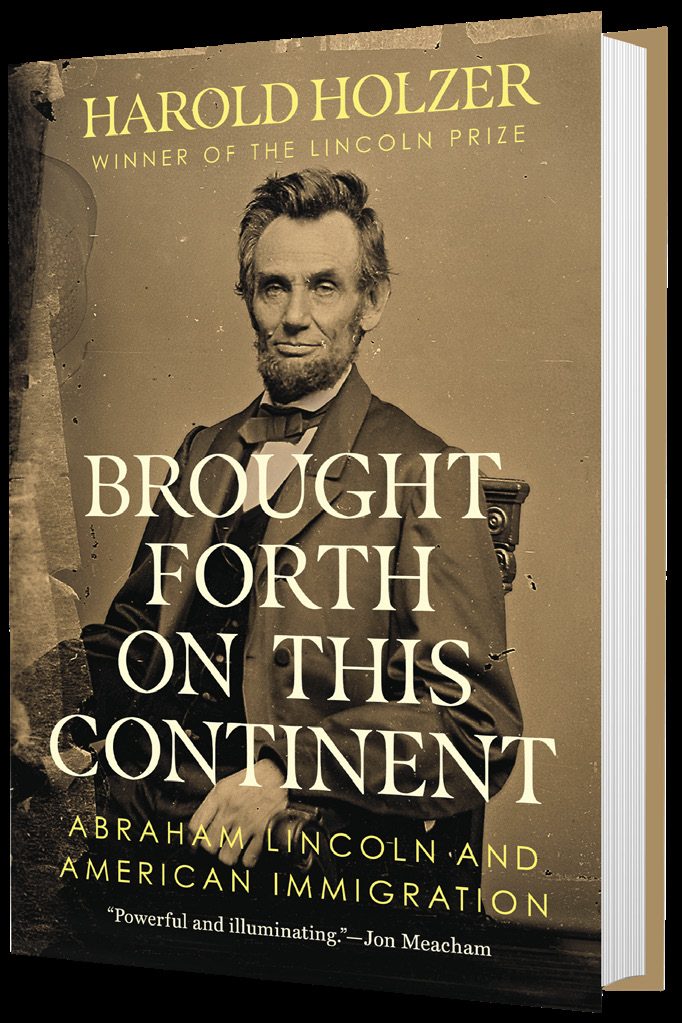
Brought Forth on This Continent: Abraham Lincoln and American Immigration. By Harold Holzer, notes, bibliography, index, 464 p., 2
In a timely and remarkably relevant examina Harold Holzer has crafted a new and important narrative of our 16th President and his relat immigrants and immigration. Originally a Whig
Lincoln was able to fend off the increasingly important role the Know-Nothings played in the party’s politics in preCivil War America. Eventually, Lincoln spoke out forcefully against the growing anti-immigrant wave sweeping across the nation. He perceived the need to cultivate the new citizens as potential supporters at the ballot box. The Whigs championed a strong central (but legislative) government and a weak executive. They favored subsidized national infrastructure projects such as roads, canals, a protective tariff, and a national bank. Many Whigs were staunchly anti-immigrant. During the 1840s, the Whig party pushed an ill-fated bill to limit, monitor, and tighte immigration policies, but new immigrants, including Catholics, aware of the Know-Nothing odor in the Whig party, tended to vote Democrat. Ironically, building infrastructure projects required manpower that was filled by Irish, German, Chinese, and other immigrants. As Holzer forcefully argues, after the 1844 anti-Irish riot in Philadelphia, Lincoln issued a statement in favor of lenient immigration policies. By 1852, Lincoln supported both European immigration and African emigration. He saw the political potential in these new citizens. In 1858, German American Heinrich Theodore Canisius, editor and publisher of Freie Presse in Alton, Illinois, supported Lincoln’s bid for senate. Moving to Springfield, he launched the Illinois Staats-Anzeiger and began running articles favorable to Lincoln. In return, when Canisius needed capital to keep the paper running, Lincoln secretly advanced
The paper eventually folded and Lincoln lost his investment. Lincoln rejected, as Holzer writes, “hostility to foreigne and Catholics.” He favored an easy path to naturalization stating that it should be “as convenient, cheap and as expeditious as possible.” He noted that the Constitution belonged “no less to the Catholic, than to the Protestant” and went on to insist that the Constitution “reprobate(s) an condemn(s) each and every thing in the Philadelphia riots, and the causes which led to them, from whatever quarter Civil War News Magazine | Sept.-Oct. 2024 6
they may have come.” Holzer concludes “Lincoln (was) out of step with his own increasingly nativist base, perhaps eve destined to become what might today be called a WINO (Whig in Name Only).” Throughout Holzer’s excellent treatment he argues that Lincoln depended on the immigrant vote, especially German support. It and the Irish vote were complicated and vacillated according to events on the battlefield and th national scene. Both populations were affected by the 1848 Revolutions in Europe and the potato famine in Ireland. Holzer goes to great lengths to show Lincoln’s dealings with the German American population in Illinois and the necessity of German American support there and during the Civil War. Colorful figures such as Franz Sigel, Carl Schurz and Alexander Shimmelfennig are constantly on and off the scene with plans, schemes, negotiations and deals. When the Union XI Corps, originally recruited by Sigel, folded at Chancellorsville under Stonewall Jackson’s flank attack, the anti-German attitude increased substantially. Holzer outlines the rocky road Lincoln walked with such characters including General Thomas Francis Meagher, commander of the Irish Brigade. Meagher originally supported the Confederacy; the fall of Fort Sumter changed his mind. The Irish support of the democratic party was related to emancipation which Irish working men despised. Although they supported the war effort to restore the union, Lincoln alienated them with the proclamation. The 1863 New York draft riots were the bloody manifestation of their rage. Yet in 1864, they voted for Lincoln. Perhaps the most outrageous figure drawn by Holzer is Dr. Issachar Zacharie, a British-born Jewish podiatrist. Possibl a fraud, Zacharie treated Lincoln’s foot corns and “designed comfortable boots to cushion the President’s enormous feet.” In gratitude, Lincoln wrote three endorsements of the good doctor’s work, to which the New York Herald snarked “The President has been greatly blamed for not resisting the [emancipation] demands of the radicals, but how could the President put his foot down firmly when he was troubled with corns?” In return, Lincoln sent Zacharie to New Orleans to rebuild loyalty to the Union. He traveled extensively garnering support for Lincoln’s re-election, while showering the President with “edible gifts,” hominy, bananas, and apples. Zacharie failed to convince the war department that he should be hired to treat the foot sore armies of the Union. That didn’t stop him from adopting the title: “Late Chiropodist-General, United States Army.” Lost in the flood of events of 1863, Lincoln’s annual message to Congress in December proposed an enlightened immigration bill to ease the path to naturalization for prospective new citizens. With that progressive step was an obligation for military duty. As Lincoln saw it, rights came with responsibility. Unfortunately, he did not live to see t bill come to fruition. Andrew Johnson signed it into law in June 1865. In coming full circle, Holzer points out it would be the last generous federal legislation until 1965 when Lyndon Johnson signed the Immigration and Naturalization act. What’s that cliché about history not rhyming, but repeati itself? 64 Civil War News Magazine | Sept.-Oct. 2024
Salvatore Cilella is the retired CEO of the Atlanta History Center. He is the author of Upton’s Regulars, (Univ. of Kansas Press, 2009). He has edited The Selected Correspondence of General Emory Upton, 2 Volumes. (Univ. of Tennessee Press, 2017). A recipient of the 2019 Founder’s Award, American Civil War Museum. He has edited “Till Death do us Part,” the love letters of Emory and Emily Upton documenting their brief and tragic twoyear marriage (University of Oklahoma Press, 2020) and the Memoirs of Dewitt Clinton Beckwith, of Upton’s Regulars, (McFarland Publications) Spring 2023.
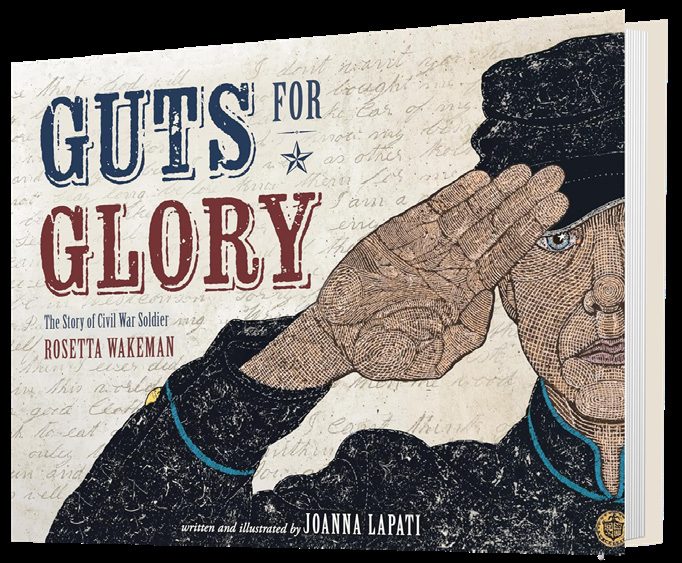
Guts for Glory: The Story of Civil War Soldier Rosetta Wakeman. Written and illustrated by Joanna Lapati. Drawings, glossaries, author’s note, 56 pp., 2024. Eerdman
As a senior at the University of Massachusetts Dartmouth in 2000, J o an n a Lapati began “randomly pulling books off the shelf” at her university library when she came across An Uncommon Soldier: The Civil War Letters of Sarah Rosetta Wakeman, alias Pvt. Lyons Wakeman, 153rd Regiment, New York State Volunteers, 1862–1864 (1994). Lapati became fascinated with Rosetta’s story and began earnestly researching the Civil War—attending reenactments, reading books, and painting miniatures. Knowing that several hundred women dressed as soldiers and fought for the Union and the Confederacy, Lapati attempted to join a reenactment group. “Sorry, wome soldiers are not authentic to the history of our regiment, was the reply. But the second unit she approached, the 22n Massachusetts Volunteers, permitted her to enlist. For six years Lapati learned about soldier life as a living histor and she incorporated her experiences into the artwork in h first book, Guts for Glory. Guts for Glory tells the story of Rosetta Wakeman, a yo woman living in upstate New York while the Civil War was raging. Bored by farm work and family responsibilities, writes Lapati, Rosetta “wanted something . . . different. wanted something more.” So one night the nineteen-year-old dressed in her father’s old clothes, bound her chest, cut hair, and ran away, now calling herself Lyons Wakeman. For
a time she found work transporting coal on the Chenango Canal, but she soon joined the 153rd New York Volunteer Infantry disguised as a man. On November 24, 1862, she
soon discharged. All the money I send you to spend it for t family in clothing or something to eat.” For two years Rosetta served in the Union army, first in Virginia and later in Louisiana. She participated in the Ba of Sabine Cross Roads on April 8, 1864. As Lapati describes it, Rosetta “stood shoulder to shoulder with her comrades, ready to face the enemy,” and she “did not falter under a storm of fire and lead. She held her position, pushing Confederates back.” A week after the battle, Rosetta wrote home, “I feel thankful to God that he spared my life. . . . pray to him that he will lead me safe through the field of battle and that I may return safe home.” Lapati concludes the book, “The war was not over, nor the risk of many more lives. But Lyons remained in the ranks, a place where she longed to be—supporting her family and serving her country.” Readers will find more details about Rosetta’s life in a note at the end of the book, such as that she died of dysentery at the marine hospital at New Orleans on June 19, 1864. The note, two glossaries, and a timeline also provide more information and context about the Civil War and the experiences of women—both civilians and soldiers—during that period of national upheaval. Lapati created the artwork using scratchboards, which sh hoped would “convey a gritty and difficult time in American history.” It is beautifully done and quite evocative. Taken together, Guts for Glory is a compelling picture book that will introduce young readers to an historical figure who is not typically be found in the textbooks.
Jonathan W. White is professor of American Studies at Christopher Newport University and the author or editor of 17 books, including My Day with Abe Lincoln (2024), an early reader chapter book about Abraham Lincoln’s youth.
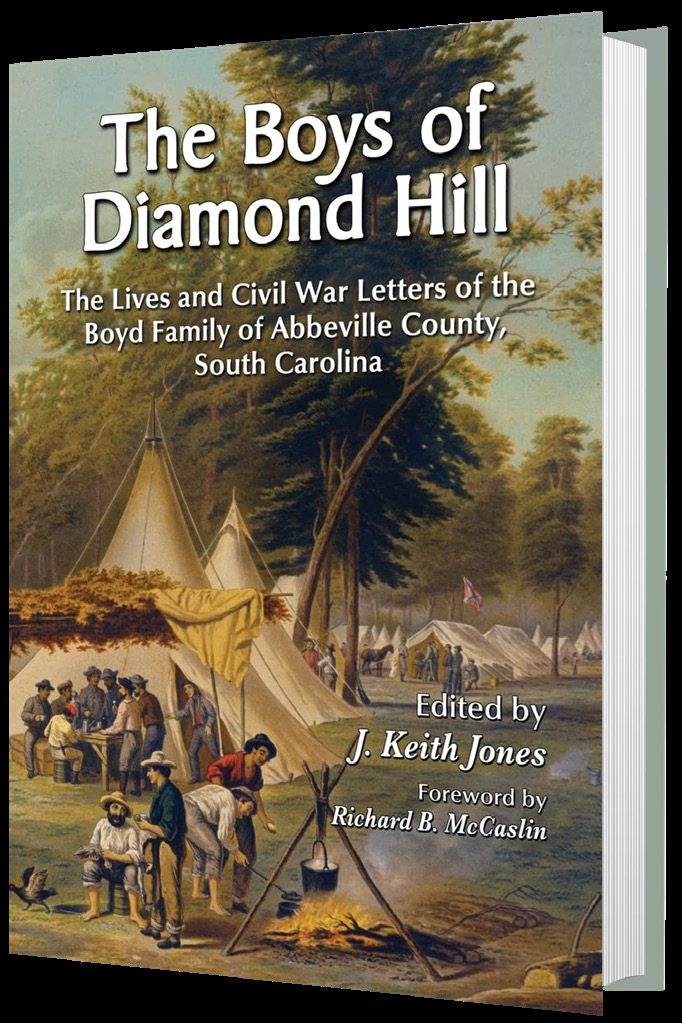
The Boys of Diamond Hill- The Lives and Civil War Letter of the Boyd Family of Abbeville County, South Carolina. J. Keith Jones, ed. Notes, Photos, Bibliography,
This book is a collection of letters written from 1857 until 1871, primarily during the Civil War years of 1861– 1865. The patriarch of the family was Richard Boyd, an Irish immigrant who was a farmer in northwestern South Carolina. This book shares the letters home from his sons Andrew, Daniel, Presesley, Thomas, and William, and his son-in-law, Fenton Hall, who all served in the Confederate army.
The six young men, whose ages ranged from 14 to 25 in 1860, saw action in Virginia, Mississippi, Tennessee, and the Carolinas, giving a unique, holistic view of the war from different theatres. Accounts include the Battle of Fredericksburg and some personal experiences from some of the war’s most significant and lesser-known battles. One notable passage comes from Daniel, writing from Virginia in1861, refers to the conflict as a “civil war.” This is th time this reviewer has seen the war being called that by a Confederate soldier. Those looking for a heroic, glory-filled account of the war will be disappointed. Most of the letters are sad and tragic or have depressing undertones. Their biggest enemy was not the Union army but illness, boredom, inflation, and deprivation. Death is a constant theme, for good reasons: Daniel was the lone letter writer to survive the war. Sadly, he did no live long after war, dying in 1871, presumably from cholera William was mortally wounded at Gaines Mill, Robert was killed at the Battle of Maryland Heights, and Thomas at the Second Battle of Murfreesboro, all in 1862. Andrew died from measles in 1864. Fenton Hall was listed by Confederate army as captured by Union forces near Charleston in 1863, but his wife never heard anything about or from him again. Richard outlived all his sons, dying in 1875 at the age of Editor Jones kept the original spelling and grammar of the letters, which can make it difficult to read since some of the writers were semi-literate. But the biggest problem that too much annotation is added to each letter. A summary is given before each letter along with some background information, which on occasion runs several pages. This slows the flow of the text and would have been better as endnotes. Also, maps of the places and battles mentioned would have been helpful. This is the second edition of the book, the first having come out in 2011. In this version some factual errors have been corrected and newly discovered information and letters are presented. Especially welcomed are photographs believed to have been of Daniel and Pressely. Civil War News Magazine | Sept.-Oct. 2024
This is a raw, gritty, and occasionally graphic, first hand account of the war that tears down any romanticized “moonlight and magnolias” notions that anyone may have of the Civil War.
Tom Elmore has written five books and numerous articles about South Carolina in the Civil War.
A Valuable Family Treasure Reveals Important Insights
Here’s a Letter from Thy Dear Son: Letters of a Georgia Family during the Civil War Era. Edited by Edward H. Pulliam. Photos, notes, index, 602 pp., 2024. Mercer
James and Thirza David, farmers in northern Georgia, cherished the correspondence they received from family members during our nation’s most tumultuous era. As the Davids grew older they hoped the letters would be preser as a family heirloom and passed from one generation to t next. From the moment the Davids entrusted the letters t the care of their daughter, Pillona, descendants have ho the Davids’s wish. While heirs always acknowledged the value of the letters to the family’s history, Edward Pul the editor of this superb collection and the latest in t line entrusted with stewardship of these treasured famil documents, recognized the value of making these letters available to a broader audience. While the volume contains letters from 1847 into the early 1900s, the Civil War’s four years form the book’s core. Unsurprisingly the letters are filled with content 66 Civil War News Magazine | Sept.-Oct. 2024
would expect from this era, weather, illness, the everyday difficulties confronted by soldiers, and hardships endured by family at home. Although historians will always find that content useful, the real value of these letters stems the insight they offer into a variety of topics that illust the era’s complexities and how ordinary people coped with them. Particularly interesting are letters between Pillona Alexander, the Davids’s daughter, and her husband Manning. The couple, married in 1857, like all husbands and wives during the conflict, sought ways to relieve the loneliness that war produced. Their letters reveal much about the role dreams played. For example, on April 14, 1862, Pillona wrot Manning, serving in the 43rd Georgia, that she dreamt about Manning “nearly every night.” While the dreams oftentimes brought Pillona comfort, they occasionally caused a sense of dread as she thought they portended something horrible might happen to Manning. Additionally, the letters disclose much about how the war weighed on Confederate soldiers’ commitment to the war effort. Letters written in the war’s early days, as was typ the case, are filled with sentiments of invincibility and excitement. Those expressions waned as the war continued. Letters became brutally honest about the Confederacy’s fortunes in the war’s final months. For example in midSeptember 1864, Manning Alexander wrote gloomily to Pillona about the Confederacy’s prospects in Georgia. Manning believed that without sufficient reinforcements, something he acknowledged the Confederacy did not possess, “so many noble and brave men should be sacrificed without any advantage.” Those seeking to better understand how the presence of Union troops impacted enslaved people will find much worth in this collection. For instance, on August 2, 1864, Horatio David, the Davids’s youngest child and an officer in the 16th Georgia, offered advice to his mother, Thirza, about how the family should respond to the unruliness some of the family’s enslaved people exhibited when they learned of the presence of Major General William T. Sherman’s command. Horatio suggested that if the “rascality” did not cease immediately “blood” should “flow.” Military historians focused on the conflict in Georgia, Tennessee, Mississippi, and Virginia will find much value in these letters. The letters are peppered with information about various campaigns, battles, and areas through which Confederate troops passed. On December 5, 1862, for example, Simeon David, a member of Georgia’s legislature before the conflict and a captain in the 14th Georgia, offe a compelling description of the Shenandoah Valley as his regiment made its way to Fredericksburg, Virginia, in the autumn of 1862. “I think the Valley of Virginia is the eden of the whole earth,” Simeon explained to his parents. The letters, exhaustively contextualized by the edior, also provide a sobering reminder about the conflict’s tragi consequences. The section of postwar writings bares much about the Civil War’s economic impact and how human loss suffered during the conflict caused unquantifiable anguish for those left behind. Documents in the postwar section als provide useful details about the activities of the Ku Klux Klan.
The richness of this collection marks this volume as arguably one of the most important assemblages of Civil War era correspondence in recent years. Social and militar historians owe a debt of gratitude to the editor for makin these letters available to all.
Jonathan A. Noyalas is director of Shenandoah U niversity ’ s M c C ormick C ivil W ar I nstitute in Winchester, Virginia, a professor in Civil War Era Studies at Shenandoah University, and founding editor of Journal of the Shenandoah Valley During the Civil War Era. He is the author or editor of fifteen books including most recently Slavery and Freedom in the Shenandoah Valley during the Civil War Era, published by the University Press of Florida.
Great Tactical Analysis of a Little-Studied Battle
Contrasts in Command: The Battle of Fair Oaks, May 31-June 1, 1862. By Victor Vignola. Photos, maps, footnotes, appendices, bibliography, index. 269 pp., 2023.
Until now, little has been written on the Battle of Seve Pines/Fair Oaks. Contrasts in Command concentrates on Fair Oaks, a portion of the battle even less has been written o Stephen W. Sears, in his excellent To the Gates of Richmon The Peninsula Campaign devotes only four pages to Fair Oaks. For many Civil War students, the main interest in th battle is the wounding of Gen. Joseph E. Johnston, which led to placing Gen. Robert E. Lee in command of the Army of Northern Virginia. Vignola has written a detailed, tact study of the battle, going a lot further than that.
Victor’s focus is on the various leaders and a comparison of their command styles. Although the major commanders, Generals Johnston, James Longstreet, and Edwin V. “Bull” Sumner, get their fair share in Vignola’s study, he does not forget lower grade officers. At Fair Oaks, Col. William Dorsey Pender of the 6th North Carolina, commanded a brigade and pressed the attack on the Federal guns until the fruitlessness of taking them became obvious. Driving his men forward through knee-deep mud, his actions were observed by President Jefferson Davis. After the battle, Davis sought him out and promoted him to Brig. Gen., on the field. Pender later rose to division command. Lieutenant Edward “Ned” Kirby commanded one of the Union artillery batteries assaulted by Pender and other Confederates forces. Each discharge of his guns drove them backward into the muck, and soldiers of the infantry regiments in support volunteered to help push them back into position. Kirby kept up the fire of his battery even wh running low on ammunition. When he ran out of cannister, he fired shot with the fuses cut to explode as soon as they left the mouths of the cannon, like giant shotguns. Vignola found it difficult to write of the Confederate side; few officers filed official reports. He had to fill in blanks with research into letters, diaries, and journals. Th result is a masterful tactical study of the battle, down to regimental level. I highly recommend this book; it should be on the bookshelf of every Civil War buff. I placed my copy right next to my Sears volume. Robert L. Durham, retired from the Defense Logistics Agency, is a freelance writer who has written articles and reviews for numerous historical publications. A lifelong history buff, he recently went back to college for a history degree. A Confederate Hero Rediscovered Confederate Privateer: The Life of John Yates Beall. By William C. Harris. 6 halftones, notes, index, 200 pp.,
Reviewed by Paul Taylor John Yates Beall was a colorful Confederate who was well-known, feared, and considered to be nothing more than a pirate in the northern states during the last two yea of the Civil War. He is virtually unknown today except by the rebellion’s most ardent students. In this traditional biography based significantly on Beall’s diary and letters, historian William C. Harris gives readers a full account of Beall’s relatively short life, from his birth in 1835 to his death on the gallows at Governor’s Island, New York, on Feb. 24, 1865. Beall was born in Charles Town, Virginia (now West Virginia), to well off planter parents who owned twentynine slaves. He developed an unshakeable Old Testament Civil War News Magazine | Sept.-Oct. 2024
religious faith as well strong “states rights” political convictions. His early adult militia duty saw him serving as a guard at John Brown’s 1859 execution. When civil war came just over sixteen months later, Beall quickly enlisted as a private in the 2nd Virginia Infantry. After he was shot through the shoulder and lung during an Oct. 1861 skirmish at Bolivar Heights, Beall began a lengthy convalescence in the Deep South, though he would never completely recover from his battle wounds. He was a fervent Confederate, convinced that President Abraham Lincoln and his Republicans had created a military despotism determined to crush the South. His papers, however, reveal that he usually found Lincoln himself to be unworthy of comment. Still yearning to do something for the Southern cause, Beall traveled to Toronto, where h and Rebel sympathizers hatched two plans for Confederate operations on the Great Lakes. Beall’s favorite was a commando-style operation to free Confederate prisonersof-war at the Johnson’s Island prison camp on Lake Erie in Sandusky Bay, Ohio. The second was to take a small flotilla of privateers and attack Union merchant vessels i Chesapeake Bay. After traveling back to Richmond, Beall outlined his pla before Confederate President Jefferson Davis and Secretary of the Navy Stephen Mallory. Not wanting to endanger the Confederacy’s neutral relations with Canada, Mallory rejected the Johnson’s Island raid; however, he did approv Beall’s Chesapeake Bay plan. Beall was officially given an acting master’s commission in the Confederate States Navy and within months, his small boats sunk or damaged several Union merchant ships in the Bay. Beall was captured and eventually freed in a prisoner exchange. He returned to the South where he learned that Mallory had now sanctioned a Johnson’s Island raid. Harris covers the semi-famous and often written about waterborne raid in depth. The planned attack on Johnson’s Island emanated from the Detroit docks on Sept. 19, 1864; it was aborted in failure within eyesight of Johnson’s Island. Beall and his men retreated to Detroit. From there they dispersed with Beall ending up in Toronto. There, the youn Confederate concocted a plan to hijack a passenger train o Dec. 15, 1864, in western New York that was supposedly transporting seven Confederate generals who were prisoners of war. Beall was later captured by local police in a trai station as he dozed. The Union army charged Beall with being a spy and acting 68 Civil War News Magazine | Sept.-Oct. 2024
as a “guerrillero.” Using trial transcripts, Harris presents vast detail a military commission trial that was every bit as much political as legal and whose guilty verdict seemed preordained in retrospect. Beall’s supporters were adamant that he was not an irregular guerrilla but in fact a legitim Confederate soldier engaging in lawful military activity. Their evidence was such that in the days to follow, eighty-s U.S. Congressmen and six U.S. senators petitioned Lincoln to commute Beall’s death sentence to life imprisonment. Despite those efforts, Beall met his fate on Feb. 24, 1865, after Lincoln declined to overturn the commission’s ruling. Harris’s work digs deep into primary sources with ample analysis that places Beall’s beliefs and actions within the larger context of Confederate paramilitary activity. It represents the first full-length scholarly biography of Beal Perhaps ironically, another excellent book on Beall and his exploits was published almost simultaneously in 2023. That work is Confederates from Canada: John Yates Beall and the Rebel Raids on the Great Lakes by Ralph Lindeman (reviewed elsewhere in this issue). Beall is the central player in Lindeman’s work but is presented more within the broader scope of Confederate Canadian paramilitary operations. While each book has some obvious similarity with the other, there is significant complimentary discussio as well. One notable difference is that Harris’s biography contains no maps, the book’s only shortcoming. Beall’s exploits generated wartime admiration for him in the South every bit as much as infamy in the North. Legend had it that his renown among Southerners was so great that John Wilkes Booth purportedly added Beall’s execution to his list of reasons for assassinating Lincoln, though the author doubts the veracity of such a tale. Thanks to Harris’ fine biography, general readers and scholars alike may now gain a better understanding of the man who was once known as “The Terror of the Chesapeake.”
Paul Taylor is an award-winning author of nine books pertaining to the American Civil War era. His newest book is titled ’Tis Not Our War: Avoiding Military Service in the Civil War North and is recently published by Stackpole Books.
Confederates from Canada: John Yates Beall and the Rebel Raids on the Great Lakes. By Ralph Lindeman. 20 photographs, seven maps, notes, index, 240 pp., McFarland
By early 1863, Confederate authorities yearned to take the war into the North and, from their perspective, give the Yankee invader a taste of his own medicine. In this absorbin and smoothly written new book, Ralph Lindeman details the story of how Confederate agents sequestered in Canada