Civil War News book reviews provide our readers wi
analysis of the latest and most significant Civil W
Emerging Civil War Blog Posts in a Single Package
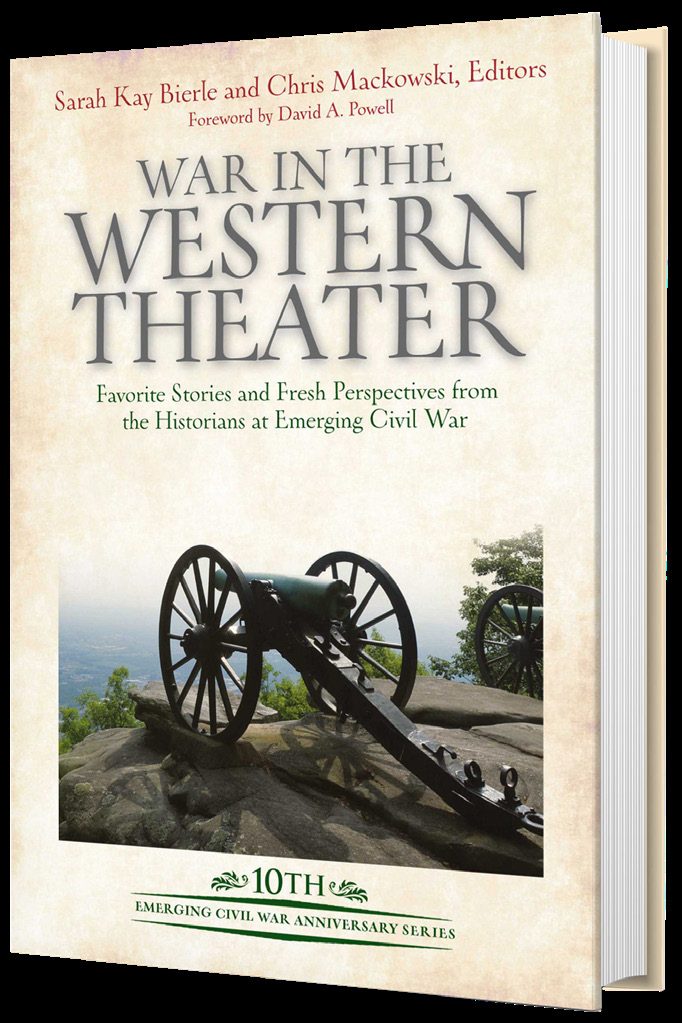
War in the Western Theater: Favorite Stories and Perspectives from the Historians at Emerging Civil Edited by Sarah Kay Bierle and Chris Mackowski. Map photographs, footnotes, index. 336 pp., 2024. Savas
The editor-in-chief of Emerging Civil War (Mackow and the managing editor of ECW’s blog (Bierle) have assembled a decade’s worth of blog posts and other materials which cover a wide variety of subjects re the war in the Western Theater. The work is part of 10th Anniversary Series. 68 Civil War News Magazine | Jan.-Feb.
War in the Western Theater comprises 47 entries written by 29 contributors, including the co-editors, most publishe originally in the ECW blog. The entries vary in length, but
the majority are in easily digestible bites of five or six Among the pieces I found of special interest is Theodore Savas’s in-depth discussion of Col. George Washington Rains and the impact the fall of Forts Henry and Donelson had on Rains’s plans for the Confederate Powder Works. Also impressive is David Powell’s detailed analysis of Gen.
James Longstreet’s 1863 sojourn in the Western Theater. A brief entry by Robert Dunkerly offers thoughts on Gen. Braxton Bragg and the troubled command team that led the Army of Tennessee. Others cover the fall of New Orleans, the naval Battle of Memphis, a Missouri (U.S.) regiment’s action at Shiloh and the capture of Spanish Fort near Mobil on April 9, 1865.
The story of the war is, of course, more than a study of
battles and campaigns. Various contributors tell the reader
about assorted matters, from Mardi Gras in Civil War New Orleans to an epic march by a Federal force from the Cumberland Gap to the Ohio River; from a tactical innovation used by Federal Maj. Gen. August Willich to an odd, temporary prison on a bridge over Mississippi’s Pearl River. The editors note that the entries “have been updated and, in most cases, expanded and footnoted.” This editing could have been done with greater care to eliminate some mistakes that careful readers will notice. I will mention only two. man whose wife has died is a widower, not a widow, and (in the “never trust spell check” department) “taught” and “taut” sound the same but have quite different meanings. These are small blemishes in a very good book, but they are blemishes that could have been avoided. Many of the chapters cover characters and episodes with which most students of the war are generally familiar; however, there are always new perspectives and more things to learn. Other entries will introduce readers to li known events and people and will whet their appetite for more reading. Gould Hagler is a retired lobbyist living in Dunwoody, Ga. He has been a regular contributor to CWN since
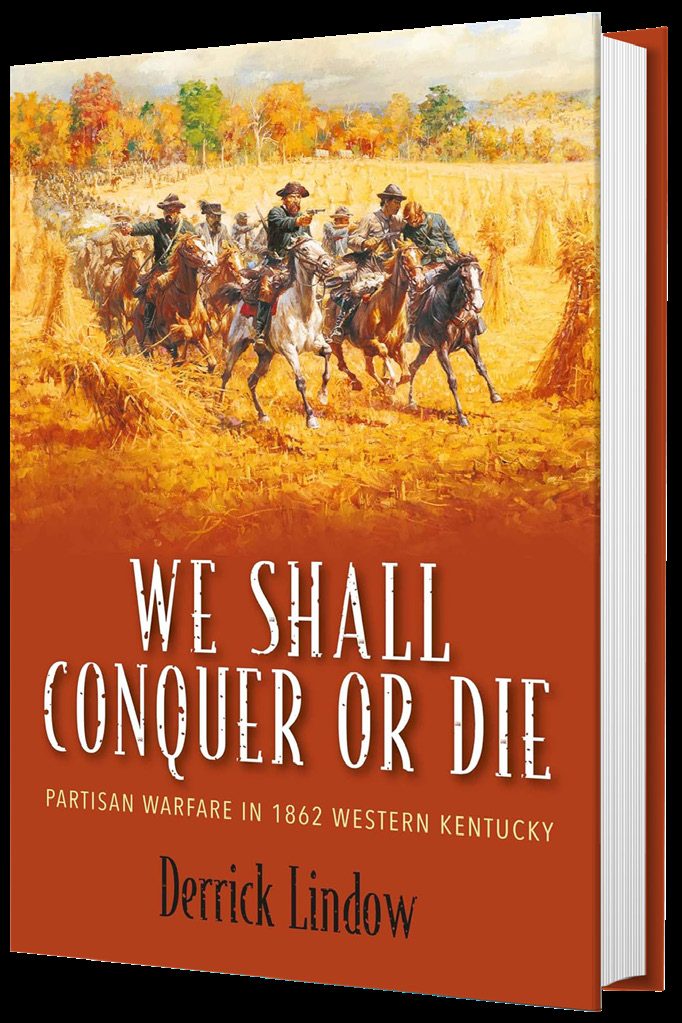
Partisan Rangers-Unusual and Romantic We Shall Conquer or Die: Partisan Warfare in 1862 Western Kentucky. By Derrick Lindow. Illustrated, bibliography, index, Savas Beatie Publishers, 222pp., 2024,
Derrick Lindow takes the reader along on a thrilling ride with the Partisan Rangers of Kentucky’s Colonel Adam Rankin “Stovepipe” Johnson’s 10th Kentucky Regiment. Starting out with just two original members the 10th
Kentucky, through exhaustive recruiting efforts propell by exaggerated newspaper accounts of their exploits, the regiment grew to 800 members and was officially recognized by the Confederate government. This book primarily focuses on 1862 during which Adam Johnson struck Union positions in Western Kentucky, captured hundreds of prisoners, confiscated great quant of Union supplies and arms, and generally kept Southern Indiana and Northern Kentucky in a state of uncertainty and fear. Unlike roving bands of guerrillas, the 10th Kentucky prided itself on obeying military directives, morally upright, and not engaging in brutality or wanto theft and property destruction. They fought honorably a thus earned the support and protection of many Southern sympathizers and civilians alike. Adam Johnson’s capture of Newburg, Indiana, cemented his reputation as a skillful leader to be reckoned with earning him his nickname for terrifying the town with a phony cannon fashioned from an old stovepipe. The 10th Kentucky then went on to engage Union forces at Dover, Clarksville, Fort Donelson, Uniontown, Geiger’s Lake, Owensboro, Southerland’s Hill, and Ashbyburg. While the first encounters with Union troops were victories, federal authorities eventually committed more troops and drove the rangers farther South, inflicted casualties that weakened the regiment, and even caused them to lose their one beloved artillery piece, the Clarksville Belle. The last major action of the 10th Kentucky was with Gen. John H. Morgan’s raid into Indiana and Ohio. Many rangers were captured and, although Johnson escaped, his regiment was decimated. Now a Brigadier General, in August 1864 Johnson was accidentally shot by one of his own men, captured, and sent to Fort Warren was a prisoner.
This book is well researched, appropriately illustrated does an excellent job of retelling how the 10th Kentucky, a partisan unit, had a great effect on drawing Union troo away from larger battles where they were needed, forcing the Union to expend money and resources that could have been used more effectively elsewhere. The text is very readable, infused with personal primary materials, and brings a little covered area of the war to the forefront. book is recommended for any historian desiring to increas his understanding of the role of partisan rangers in the War. Dr. Wayne L. Wolf is Professor Emeritus at South Suburban College and past president of the Lincoln-Davis Civil War Roundtable. He is the author of numerous texts and articles on the Civil War including Heroes and Rogues of the Civil War, The Last Confederate Scout, and They Saw the Elephant. He frequently appears on the lecture circuit.
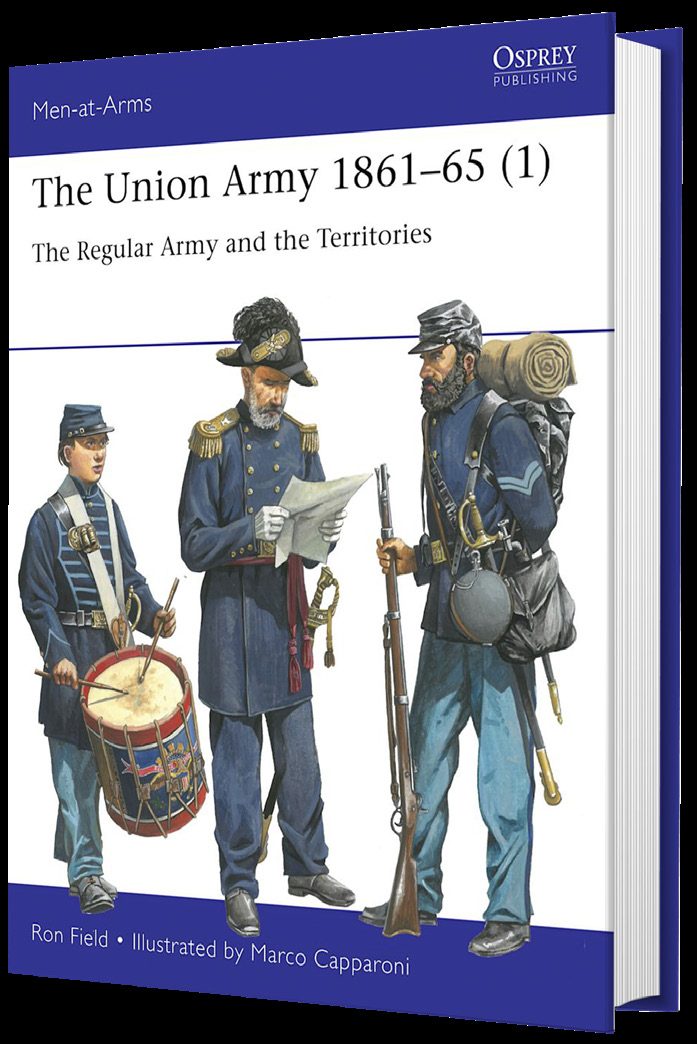
Internationally Recognized Author’s Newest Work on the Union Army The Union Army 1861-65 (1): The Regular Army and the Territories, by Ron Field, illustrated by Marco Capparoni
The Men-at-Arms series adds another volume, this time covering the Union’s Regular Army and the Territories. This book covers the various special organizations within the United States Army. Author Ron Field deftly crafts hi way through the less familiar branches of the military. Domiciled in England, Field’s expertise on the American Civil War is internationally recognized. He has published over 35 books with Osprey alone. This latest volume also includes detailed illustrations by Marco Capparoni. This book concentrates on the Regular U.S. troops and the Federal soldiers stationed in the nation’s territorie
readers are not disappointed. The entire series augments t text with a combination of original photographs, uniforms, artifacts, and drawings. This volume also contains an extensive bibliography and index that complement the plate commentaries of the detailed color illustrations. One section in the subcategories examines the Invalid/ Veteran Reserve Corps and its important service to the war effort. Created by the War Department on April 28, 1863, the Invalid Corps eventually transitioned into the Veteran Reserve Corps. This group utilized wounded and disabled veterans for service in mostly behind-the-lines duty. The author scoured the globe to locate photographs of the obscure branches of service, which in turn led to the commissioned artwork providing additional details in a colorized version. The visual interpretations of the soldi provided by Artist Capparoni, created in various situation poses, are very detailed. They assist the reader in better understanding the uniforms and accoutrements worn by the troops in each department. While the narratives are by no means a complete story of each branch of the U.S. military, it certainly gives th reader a good sense of how they were attired and shows the equipment they used. Both author and artist deliver a very welcome volume to add to the massive library created by Osprey. A welcome addition to any personal or professional repository.
Richard H. Holloway, a Louisiana native, formerly a Senior Editor for America’s Civil War and Civil War Times magazines. In addition to numerous articles, he wrote biographies of Richard Taylor, Hamilton Bee, and William R. Boggs for Confederate Generals of the TransMississippi (Univ. of Tennessee Press) as well as essays f Vicksburg Besieged and Forts Henry and Donelson (Univ. of Southern Illinois Press). Holloway can be contacted
Hood’s Blunder in Alabama Detour to Disaster – General John Bell Hood’s “Slight Demonstration” at Decatur and the Unraveling of the Tennessee Campaign. Noel Carpenter. Notes,
Much of the writing about Gen. John Bell Hood’s disastrous Tennessee campaign has focused on Spring Hill, Franklin, and Nashville. However, the late Noel Carpenter a former Air Force pilot and data specialist, argued that the campaign’s doom was determined when Hood spent four days unsuccessfully trying to capture a Union fort i Decatur, Alabama, from October 26-29, 1864. The fort’s capture would have given Hood access to a crossing point on the Tennessee River. Since the Decatur garrison had only an estimated 1,750 troops and the Union forces in Tennessee were badly scattered, Hood thought taking it would be easy. However, just about everything that could have gone wrong for Hood did. The Confederates were short on food and ammunition, and the weather was wet and cold. Requests to Gen. Nathan Bedford Forrest to bring his cavalry forces to Decatur went unanswered, while Gen. Joseph Wheeler’s cavalry was fifty miles away, leaving Hood with no cavalry to gather intelligence. On the battlefield the Confederates were disorganized, uncoordinated, and sometimes caught off guard by Union attacks. The latter led the Southerners to believe the fo been reinforced and the garrison was stronger than what i
actually was. Perhaps the biggest Confederate mistake was not bombarding the fort. Many veterans of the battle felt that the fort would have fallen had artillery played a big role. The author places blame for the Confederate failure to take the fort on Gen. Hood, noting that his passive attack contrasted with his usual aggressiveness, and Hood even called the siege a “demonstration.” Carpenter argues that the “demonstration” at Decatur was “a spur-of-the moment decision with little or no planning, with insufficient or misleading intelligence information, and without the necessary logistical infrastructure,” adding that Hood “simply became rattled and confused.” When he lifted the siege, Hood had suffered 1,0001,500 casualties to only 113 for the Union forces. More importantly, he had lost precious time and had to find another river crossing, causing the route and timetable of the Tennessee invasion to be altered. Carpenter knew this subject well, having grown up in Decatur and spending twelve years researching and writing this account. The writing and the conclusions are strong. The only negative is that maps would have been very useful This is an excellent example how a little thing can have major impact on larger events, and a fine examination of a often overlooked event. Anyone with a deep interest in the war’s western theatre should read this book.
Tom Elmore has written numerous books and magazine articles about Sherman’s activities after the fall of Atlanta.
Voices From Gettysburg: Letters, Papers, and Memoirs from the Greatest Battle of The Civil War. Allen C. Guelzo Footnotes, index, appendix: “Gettysburg Order of Battle.” 400 pp., 2024, New York, Citadel Press, Kensington Publishing Corp.
Allen Guelzo has followed up his successful Gettysburg: The Last Invasion with the Voices From Gettysburg: Letters, Papers, and Memoirs from the Greatest Battle of the Civil War. Mining the myriad documents of those who were there, he has positioned the ordeal of the three days right in your lap. First person accounts, with the additio of powerful memoirs, weave a dramatic narrative which immediately brought to mind William Faulkner’s legendary quote on this, the most famous charge in the most famous military engagement of the war. In his 1948 novel, Intrude in the Dust, he wrote: “For every Southern boy fourteen years old, not once but whenever he wants it, there is the instant when it’s still yet two o’clock on that July afternoon in 1863, the brigad
are in position behind the rail fence, the guns are laid an ready in the woods and the furled flags are already loosene to break out and Pickett himself with his long oiled ringle and his hat in one hand probably and his sword in the other looking up the hill waiting for Longstreet to give the word and it’s all in the balance, it hasn’t happened yet, it has even begun yet, it not only hasn’t begun yet but there is still time for it not to begin against that position and th circumstances...” Guelzo treats the lead up to the conflict at Gettysburg Hooker’s dismissal and Meade’s promotion to commander of the Army of the Potomac and all the uncertainties attendant with preventing Lee’s army access to Baltimore and Philadelphia while defending Washington. The author proves that the power of primary sources surrounding Pickett’s charge still produces heart-pounding, tension. Th documents revealing Longstreet’s doubts about Pickett’s advance are in his own words and they are wrenching. Frederick Fuger’s description of the opening salvos at 8 a.m. July 3rd on Lieutenant Cushing’s Battery A, 4th U.S. Artillery are vivid:” Lieutenant Joseph Milne, who commanded the right half battery, was killed when the enemy was within 200 yards of the battery. When the enemy came within about 100 yards from the battery, Lieutenant Cushing was shot through the mouth and instantly killed.” Guelzo doesn’t stop with the battle but deals with Lee’s retreat, which has been well documented previously by Kent Masterson Brown’s excellent Retreat from Gettysburg; Lee, Logistics & the Pennsylvania Campaign (Chapel Hill, 2005). Lee tapped General John Imboden to cover and organize the retreat with its thousands of animals, sick an wounded (and starving) Confederates and some Union prisoners. Imboden wrote about it in 1871 in graphic detail “Our situation was frightful. We had over 10,000 animals and all the wagons of General Lee’s army … and all the wounded” that could be moved. He had “a few wagon loads of flour … a small lot of cattle.” They had an effective force of only “2100 men and twenty odd field pieces.” The swollen Potomac River made crossing extremely Civil War News Magazine | Jan.-Feb. 2025
dangerous in most cases, impossible. Incessant rains over rocky mountainous terrain played havoc with and tortured the wounded, who Imboden quotes without filters: “O God! Why can’t I die?” “My God! will no one have mercy and kill me and end my misery?” “Oh! stop one minute and take me out and leave me to d on the roadside.” “I am dying! I am dying! My poor wife, my dear childre What will become of you?” Although Guelzo covers the logistical, the strategic, the tactical in excerpts from Meade’s and Lee’s camp, it the human tragedy unfolding over three hot days in July 1863 on a pleasant rolling countryside and all-American village, that leaves the lasting impression. 50,000 casua and un-counted post battle casualties in the remainder of the war marked Gettysburg’s legacy. In the end this book is about the human condition and man’s stubborn attractio to war. Voices from Gettysburg is well constructed as Guelzo introduces each section with a narrative that provides the connective tissue explaining the lead up; each day of fighting; the retreat; and “The Address & Remembrance.” The last entry is Vice President Lyndon Johnson’s speech at Gettysburg, May 30, 1963, echoing Lincoln’s call for “equality” a hundred years earlier. As Faulkner also said “The past is never dead. It’s not even past.”
After 43 years in the museum field, Cilella devotes his time to collecting American prints and maps and writing. He has written extensively on Emory Upton: Upton’s Regulars: A History of the 121st New York Volunteers in the Civil War (Kansas, 2009); a twovolume Correspondence of Major General Emory Upton, (Tennessee, 2017), He edited Upton’s love letters 186870 to his wife—Till Death Do Us Part (Oklahoma, 2020) and The Memoirs of Dewitt Clinton Beckwith of Upton’s Regulars (McFarland, 2023).
Charley: The True Story of the Youngest Soldier To Die in the American Civil War. By Brendan J. Lyons. Illustrated, Brookline Books, Casemate Publishing, 160 pp
Charley King was a talented drummer from West Chester, Penn., whose love of the Union and romantic notions of fighting for the Union cause propelled him to enlist at a 12 years, five months, and nine days old. He mustered in as a drummer on September 12, 1861, into Company F, 49th Pennsylvania Infantry Regiment, VI Corps, Army 72 Civil War News Magazine | Jan.-Feb. 2025
of the Potomac. He became the youngest known soldier to give his life for the Union, dying on September 20, 1862, at Antietam after being struck by an artillery fragment th passed through his body. This book is Charley’s story. The names of Charley’s closest friends (Lenny, Alfred, Chuck, Joe, Abel, and John are real soldiers who served with Charley. Likewise, the officers he served under (Captain Sweeney, Major Huling, Colonel Irvin, and General Hancock) are historically accurate. But the real value of this book lies in the emot dreams, stark realities, loss, bravery and devotion of Cha and those he served with in the 49th Pennsylvania. This is human-interest story that could belong to any soldier. This story takes Charley from his pre-military days drumming in the streets of West Chester, marching with fellow schoolmates to his drum beats, through the real military training at Fort Griffin and then the battles of Savage Station, White Oak Swamp, the Seven Days, Crampton’s Gap, and finally Antietam. The death of two of Charley’s close friends, the absence from family, the harsh camp conditions, ever-present disease, and living with constant fear became Charley’s companions. His story is just one of what could be for any of the 600,000 men who perished in the Civil War. The author needs to be commended for researching all he could find about Charley as part of what began as an Eagle Scout project and then lasted over two decades before this book saw publication. The time spent was well worth it. This book is highly recommended, particularly for a younger audience who want to learn what it is to believe in a cause and fight f what is held righteous. This book is well written in narra format, as historically accurate as possible with the scan military records available, and objective in its treatment the realities of a Civil War. While the scholarly historia will find no new facts on battles or leaders, they can sti enjoy the story of a young drummer boy who gave his all.
Dr. Wayne L. Wolf is Professor Emeritus at South Suburban College.