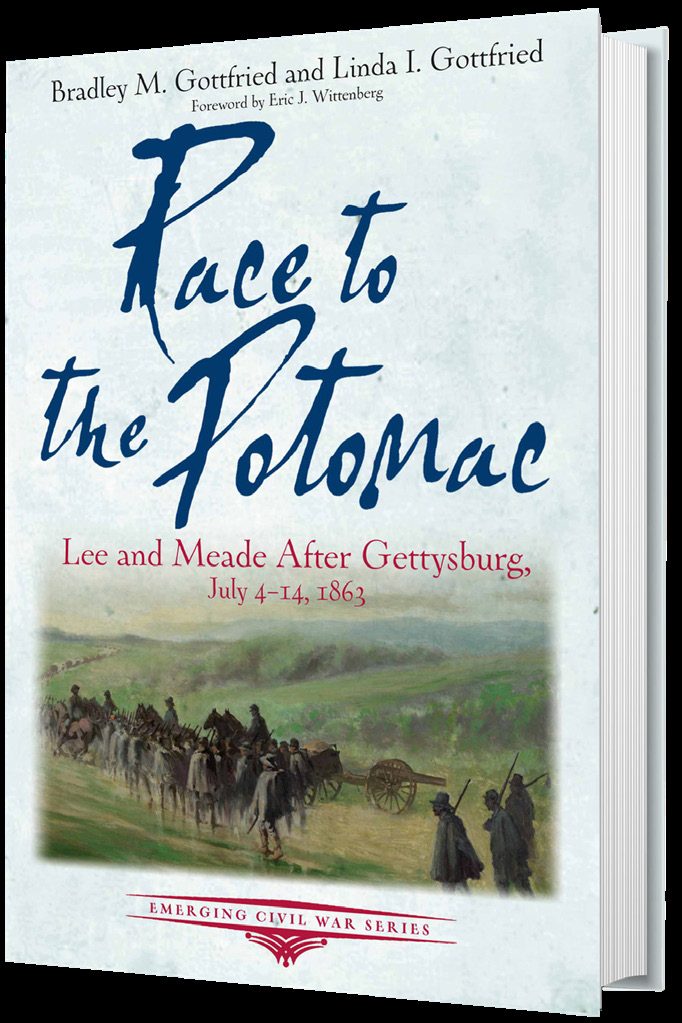
Race to the Potomac: Lee and July 4-14, 1863. By Bradley M. Gottfried. Savas Beatie, savas
Following the titanic clash July 1863, Confederate General monumental task of withdrawing Northern Virginia back across safety of Virginia. Extricatin proved to be one of the most d Rebel commander experienced up
t Gettysbu Robert E. his mauled he Potomac his force fficult ch to that po
g in ear ee faced Army of River to from Pen llenges nt in th
While torrential rains turned the country roads to muddy quagmires, the Confederate units had to march southward, ready to turn on pursuing Federals units while protecting
two large wagon trains, one filled with seriously wounded and the other with tons of precious supplies acquired in Pennsylvania and Maryland during the campaign. Lee knew that without those supplies, his army would struggle to feed itself over the coming months. Lee’s Federal counterpart, Major General George
G. Meade, likewise faced the grim task of caring for thousands of seriously wounded soldiers while also enduring unrealistic pressure from Washington to rapidly pursue and crush Lee’s retreating army. Although Meade would shadow Lee back to Virginia, attempting to strike the vulnerable wagon trains and/or trap his army at the Potomac, he was always cognizant of the fact that Lee and
his men still had plenty of fight left in them and would lik
nothing better than to ambush or counterattack an overly
aggressive Federal pursuit. The story of Lee’s retreat and Meade’s chase is both interesting and important in that it demonstrates the qualit of both generals, the realities and limits of Civil War-era military operations, and the complex story of the last chapt of the Gettysburg Campaign. In the end, both generals performed as well as could be expected. Lee escaped with his army and most of his food and fodder. Despite the claims of many, Meade did as well as he could given the state of his army, the wariness of his brilliant opponent, and the reality that outright destroying a Civil War army, even in the most advantageous of situations, was virtually impossible. The battles of Chattanooga (Missionary Ridge) and Nashville clearly attest to this. While the story is important and Bradley Gottfried and Linda Gottfried tell it well, it is a story that has been to before and in greater detail. Numerous other works covering the retreat can be found in the Suggested Reading section, the best of which include Kent Masterson Brown’s Retreat from Gettysburg: Lee, Logistics, and the Pennsylvania Campaign (2005) and his Meade at Gettysburg: A Study in Command (2021). Both volumes are meticulously researched, well-written, and give readers a detailed accoun of the Confederate retreat. The Gottfrieds list several othe notable works as well, so is there a need for another book? The answer is absolutely. Like most titles in Savas Beatie’s Emerging Civil War Series, this book is designed as an introduction to the subject. It offers a solid yet not overly detailed summary of the campaign and/or battle, places the event in historica context, and then offers the reader lots of extras in the fo of appendices. These appendices sometimes offer vignettes of personalities, whether famous commanders or ordinary soldiers; battlefield tour information; orders of battle; information on monuments; key locations, etc. While those unfamiliar with the historical events will find the books informative and entertaining, even those students of the war with extensive knowledge can find items of interest, especially the hidden gems in the appendices. In the case of Race to the Potomac, the Gottfrieds, in tw succinct chapters and an “Aftermath,” have provided a wellwritten, even pithy account of Lee and Meade throughout
the retreat to Virginia. They then offer information for five driving tours: “The Wagon Train of Misery Tour,” “Monterey Pass,” “Subsequent Cavalry Movements,” Lee’s Army Retreats,” and “The Union Army’s Pursuit.” Anyone unfamiliar with the immediate events following the battle at Gettysburg should start here, and while the book offers nothing new in terms of scholarship to scholars or well-re aficionados of the war, the excellent location photographs (both past and contemporary), along with the tours, make this an invaluable resource for anyone wanting to explore the battlefield. In sum, this is an excellent introductory study and guide. Indeed, it is a model. John D. Fowler, Ph.D., is the author of several books and articles on the Civil War Era. He is the author of Breaking the Heartland: The Civil War in Georgia. He is currently a Professor of History at Dalton State College.
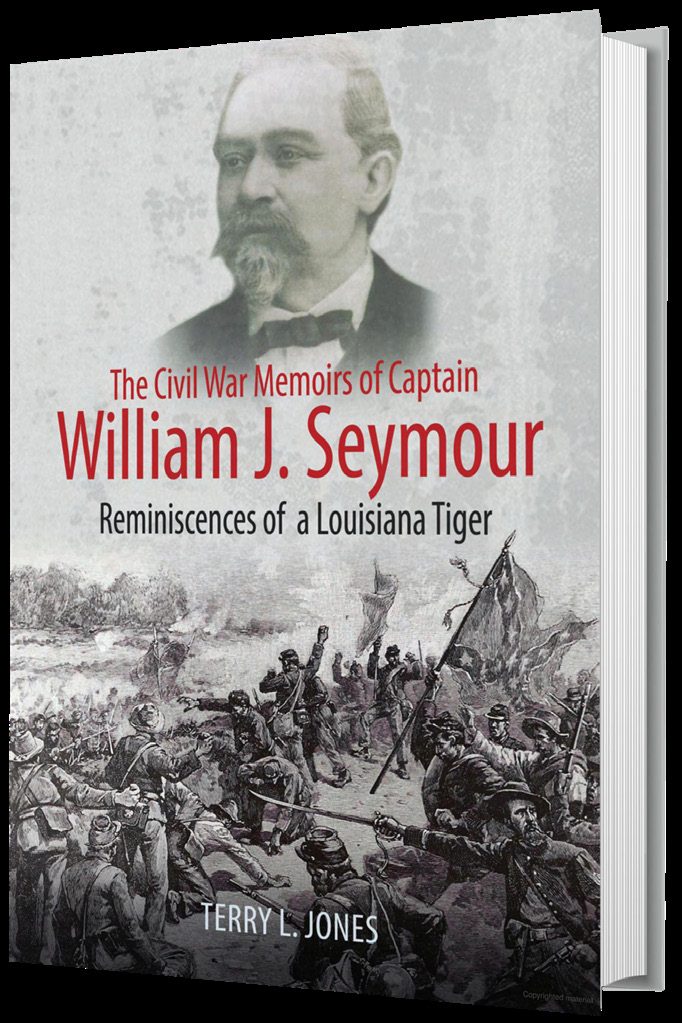
The Civil War Memoirs of Captain William J. Seymour: Reminiscences of a Louisiana Tiger. Edited and annotated by Terry L. Jones. End notes, index, maps, photograph, bibliography: 192 pp., 2023, California, Savas Beatie,
William Johnson Seymour, an assistant editor and partner in the New Orleans newspaper, Commercial Bulletin, was an early supporter of secession and war with the union. A native of Macon, Georgia, he attended Hobart College in Geneva, New York. Ironically, the southern Seymour’s were originally Connecticut Seymour’s and distant relative of Horatio Seymour, New York governor during the war and later, unsuccessful Democratic presidential candidate. William left no record of graduating and joined his fami in New Orleans. When war came, his father Isaac, a veteran of the Mexican War, joined the 6th Louisiana Volunteers leaving William in charge of the Bulletin. Isaac wasn’t sure William could handle the new responsibility while William chafed at not being able to join the Confederate Army. Seymour felt a sense of duty to his father and the paper and badly wanted to join the fight. But by 1862, according to editor Terry Jones, Seymour “could wait no longer and accepted the position of aide to Brigadier General Johnson Kelly Duncan” who was given charge of the coastal defenses of New Orleans. The key to controlling the Mississippi was New Orleans, and the key to defending New Orleans was Fort Jackson, seventy-five miles below the city in the Gulf of Mexico.
There, Seymour began his reminiscences of his experiences in the Civil War. Aside from the Official Records, his memoirs document the severe pounding the Federal Navy unleashed on Fort Jackson’s Confederates. Following the New Orleans campaign, he transferred to Brigadier General Harry T. Hays’ First Louisiana Brigad in Virginia. As an aide to Hays, Seymour witnessed the most consequential Eastern theater battles. He was at Chancellorsville, Gettysburg, Rappahannock Station, the Shenandoah Valley at Third Winchester, and Cedar Creek. Abruptly and unexpectedly, Seymour’s chronicle ends Cedar Creek. Jones speculates that it was inconceivable an old newspaper man would leave the story mid-stream. possible he wrote more, but that portion is missing. Mo likely Seymour’s health intervened. Jones traced his ro after Cedar Creek and the answer appears not mysterious at all. Seymour reported ill with fever and diarrhea in October 1864 was granted sick leave. He was absent from the brigade from October 10, well before the battle of Creek, to February 1865. Part of that time was spent in Ladies Relief Hospital and a hospital in Lynchburg. Seymour describes in detail the effect of Union Colo Emory Upton’s surprise nighttime attack on Lee’s troops
l War News Magazine | Vol. 51, No. 4, July-August 2025
at Rappahannock Station. Brigadier General Robert Hoke’s and Hays’ two brigades and four artillery pieces bore the brunt of Upton’s assault. Hoke and Hays were tasked with defending the bridgehead across the river. The Rebel forc melted under the intense pressure. Seymour, along with others, fled by swimming the river or capitulated to the advancing Federals. Jones’ new publication of Seymour’s memoir is marked improvement on his original 1991 edition. Gone are the footnotes replaced by heavily researched endnotes. The maps have also been improved for clarity and relevance. The bibliography has been expanded and wisely chosen. The original edition contained introductory essays for each chapter or subject. These have been retained and refreshed with new research material and remain essential introductions to understanding the memoir. There is only one quibble with Jones’ research and annotations. In this updated version with several new endnotes, the editor identifies several Confederate and Federal officers and enlisted men, which helps the reader understand the participants. But at Gettysburg is it nece to identify George Pickett, Henry Heth, and James Pettigr in the new edition? Just asking for a friend. This edition by Savas Beatie is an improvement over the earlier edition and a welcome addition to first perso memoirs of the war. The history of memory only increases our understanding of the past and the tragedy we call the Civil War.
After 43 years in the museum field, Cilella devotes his time to collecting American prints and maps and writing. He has written extensively on Emory Upton: Upton’s Regulars: A History of the 121st New York Volunteers in the Civil War (Kansas, 2009); a twovolume Correspondence of Major General Emory Upton, (Tennessee, 2017), received the 2017–2018 American Civil War Museum’s Founders Award for outstanding editing of primary source materials. He edited Upton’s love letters 1868-70 to his wife—Till Death Do Us Part (Oklahoma, 2020) and The Memoirs of Dewitt Clinton Beckwith of Upton’s Regulars (McFarland, 2023).
The Rest of the Story. The comprehensive sequel about the George Spangler Farm
Tell Mother Not to Worry: Soldier Stories from Gettysburg’s George Spangler Farm. By Robert D. Kirkwood. photographs, maps, appendices, footnotes, index, and bibliography. 320 pp. Savas Beattie, El Dorado
In his previous work, Too Much for Human Endurance, we met George Spangler and his family. We learned how 68 Civil War News Magazine | Vol. 51, No. 4, July-
sacred this farm/hospital became during and after the Battl of Gettysburg. This sequel, Tell Mother Not to Worry, continues the story with additional insights into previousl covered soldiers. It also includes in-depth coverage of man new soldiers and hospital operations. After a forty-year career, Robert Kirkwood retired as an award-winning editor. Since its opening in 2013, he has served as a docent at the Gettysburg Foundation George Spangler Farm Civil War Field Hospital. This allowed him to research thousands of pension/military records, hospital files, letters, newspapers, and diaries of those present on George Spangler’s land. The result is an invaluable research tool about soldiers and hospital workers. Readers gain insight into soldiers’ thoughts and interactions with family members. This book also contains a great deal of information about the logisti required to operate multiple care facilities in the same geographic area. His audience gains a deeper appreciation for all aspects of military operations, because of the deta maps and background synopses he provides. Additionally, Kirkwood gives readers some interesting details about the descendants of George and Elizabeth Spangler. Kirkwood’s multiple appendices provide specific details about medical records for wounded/deaths at the various corps hospitals. This reminds readers that the cost of victory is high. Wives became widows and children became orphans. If the soldier returned home, many aspects of home-life become quite different. Kirkwood’s appreciation for military strategy, logistics and tactics brings the real horrors of war to life. This wo an excellent reference for medical operations. It also rela soldiers’ personal stories of hardships and interactions wi their families. It is well worth the price and occupies an important spot on this reviewer’s reference shelf. Richard J. Blumberg has three articles published in various issues of Civil War News. His current work focuses on Animal Service and Veterinary Medicine in the Civil War.
Personal Conflict Between Leonidas Polk and Braxton Bragg
Southern Cross: A New View of Leonidas Polk and His Clashes with Braxton Bragg. By Amanda Low Warren. Photos, notes, bibliography, index. 232 pp., 2024. McFarl
Southern Cross takes on a worthy subject and is hardhitting and well-written. In histories of the various campaigns and battles of the Army of Tennessee, much is written on the irascible nature of Gen. Braxton Bragg. Gen. Leonidas Polk appears in these histories, normally negatively. The acerbic and combative Bragg feuded with many other generals, most notably Longstreet and Hardee. Bragg’s clashes with Polk, though, were long-lasting an severe. They started before the Battle of Shiloh and last until Bragg forced Polk from his command after the Battle of Chickamauga. Many historians judge Polk at fault with these disputes. Warren puts many criticisms of Polk to re This reviewer found Warren’s volume exciting and highly entertaining. I have several problems with it though. Whi the bibliography is extensive, Warren relies mainly on secondary works for her arguments. She quotes from them extensively and these quotes are well thought out. They make clear the way most historical authors think about the relationship between Polk and Bragg. I believe more quotations from the Official Records and other primary sources would have made her arguments more persuasive. Most of the difficulties between Polk and Bragg were due to a lack of communication on Polk’s part. Often, he would go against orders, which may have been justifiable, and Bragg would possibly have understood the reasons for Polk’s disobedience if properly informed. Many times, lat circumstances proved Polk right in his decision to disobe but Warren relies too heavily on the aftermath of those
decisions. Those aftereffects were not known at the time, of course, and had nothing to do with Polk’s determination to violate the orders. After the Battle of Chickamauga, Bragg relieved Polk of corps command and President Jefferson Davis transferred him to control of Northern Mississippi and Alabama. There, his major achievement consisted of thwarting General W.T. Sherman’s Meridian Expedition. Here, Warren lets an antiSherman bias overpower her description of the expedition. In many ways, this is like the bias of the authors she quo had against Polk. Except for the caveats I stated above, this is a fascina book and will be well-received by Polk fans. While not for everyone, I found it an enjoyable read. Robert L. Durham retired from the Defense Logistics Agency, where he had an opportunity to see some rarely visited countries. He is now a freelance writer with articles published in numerous historical publications. A life-long history buff, he recently went back to college for a history degree. Every Battle Changes Lives Forever The Blood-Tinted Waters of the Shenandoah: The 1864 Valley Campaign’s Battle of Cool Spring, July 17-18, 1864. By Jonathan A. Noyalas. Bibliography, index, illustrations maps, appendices. 192 pp., 2024, Savas Beatie, savasbeatie
There is no one more qualified to write about the Battle of Cool Spring, and few as qualified to write about the l War News Magazine | Vol. 51, No. 4, July-August 2025
Shenandoah Valley during the Civil War, as Jonathan A. Noyalas. A professor of history at Shenandoah University, and director of SU’s McCormick Civil War Institute, Noyalas has devoted much of his professional career to researching and writing about the Valley during the Civil War and Reconstruction. Since 2017, he has been managing the interpretative efforts at Cool Spring, a 195-acre battlefield that was turned over to Shenandoah University by the Civil War Trust (now the American Battlefield Trust in 2013. In The Blood-Tinted Waters of the Shenandoah, Noyalas brings the Battle of Cool Spring to life for readers, capturing the tragedies and complexities of the Union and Confederate men who fought there. Acknowledging that this is a lesser known engagement, Noyalas nevertheless rightly points out that “a battle’s meaning should never be confined to the number of troops engaged, amount of casualties, strategic consequences, or political gains.” Rather, he argues, “For the wife transformed into a widow, to the child made an orphan, to a soldier wounded in combat, or veteran traumatized by what occurred on the battlefield, an engagement’s significance was defined by how that battle forever altered their earthly existence.” book is full of personal stories of the men who struggled along the banks of the Shenandoah River in mid-July 1864, and the wreckage that accompanied many of their lives in the years after the war. In June and July 1864, Confederate soldiers under General Jubal A. Early were on the move. Advancing from Petersburg to Lynchburg, they then marched down the Shenandoah Valley, captured Harpers Ferry, fought a battle on the Monocacy River in Maryland, and assaulted Union fortifications on the outskirts of Washington, D.C. Following the Battle of Fort Stevens, where Lincoln was famously under enemy fire, Early boasted to one of his sta officers, Maj. Henry Kyd Douglas, “Major we haven’t taken Washington, but we’ve scared Abe Lincoln like h[ell]!” Following the attack on Fort Stevens, Early and his exhausted men retreated into Virginia, with Union forces under General Horatio Wright in pursuit. On July 17 and 18, a portion of Early’s command clashed with Union troops at the Battle of Cool Spring, along the banks of th Shenandoah River near Snickers Gap in eastern Clarke County. Nearly 15,000 men clad in Blue and Gray fought in the battle, and roughly 1,000 became casualties, killed wounded, captured, or missing. After engaging Confederates on the west bank of the river, Union soldiers retreated back to the eastern shore. Some retreating Federals drowned while crossing the river at Parker’s Hole, which Noyalas describes as “a deep abyss amid the Shenandoah’s otherwise fordable waters that proved a deadly obstacle.” One Connecticut chaplain described these horrific scenes, writing, “in the hurry of moment many of the men rushed into the river regardless of the depth of the water, when in many cases the boys had to swim for their life, and quite a number struggled i vain, and at length found a watery grave.” Other fleeing soldiers were hit in the back by Confederate bullets as th waded across the waters and scrambled up the shoreline on the other side. “I shall always remember the piercing 70 Civil War News Magazine | Vol. 51, No. 4, July-A
shriek of one poor fellow who successfully crossed the river and was climbing up the bank ahead of me and in my range . . . when a Confederate bullet struck him, and he f back into the river, and was seen by me no more,” wrote one Union surgeon. The battle was a tactical victory for the Confederacy, possibly, in part, because General Wright refused to send reinforcements across the river. The Blood-Tinted Waters of the Shenandoah is highly recommended to readers of Civil War News. Noyalas’s narrative is fast-paced and well-crafted, and the book is beautifully illustrated with dozens of historical and mode photographs, as well as with maps that help explain the battleground and troop movements. A tour guide is included in Appendix A, and unabridged primary sources are included in Appendix F. On a personal note, I was invited to speak at Shenandoah University’s River Campus (the Cool Spring battlefield) in July 2019. As part of the day’s events, Noyalas led a captivating walking tour of th grounds. Anyone interested in the Shenandoah Valley and the pivotal summer of 1864 should read this book and then be sure to attend one of the Cool Spring anniversaries so that they can experience a tour first-hand.
Jonathan W. White is professor of American Studies at Christopher Newport University and the author or editor of 19 books, including A Great and Good Man: Rare, First-hand Accounts and Observations of Abraham Lincoln (2024), co-edited with William J. Griffing of Spared & Shared. He is also the author of an exciting children’s book, My Day with Abe Lincoln (2023).
The Cavalry of the Army of the Ohio: A Civil War History By Dennis W. Belcher. Illustrated, notes, bibliography,
Dennis Belcher divides his exhaustive study of cavalry operations into two distinct time periods, 1861–1862 and 1863–1864. The former deals with the original formation of the Army of the Ohio at the onset of the war. During these first two years, farm boys and shopkeepers were trained in cavalry tactics and, while learning the basics, served mostly in a defensive role protecting supply lines and critical infrastructure. Officially organized on November 1861, the first Army of the Ohio was composed of recruits from Ohio, Michigan, Indiana, Illinois, Pennsylvania, Kentucky, and Tennessee. This early period of the war saw the supremacy of the Confederate cavalry as Union official believed the war would be short and thus felt the year or two of necessary training was not needed. This thinking likewise led to the poor equipment, frequent command changes, and disorganization. These deficiencies were manifested in early skirmishes and battles at Camp Wildcat
Sacramento, and Mill Springs, among others. As the closing days of 1862 approached and John Hunt Morgan and Nathan Bedford Forrest increased their raids against communication assets and vulnerable supply lines, Washington authorities finally realized that their cavalry needed to be increased and professionalized to gain par wit Confederate units. Their call for additional cavalry, bette equipment, and centralized command began bearing fruit by the end of 1862. It was evidenced in cavalry contributions at Murfreesboro, Shiloh, Corinth, Perryville, and Stones River, as well as numerous other skirmishes. After Gen. Don Carlos Buell was replaced by Gen. William Rosecrans on October 24, 1862, the first Army of the Ohio ceased to exist, becoming for a short time the Army of the Cumberland. In March 1863, the Second Army of the Ohio was organized as a consolidated force under Gen. Ambrose Burnside. With a new emphasis on concentrating cavalry, capturing John Hunt Morgan, and contributing greatly to Union victories at Chickamauga, Resaca, Kennesaw Mountain, and Atlanta, the cavalry proved its worth in the face of the enemy. After Atlanta, t Army of the Ohio ceased to exist, and Union cavalry was no longer associated with any particular army but consolidated under Gen. James Wilson. The author has done a commendable job of tracing the evolution of the cavalry in the Army of the Ohio through it numerous changes, skirmishes, battles, and hardships. He not only covers the battles and their outcomes but adds a human touch to the participants with carefully chosen first person accounts. The historiography is sound, the readabili entrancing, and the coverage exhaustive. For any historian interested in the Army of the Ohio or cavalry’s contributio during the war, this book is highly recommended.
Dr. Wayne L. Wolf is Professor Emeritus at South Suburban College, past president of the Lincoln-Davis Civil War roundtable, and the author of numerous books and articles, including Two Years Before the Paddlewheel, The Last Confederate Scout, and They Saw the Elephant.
An Impressive First Volume The Atlanta Campaign, Volume 1: Dalton to Cassville, May 1-19, 1864, by David A. Powell. Maps, photos,
The Atlanta Campaign, May to September 1864, has been the subject of seemingly countless works. Historians have researched and written about the various engagements, the leadership in both Union and Confederate armies, and the months-long operations’ military and political significanc In its geographic expanse, size of the opposing armies, an the amount of fighting, it was a mammoth campaign. The new book by David A. Powell is the first work in a multi-volume study of the critical struggle in Georgia. If this initial effort is indicative of subsequent books, it be the most detailed examination of the campaign. The author has previously written a richly detailed trilogy on the Chickamauga Campaign, which seems likely to be the model for the Atlanta Campaign. As the subtitle indicates, this book covers the initial phases of the campaign as the Union armies under William T. Sherman advanced south against Joseph E. Johnston’s Confederate forces. The author offers profiles of the opposing commanders and their key subordinates and of the armies themselves. According to the author, when activ operations began on May 4, Sherman commanded 98,797 combat ready troops, while Johnston had 54,628 present for duty, with another 20,214 reinforcements soon to arriv The opening movements were directed toward Dalton and then Resaca. Although the Federals assaulted enemy defenses at Rocky Face Ridge, maneuvering comprised most of the operations during the initial week or more. On May 14 and 15, Sherman undertook attacks on Johnston’s l War News Magazine | Vol. 51, No. 4, July-August 2025
fieldworks at Resaca. The author examines this fighting in seven chapters in over one hundred pages. From there the armies moved toward Cassville, passing through Adairsville and Rome. Johnston adhered to a defensive strategy to spare his men, while willing to undertake an offensive strike only at an advantage or if he was caught in a bad position. When his army reached Cassville, Johnston was determined to retreat no farther. On May 19, however, the Confederate commander ordered a retreat. At crucial moments, according to the author, “indecision won out,” and Johnston “revealed his greatest flaw as a commander.” (p. 535) In this fortnight and more of the campaign, Sherman clearly outperformed his foe in Powell’s judgment. (p. 543) The book is based on impeccable research and sound writing. Admittedly, however, the level of detail, particula on the fighting, can make the narrative move rather slowly. If readers prefer descriptions of combat often at the regimental level, this book provides that detail. Ultimately this is an impressive study and highly recommended.
Jeffry D. Wert is a well-known Civil War historian. After receiving a B.A. and M.A. in History, Wert has had articles published in several magazines and journals and has written six books. His latest book, The Heart of Hell: The Soldiers’ Struggle for Spotsylvania’s Bloody Angle, was published in 2022.
High-Bounty Men in the Army of the Potomac: Reclaiming Their Honor. By Edwin P. Rutan. Photos, notes, index, 312 pp 2024. Kent State University Press, KentStateUniversityPress.
In his Pulitzer Prize-winning work, The Army of the Potomac: Stillness at Appomattox (1953), historian Bruce Catton delivered a sharp critique of soldiers drafted or lur by financial incentives to join the Army of the Potomac during the final two years of the war. “The men who were coming into the ranks now were for the most part either men who had been made to come or men who had been paid to come… and in the great majority of cases these men were worse than useless.” Catton’s claim, drawn from Union veterans’ observations, seemed to be a valid conclusion at the time and has been echoed by historians ever since. This thoroughly researched volume by Edwin P. Rutan II, a retired lawyer armed with a degree from Harvard Law School, has effectively dismantled the notion that soldiers who joined t Army of the Potomac in the war’s later years were “useless.” Rutan’s insightful study, grounded in a wide array of primary sources, the strongest secondary scholarship, and a thorough analysis of statistical data, effectively contend that the portrayal of soldiers who joined the Army of the Potomac during the conflict’s last two years is inaccurate and, frankly, the product of lazy scholarship. For far too l Rutan asserts, and rightfully so, that historians have unfai 72 Civil War News Magazine | Vol. 51, No. 4, July-Au
characterized soldiers who enlisted in 1861 or 1862 as patriotic and those who joined the ranks in 1864 or 1865 as n better than mercenaries. While the author notes that financia bounties offered by the national, state, and local government enticed a portion of late-war volunteers to enlist, including men such as Michael Kennedy, a private in the Thirty-Second
his mortgage, it does not necessarily mean that they were less patriotic than those who joined in the aftermath of the bombardment of Fort Sumter. Building on the scholarship of J. Matthew Gallman, the author demonstrates that one’s patriotism cannot simply be equated with whether or not they enlisted at the war’s outset. For example, farmers who refused to enlist in the conflict’s first year but joined in 1864 or 1865 might have waited because a farmer “might have well thought that he could better serve his country as a farmer than as a soldier. (49) Additionally, familial considerations weighed heavily on married men with children. Besides skillfully addressing the intricacies of patriotis the reasons soldiers accepted bounties, and how bounties assisted local governments in “mitigating the impact of the federal draft on their community’s economy and social structure,” the author emphasizes the important contributions of the Army of the Potomac’s late-war soldiers in helping to bring about the Confederacy’s collapse. (205) Throughout the book’s final six chapters, Rutan analyzes the effectiveness of late-war troops in engagements from the Overland Campaign through Five Forks. The author’s investigation reveals various instances where troops fought well and, in some instances, played key roles. For example, t six late-war regiments in Brigadier General John Hartranft’s Division were vital in stemming and repulsing the Confederate assault on Fort Stedman on March 25, 1865. Although critical to Union success, one that resulted in Hartranft’s brevet to major general, Rutan, in his attempt to maintain a balanced argument, something he does extraordinarily well throughout the book, notes that “their excellent performance” was not necessarily “typical of all late-war new regiments and latewar replacements” but certainly shows “that late-war new regiments and late-war replacements should not be presumed as a group to have been poor soldiers.” (176) Diligently researched and beautifully written, Rutan’s study redeems the reputation of late-war soldiers in the Army of the Potomac in a balanced fashion. Furthermore, this outstanding volume offers a caveat about what happens when historians draw conclusions based merely on anecdotal evidence, reputations suffer and historical reality becomes skewed. Rutan’s study is vital for anyone seeking a deeper understanding of the Army of the Potomac, the intricacies of patriotism, and the complexities of wartime bounties in the North.
J onathan A. N oyalas is director of S henandoah University’s McCormick Civil War Institute in Winchester, Virginia, a professor in Civil War Era Studies at Shenandoah University, and founding editor of Journal of the Shenandoah Valley During the Civil War Era. He is the author or editor of sixteen books including most recently “The Blood-Tinted Waters of the Shenandoah,” published by Savas Beatie.