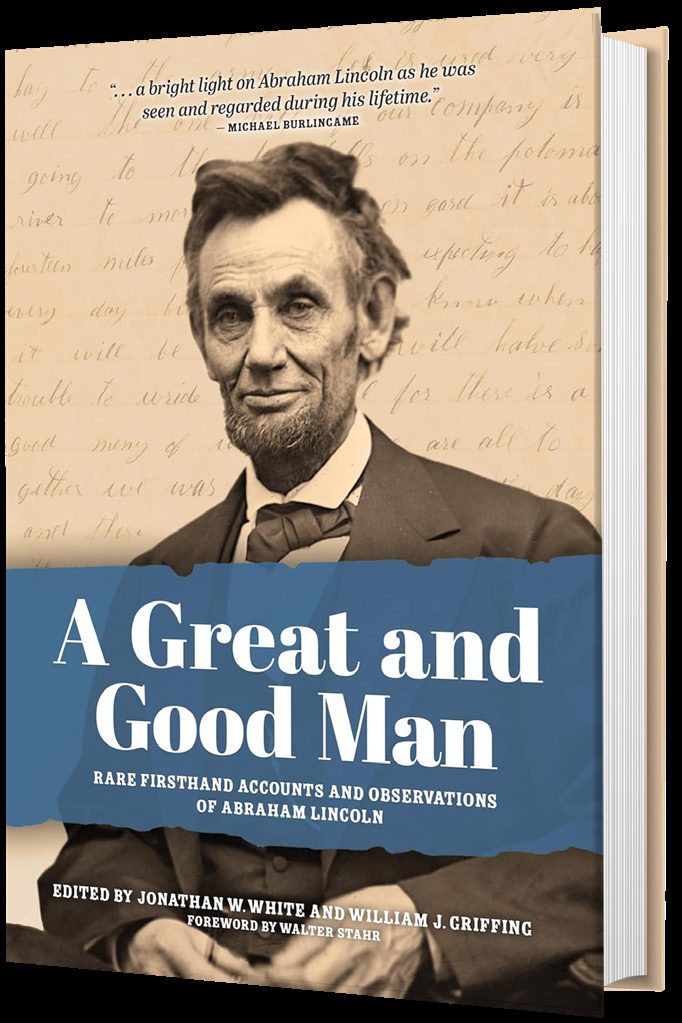
Letters that Deepen Our Lincoln and His Era Res A Great and Good Man: Observations of Abraham White and William J. Gr pp., 2024. Reedy Press,
Each time I visit the Education and Leadershi by the massive thirty-f nearly 7,000 volumes wr Lincoln in the sixteen
iews provide our readers st significant Civil War
Understanding of ued from Obscurity Rare, First-Hand Account Lincoln. Edited by Jonat ffing. Photos, notes, in
Ford’s Theatre Society’s in Washington, D.C., I ur-foot tower of books r tten about President Abr ecades since John Wilkes
assassinated him. One would think that with the staggering number of volumes devoted to the nation’s sixteenth president, nothing remains for historians to publish that
would enhance our understanding of Lincoln. This volume, edited by historian Jonathan White, one of the world’s foremost scholars on Lincoln, and William Griffing, the creator of the widely popular digital history site “Spared and Shared,” is a powerful reminder that such a perspective is misguided.
The scores of letters in this book, written by Lincoln’s contemporaries and in private hands, offer an astounding glimpse into what people from various backgrounds, North and South, thought about Lincoln, his policies, death, and legacy. This assemblage of letters, smartly annotated, reveals the complete gamut of how people perceived Lincoln as a leader. For example, four days after Lincoln won the presidential election of 1860, William T. Early, mayor of Charlottesville, Virginia, wrote that “the large majority o Virginians… have no fear of Lincoln because they know his incompetency to administer the government.” Three months later, William E. Potter, a resident of Princeton, New Jers and on the opposite end of the spectrum from Mayor Early, confided to his diary that Lincoln was a “grave, earnest, thoughtful, determined man… a second Washington.” This volume offers insights into various perspectives on the Emancipation Proclamation, details the resentment some Northerners harbored towards Lincoln due to the immense casualties suffered during the conflict, and examines how Lincoln’s 1864 reelection campaign influenced the Confederacy’s psyche. Furthermore, this superb collection underscores the loyalty of some Union soldiers toward Lincoln and their unflinching commitment to stand by Lincoln and continue their military service until the Union achieved victory. For instance, on September 9, 1863, Israe Markham, a soldier in the Seventh Illinois Cavalry, wrote that he would continue to “risk” his life until that object was achieved and urged “that every free man should do all in his power to put down this rebellion.” Among the most impactful groupings of letters are those concerning Lincoln’s death. While unsurprisingly many express profound sadness and admiration, some reveal unrestrained joy at the news of his passing. Arguably, one of the most powerful letters in this remarkable volume was written on May 2, 1865, by George Warren Campbell, a veteran of the Union army’s engineering corps. In addition to capturing the “gloom” that descended upon Union soldiers in Chattanooga, Tennessee, when they learned the tragic news, Campbell’s missive describes the excitement that Confederate prisoners and even some Union soldiers expressed upon hearing the news and the punishment they received for expressing such dastardly thoughts. While this excellent collection offers much to those pursuing a deeper understanding of the multifarious ways Lincoln’s contemporaries reacted to Lincoln and his policies, this book offers significantly more. Particularly noteworthy are letters that offer insight into views about slavery’s centrality to the conflict, black people’s though about the meaning of freedom, and how interactions with enslaved people altered white soldiers’ attitudes about slavery’s destruction.
This volume’s editors deserve abundant praise for rescuing letters that would otherwise have remained in private hands and, therefore, been inaccessible to histori and students. While it should be a staple in the library o everyone fascinated with President Abraham Lincoln, this book is a critical primary source for anyone who wishes to deepen their understanding of our nation’s most trying and defining moment. J onathan A. N oyalas is director of S henandoah University’s McCormick Civil War Institute in Winchester, Virginia, a professor in Civil War Era Studies at Shenando University, and founding editor of Journal of the Shenando Valley During the Civil War Era. He is the author or edito of sixteen books, including most recently The Blood-Tinted Waters of the Shenandoah, published by Savas Beatie.
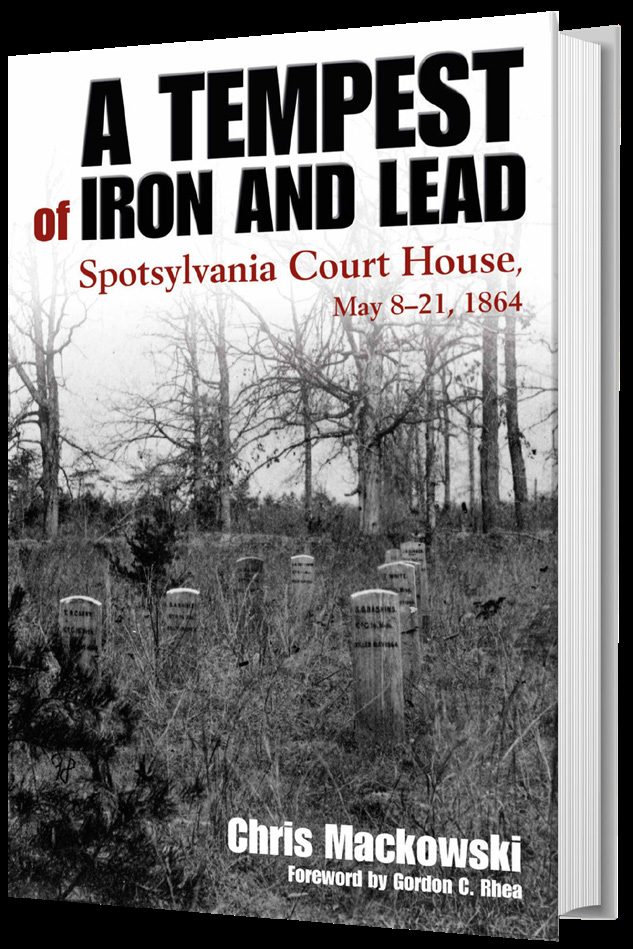
A Tempest of Iron and Lead: Spotsylvania Court House, May 8-21, 1864. By Chris Mackowski, Images, Maps, Bibliography, Index, 359 pp., 2024. El Dorado Hills, CA.: Savas Beatie. ISBN 978-1-61121-717-9. Hardcover.
In May 1864, the Army of the Potomac under Major General Gordon G. Meade, but overseen by Lieutenant General Ulysses S. Grant, launched the long-awaited Overland Campaign against Confederate General Robert E. Lee’s Army of Northern Virginia. What transpired over the next two months was a savage struggle for the fate of two nations as Lee’s men fought tenaciously to avoid being pinned down in defense of the Rebel capital at Richmond while Union forces fought just as hard to limit the Rebel general’s freedom of maneuver. Following the Confederate strike on the Army of the Potomac in the thick woods of the Wilderness (May 5-7), Lee’s outnumbered force had mauled and stymied the Federals. Yet, unlike previous Union setbacks, Grant insisted that Meade bypass Lee’s entrenched Rebels and continue the advance. There would be no stalemate and certainly no retreat. Grant planned to swing around Lee’s right flank and advance southward toward a crossroads at Spotsylvania Court House. There the Federals would interpose themselves between Lee and Richmond, thereby forcing the Rebels to fight on more open ground. Lee, however, anticipated Grant’s move, and the Rebels won the race to Spotsylvania. The result was another brutal series of actions as the Federals attempted to break Lee’s lines and shatter the Army of Northern Virginia.
The story of the Overland Campaign and the Battle of Spotsylvania has been recounted many times by several excellent historians. Among the most recent and best accounts that focus on Spotsylvania are William D. Matter, If It Takes All Summer: The Battle of Spotsylvan (Chapel Hill: University of North Carolina Press, 1988); Gordon C. Rhea, The Battles for Spotsylvania Court House and the Road to Yellow Tavern, May 7–12, 1864 (Baton Rouge: Louisiana State University Press, 1997); Gary W. Gallagher, editor, The Spotsylvania Campaign (Chapel Hil University of North Carolina Press, 2010); Jeffry Wert, Heart of Hell: The Soldiers’ Struggle for Spotsylvania’s Bloody Angle (Chapel Hill: University of North Carolina Press, 2012); and Chris Mackowski and Kristopher D. White, A Season of Slaughter: The Battle of Spotsylvania Court House, May 8–21, 1864 (Emerging Civil War Series. El Dorado Hills, CA: Savas Beatie, 2013). Given the breadth of information already in print, is another book on the Battle of Spotsylvania warranted? Author Chris Mackowski says “yes.” Mackowski, the editor-in-chief of Emerging Civil War, has already writt on the subject and is intimately familiar with the battl It is his contention that his expertise on the subject m his writing style, and his broad perspective can produce
vil War News Magazine | Vol. 52, No. 1, Jan.-Feb. 2026
monograph that covers the battle in just the right amount of detail. Is he successful? Ultimately, readers will have to make that determination for themselves, but a perusal of the Emerging Civil War website will offer insight into Mackowski’s thoughts on the book and his reasons for writing. For example, the following link shows him discussing his belief that he has something new to offer, even if it is in presentation alone: https://emergingcivil com/2024/10/14/writing-tempest-one-more-book-onspotsy. Additionally, in an earlier posting on the site on September 19, 2024, Mackowski discussed book design. He explained his desire not only to capture the nature of the unrelenting combat that characterized the Overland Campaign and struggle for Spotsylvania but also to make the story engaging to readers by including page layouts that feature smaller blocks of text, photo inserts, maps, Ultimately, he decided to use a day-by-day approach to telling the story. He hoped that his approach to the book’ design would capture the sense of unwavering movement while also making the book readable and attractive. Knowing Mackowski’s thoughts on preparing the book helped this reviewer appreciate what the author was attempting to do and why he was doing it. This is seldom available unless a detailed foreword is included. Reading the book, one is taken by the thought that went into the presentation. Just as Mackowski intended, readers are immersed in a day-to day account with easy-to-read chunks of text interspersed with excellent maps and photographs a well as footnotes. In terms of design, the author achieved his goal of providing an excellent layout. Moreover, his prose is clear and concise without being basic. Anyone can clearly understand the author’s account of the battle. So, in the end, is this book necessary? The answer is, indeed, “yes.” Mackowski is correct. His familiarity with the battlefield, his knowledge of sources, his engaging writing style, and his broad perspective of the battle off a compelling and readable work. Will his book replace the aforementioned others? Certainly not. Those works are excellent and should be read by serious students of the war. Where Mackowski excels, and indeed where the Emerging Civil War monographs excel, is in the production of outstanding entry-level works highlighting the major events of the Civil War. This reviewer has read many Emerging Civil War books. All are generally well presented, well organized, and well written. Mackowski has provided an outstanding single volume account of the fighting at Spotsylvania Court House that should reach a wide audience. It is perfect for the novice and those with some knowledge of the battle. Moreover, it should serve as a master class on how Civil War monographs should be developed and presented in the future. The days of long blocks of dry text should end, and Mackowski and Emerging Civil War are showing the way to the future.
John D. Fowler, Ph.D., is the author of several books an articles on the Civil War Era. He is the author of Breakin the Heartland: The Civil War in Georgia. He is currently a Professor of History at Dalton State College. 68 Civil War News Magazine | Vol. 52, No. 1, Jan.-F
Hell by the Acre: A Narrative History of the Stones Rive Campaign, November 1862-January 1863. By Daniel A. Masters, Images, Maps, Bibliography, Index, 615 pp., 2025.
Between November 1862 and January 1863, Union and Confederate forces engaged in a campaign that would culminate in the bloody Battle of Stones River. Although the savage struggle would result in approximately 25,000 combined casualties and severely cripple both armies, some historians have labeled the battle largely inconsequential since neither army routed the other and, more importantly, the Rebels, although forced to retreat from Murfreesboro to Tullahoma, were not driven completely out of Middle Tennessee. Such an interpretation, however, is short-sight and requires a change in perspective. While from a military perspective it is true that the ba was essentially a tactical draw, it was an important Union strategic win. On the first day, the Confederate Army of Tennessee under General Braxton Bragg nearly drove the Union forces from the field, yet dogged resistance from Major General William S. Rosecrans and the Army of the Cumberland prevented a rout. Battered but not cowed, the Federals refused to retreat over the next few days, forcin the Rebels to concede and withdraw on the night of January 3. This caused consternation in the ranks of the Army of Tennessee, and morale plummeted. Moreover, the victory by Rosecrans was invaluable to the Lincoln administration. Coming on the heels of Union failures at Vicksburg and Fredericksburg, the success at Murfreesboro gave Lincoln a stronger position to prevent European recognition of the
Confederacy and keep the Emancipation Proclamation from appearing to be an act of desperation. Clearly, Rosecrans’ success had given Lincoln and the North a desperately needed victory in the winter of 1862-63 and must be viewed from that perspective. Daniel C. Masters’ Hell by the Acre presents another change in perspective of the battle as well. Masters is perhaps best known for his blog Dan Masters’ Civil War Chronicles, where he explores primarily the Western Theater from the point of view of the common soldier. Masters took his deep interest in the common soldier and infused it into large (more than 600 pages/ 250,000 words) book covering the Battle of Stones River from the point of view of these men. Many fine books have been written on the struggle at Murfreesboro, including James Lee McDonough, Stones River: Bloody Winter in Tennessee (Knoxville: University of Tennessee Press, 1980); Peter Cozzens, No Better Place to Die: The Battle of Stones River (Urbana: University of Illinois Press, 1990); and Larry J. Daniel, Battle of Stone River: The Forgotten Conflict Between the Confederate Army of Tennessee and the Union Army of the Cumberland (Baton Rouge: Louisiana State University Press, 2012). What makes Masters’ book unique is the shift in perspective from telling the story top down from the view of politician and generals to bottom up from the perspective of the enlisted men engaged in the fight. This shift in perspective allows traditional accounts of how the campaign and battle unfolded to be corroborated by the points of view of other participants. It also allows a deeper and richer understanding of the hardships of army life and the horrors of combat, as well as an appreciation for the courage and tenacity of the enlisted men, noncommissioned officers, and junior officers who were at the tip of the spear. Writing a book such as this requires extensive research a deep understanding of and familiarity with primary source material. Masters clearly demonstrates his comprehensive knowledge of source material, his expertise in Civil War era combat, and his desire to honor the men who fought and died in this savage struggle in Middle Tennessee. This is an excellent work for anyone interested in the Civil War’s Western Theater, the campaign and battle of Stones River, and the combat experiences of Union and Confederate soldiers. Moreover, history graduate students, especially those interested in the Civil War, would benefit from examining the sources and the writing style of the author. However, for a novice Civil War reader, it would be wise to read one of the aforementioned books on the battle that gives a top down approach prior to digging into this one. Anyone not familiar with the battle might need the traditional view first. This book is large and detailed and certainly not for those wanting a brief foray into Stones River. Yet, for those wanting a deep dive, Masters has produced a solid work that will remain an important resource for many years.
John D. Fowler, Ph.D., is the author of several books and articles on the Civil War Era. He is the author of Breaking the Heartland: The Civil War in Georgia. He is currently a Professor of History at Dalton State College.
United States Military Justice in the Civil War: CourtMartial Practices and Administration. By R. Gregory Lande. Photographs, illustrations, index, bibliography. 254
The volume under review is one of Gregory Lande’s three Civil War books published by McFarland since 2017. To produce this study, Lande conducted an enormous amount of research to gather information on thousands of courtsmartial conducted by the United States Army, Navy, and Marine Corps during the Civil War. He created a database of 5,000 trial verdicts, four-fifths of which pertain to Ar personnel. Most of the rest were Navy trials; a much smaller number involved Marines. Lande provides lots of facts and figures. He tells the reader that 88.2 % of the t he studied resulted in guilty verdicts. Officers on trial w slightly less likely to be found guilty than enlisted men. About one-tenth of the guilty men were sentenced to death. Half of these death sentences were carried out, with all bu a handful being the executions of enlisted men. The reader learns about the punishments: for enlisted men, mainly confinement, hard labor and loss of pay; for th officers, usually dismissal from the service and reprimands The first chapter is a solid review of the development of the military justice system prior to the Civil War, discuss treatises and manuals written in the early 19th century and during the war. After this review Lande devotes separate chapters to various categories of offenses for which office and men were tried: unauthorized absences, alcohol and misconduct, violent misconduct, and lesser crimes. Of course, there is overlap: drunk soldiers are more apt to misbehave in ways big and small than are their sober comrades. vil War News Magazine | Vol. 52, No. 1, Jan.-Feb. 2026
The book’s organization is less than optimal. Far too much of the text is taken up with two-and three-paragraph summaries of trials, dozens upon dozens of vignettes tellin who, what, when and where, then guilty or not, and quickly on to the next vignette. The stories are interesting, but t do tend to run together and pass quickly through the mind. I am afraid we get lost among the trees and don’t get a goo view of the forest. The reader is also bombarded with data. Here is a typica sentence: “The representative database included 681 soldiers (n=4078, 16.7%), 123 service members from the Navy (n-786, 15.7%), and 29 men from the Marine Corps (n=136, 21.3%).” How important is this level of precision? I am not sure, but if it is worthwhile, it would be better placed in tables that can be studied, not spread out in the text. United States Military Justice in the Civil War is the r of a prodigious amount of careful research. The topic is important, and there is an interesting story here, but the story could have been told in a more useful way. Gould Hagler is a retired lobbyist living in Dunwoody, Ga. He has been a regular contributor to Civil War News
A Grand Opening Squandered: The Battle for Petersburg, June 15-18, 1864. By Sean Michael Chick. Maps, photographs, appendices, order of battle, 168 pp.,
I have not been to Petersburg in over 60 years. What I remember the most as a youngster was the Crater and nothing else. This recent addition to Savas Beatie’s Emerging Civil War Series has clarified the often-overlooked opening days of the siege, which led to the downfall of Richmond in Apri 1865. Traditionally, Federal General William F. “Baldy” Smith has borne the blame for launching a half-hearted and unsuccessful demonstration against Petersburg, and its Home Guard of “old men and boys.” Chick dispels that myth by explaining how the roots of the failure originated at the upper echelons of the command of the Union forces, the Armies of the James and the Potomac, the Confederate Department of North Carolina and Southern Virginia, the Army of Northern Virginia, and the Department of Richmond. Chick’s analysis of the debacle deftly describes how the proverbial “fog of war,” blended with personal politics, interpersonal relationships among the major player on both sides, horribly depleted combat units, and the audacity of an early war Confederate hero, who now commanded what seemed to be the backwater of the Eastern Theater, saved Petersburg from early capture. 70 Civil War News Magazine | Vol. 52, No. 1, Jan.-F
On the Federal side, the blame for the failure rests on President Abraham Lincoln who had decided that the only way to defeat Robert E. Lee was to annihilate the outnumbered Army of Northern Virginia. To him, the war had devolved into a war of attrition, in which the Confederates would run out of men before the U.S. armies in the East ran out of bodies and supplies. It was one thing to run the war from a desk in Washingto D.C., or from the defenses of Richmond, Virginia, and another to actually conduct it in the field. Robert E. Lee not perform as expected by adequately bolstering P.G.T. Beauregard’s outnumbered forces at Petersburg. Grant borrowed “Baldy” Smith and his XVIII Corps, which included a division of U.S.C.T. from Benjamin Butler’s Army of the James, and chose them to lead an ill-advised assault against lightly held Confederate works across the ground, which destroyed the Union regiments’ cohesiveness. Later, after the Army of the Potomac arrived in the vicini Grant detached part of the battered VI Corps from the Army of the Potomac and sent them to Bermuda Hundred. Sean Michael Chick has written an inciteful analysis of the opening stages of the Petersburg Campaign, the details of which are too intricate to unravel in this review. As w the other books in this series, one of the appendices cons of a detailed driving tour of the field. Sarah Kay Bierle, in Appendix B, has a good summary of the Battle of Piedmont in the Shenandoah Valley. Appendix C provides a brief history of the 1st Michigan Sharpshoote Appendix D, by Brian Swartz, discusses the legendary career of Joshua L. Chamberlain. Jerry Netherland follows with “A Brief History of Petersburg National Battlefield,” and the final appendix discusses the role of the battlefie in American memory. Having read several other books in the Emerging Civil War Series, all of which are quality reads, this one is on my favorites. Informative and thought-provoking, it cleare up several misconceptions I had about the opening of the campaign.
A retired high school history teacher, “Mike” Priest, resides in Clear Spring, MD, with his wife and a small he of Pekingese dogs. He gives tours at Antietam National Battlefield as a Certified Guide and is an avid miniature wargamer. His newest book from Savas Beatie, “Strong Men of the Regiment Sobbed Like Children,” John Reynolds’ I Corps at Gettysburg, July 1, 1863, is doing extremely wel He also looks forward to becoming a volunteer history teacher in several local private schools.
Somewhere Toward Freedom-Sherman’s March and the Story of America’s Largest Emancipation. Bennett Parten. Maps, Notes, Photos, Index. 253 pgs. Simon & Shuster
Maj. Gen. William T. Sherman’s “March to the Sea” from Atlanta to Savannah, Ga., is one of the most written abou events of the Civil War. Now, a new book examines it from a different perspective, that of the newly freed slaves. Author Parten calls the event “the largest emancipation event in U.S. history.” When Sherman’s men reached Savannah, up to 20,000 African Americans were following them. The numbers could have been higher, but the soldier reluctantly, chased many away because the freed slaves were hindering the march. Not to mention that Sherman opposed enlisting black troops in his army. However, some blacks found work as hired cooks, teamsters, laundresses, and musicians
Thus the former slaves found themselves facing unexpected hardships like lack of clothing, food, and shelter. Numerous deaths resulted from this. Returning to their plantations was usually not an option as Sherman’s men had taken all the food and destroyed the houses, slave quarters included. Yet the desire for freedom was so strong that former slaves continued to follow Sherman to the coast even at the risk of their lives. In Savannah, Sherman and Secretary of War Edwin Stanton developed an ambitious plan to designate 400,000 acres of land along the Atlantic coast from Charleston to the St. John’s River in Florida for the freed slaves to hav land to live and farm. Though 40,000 people settled in the region, the plan was short-lived because of its poor wordin and lack of political support. Sherman sent those who had followed his army to Port Royal, S.C., where missionaries from the northeast had been running schools and teaching self-dependency to escaped slaves. The addition of 17,000 former slaves to the 15,000 already there created logistical problems, which were further complicated when Sherman’s army arrived to start the Carolinas Campaign. Parten sums it up thusly: “After marching for the better part of three months… the story of the Georgia refugees ends with their making a long walk home” with many of them walking empty-handed while their hopes and dreams seemed like the beginning of a story that had somehow gone wrong.” The author, a professor at Georgia Southern University and a resident of Savannah, does a good job of balancing the accounts between white and black civilians and Union soldiers. The key to the book’s success is not so much what is presented, but how. His take on the march is unique and refreshing. This is one of the best books related to Sherman this reviewer has read in years. It is a thought-provoking book that adds much to the scholarship of Sherman and African Americans in the Civil War. Tom Elmore wrote about Sherman’s march through South Carolina in his 2012 book A Carnival of Destruction, published by the Joggling Board Press. What the Life of a Regiment Reveals About the War’s Impact
The Sixth Wisconsin and the Long Civil War: The Biography of a Regiment. By James Marten. Photos, notes, index, 304 pp., 2025. University of North Carolina Press,
Throughout his distinguished career, historian James Marten, professor of history emeritus at Marquette University, has written various books that have significant vil War News Magazine | Vol. 52, No. 1, Jan.-Feb. 2026 7