158th Anniversary – Battle of the Wilderness
Most who study the American Civil War must admit to having a particular battle that interests them most. Whether it be due to an ancestor who fought in it, or that it was fought in our home state, or just the nuances of the engagement that gravitate us towards the details. For me, the Battle of the Wilderness, fought May 1864, in Virginia is my choice. Why? Well, I live on the battlefield with my backyard literally bordering the original Wilderness Run. Oh, and another factor, I consider this battle to arguably be the turning point of the war itself.
Next month we will be remembering the 158th anniversary of this battle that took place May 5th – 6th, 1864.
I thought we would visit some interesting details prior to the unfolding of the battle itself as well as battlefield land saved by the Central Virginia Battlefields Trust through the years.
One of the commonly overlooked pieces of the puzzle leading up to the battle of the Wilderness played out November 27 through December 2, 1863, the Mine Run Campaign in Orange County, Virginia.
The first national day of Thanksgiving was proclaimed by President Abraham Lincoln earlier that year and celebrated November 26, 1863. The next day Union commander Major Gen. George G. Meade, under continuing pressure from the U.S. War Department to energetically engage and destroy Lee’s Confederates, planned one last offensive prior to winter weather setting in. Meade tried to steal a march southeast from Culpeper Courthouse, turn south through the thick forest of the Wilderness, and attack the right flank of the Confederate army south of the Rapidan River.
Lee withdrew to existing field fortifications along Mine Run. Payne’s Farm and New Hope Church saw the most serious fighting of the Mine Run Campaign. When the Union army closed on the Confederate works skirmishing was heavy, but a major attack never occurred. General Meade determined that the Confederate line was too strong to attack and retired the night of December 1 and 2, closing the winter campaign without accomplishing his goal.
Lincoln was not amused. When this last eastern military operation of a bloodstained year ended, both armies moved into winter quarters. The Army of Northern Virginia camped in Orange County while the Union Army of the Potomac encamped at Brandy Station. So, why was this failed Union maneuver important to the Wilderness campaign? Much of this campaign’s planning would again play out in May 1864.
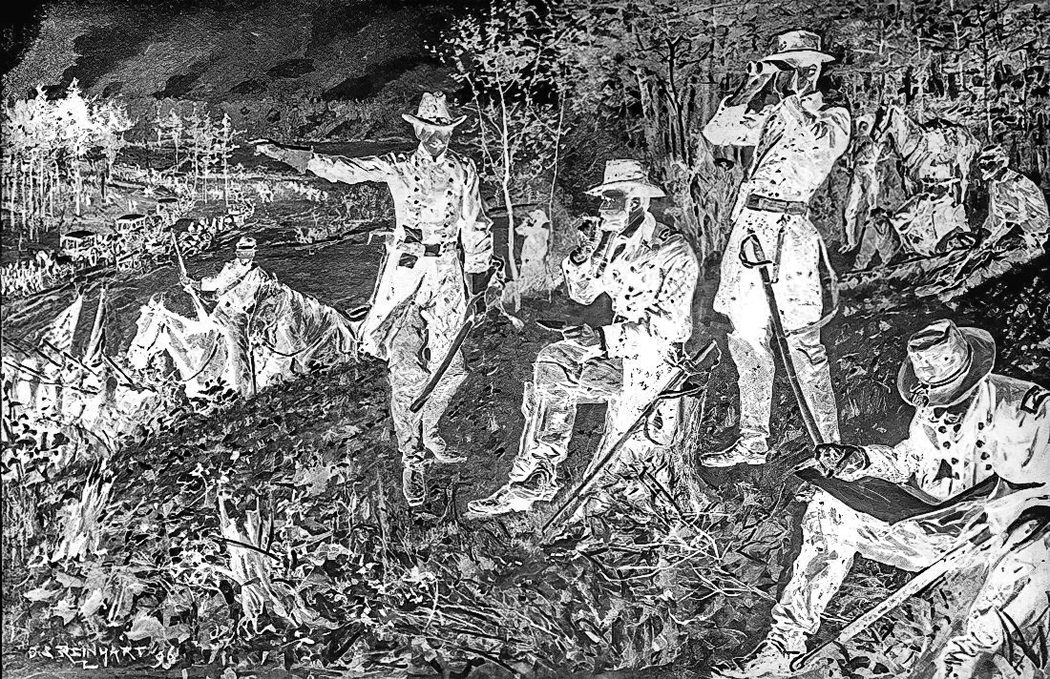
During the Mine Run campaign Major General Gouverneur K. Warren, commanding the Union II Corps, was to traverse the river at Germanna Ford. Meade’s plan relied on a smooth crossing and timely advance to the predetermined positions. Once across the river the Union advance used many of the same roads that would be used in the upcoming Wilderness campaign, roads such as Germanna Plank Road, Orange Turnpike, Orange Plank Road, and Parkers Store Road.
Both armies learned from this. The Confederates, using Clark’s Mountain as a signal station, witnessed these Union maneuvers. The Union commanders learned not to engage Lee when the Confederates could take advantage of their Mine Run works as well as understanding how quickly the Rebels could react. As both forces withdrew to their winter camps other issues became evident.
For the Federal army, the sheer number of 120,000 available soldiers seemed overwhelming compared to the Confederates
roughly 65,000 men. If we look a little closer at the Union numbers, we find some interesting details. Many of the men had enlisted in 1861 for three-year terms and those terms were ending. A Massachusetts veteran would write, “I have no desire to monopolize all the patriotism there is, but I am willing to give others a chance.”
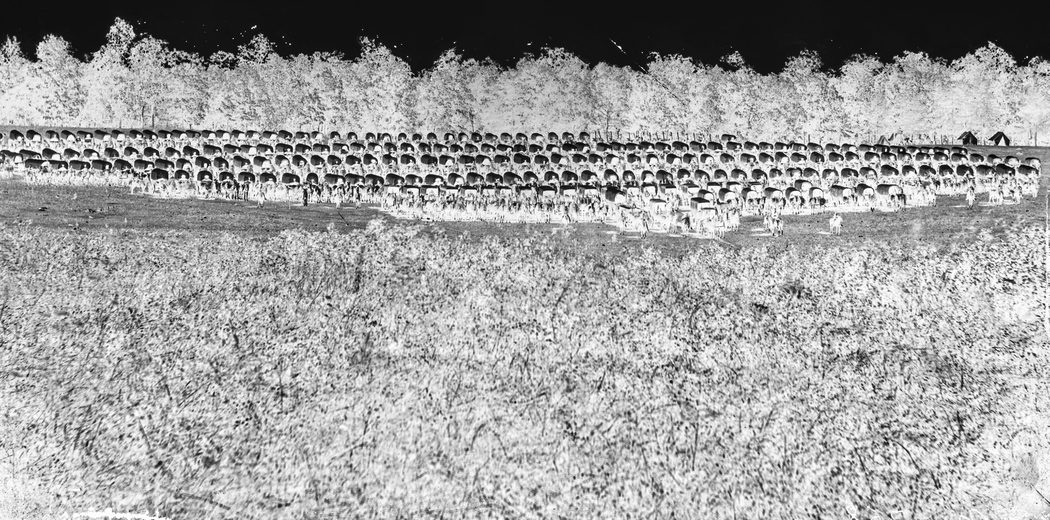
Replacements for those who were mustering out consisted largely of conscripts having far less experience than the veterans and certainly a lesser desire to fight. Overall, the Union may have had around 70,000 reliable men. On a positive note, the Union army was well supplied. The army had amassed over 4,300 wagons, 835 ambulances and a herd of cattle.
For Lee’s Army of Northern Virginia, the situation was quite different. Shortages of food, troops, and forage for the horses greatly affected morale. Their side of the river had seen two continuous years of battle that had laid the area to waste. One Confederate soldier would write, “seemed almost uninhabitable
April 2022
and not even the bark of a dog or sound of a bird broke the dreary silence.” Soldiers grumbled that rations consisted of wheat bran and beef so poor that when cooked smelled like glue. Lee had little hope of gaining fresh troops as the Confederacy no longer had any such resources.
In March 1864, President Lincoln promoted Ulysses S. Grant to Lieutenant General and named him general-in-chief of the Armies of the United States. Making his headquarters with the Army of the Potomac, Grant and Meade began an uneasy relationship and set out to begin what would become known as the Overland Campaign.
Through the years CVBT has saved several Wilderness battlefield properties from being lost to history. In 2006, CVBT obtained six acres of land, denoted as Grant’s Headquarters, southwest of the modern-day intersection of Routes 3 & 20. In 2007 CVBT acquired an additional twelve acres. The majority of these acres were transferred to the National Park Service (NPS) following a boundary adjustment in November of 2019.
In December 2009, 93 acres of the battlefield, just east of the Route 3 & 20 intersection and south of the Orange Turnpike, was preserved. This parcel is known as the Wilderness Crossroads/ Atkins Tract. In September 2011, the CVBT transferred 31 acres to the NPS and retained the remaining 62 acres. Wilderness Crossroads II was obtained in December 2012. This 81-acre tract is located just east of the modern-day intersection of Routes 3 & 20 but north of the Orange Turnpike.
In April 2016 CVBT purchased a small lot adding to a buffer abutting the thin strip of NPS land north of Hill-Ewell Drive, near the Widow Tapp field. Most recently, during October 2021, the CVBT acquired 30 acres of the Wilderness battlefield. This parcel was donated to the CVBT by Fawn Lake Holdings LLC. This is a slice of land where Longstreet’s counterattack up Orange Plank Road occurred.
To date CVBT has preserved 233 acres in the Wilderness. By leveraging grants, donations, and partnering with other preservation organizations, we were able
Visit our new website at:
to save nearly $3,000,000.00 worth of endangered Wilderness battlefield land. As we reflect upon the 158th anniversary of the battle, the ability to stand on the very ground where it all happened adds to our understanding of the events and sacrifices that occurred here.